
Most Colorado gardeners get this right by sowing pumpkin seed outdoors between mid-May and the first week of June, once the soil has warmed past 65 F. That timing gives vines enough season to flower by mid-August, the cutoff that lets a pumpkin ripen and harden before the state’s first fall freeze arrives. Wait too long and frost catches green fruit still on the vine; push seed into cold soil too early and it simply rots before it sprouts.
The short answer
Colorado’s first fall frost falls somewhere between September 30 and October 12, according to NOAA NCEI’s 1991-2020 Climate Normals for station USW00003017 on the Denver-area plains. That window is the fixed end of the calendar. Everything else in a pumpkin patch gets scheduled backward from it.
Utah State University Extension’s guidance on pumpkins puts the maturation clock at 45 to 55 days measured from the moment a female flower opens, not from the day the seed goes into the ground. That distinction matters more than almost anything else in this whole exercise. A vine can look lush and healthy all August, but if its flowers open too late, the fruit behind them never finishes.
Run the subtraction and a working cutoff appears. Take the earliest edge of the frost window, September 30, and subtract the longer 55-day maturation period: that lands on roughly August 6. Take the later edge of the frost window, October 12, and subtract the shorter 45-day period: that lands closer to August 28. So the last safe flowering window for Colorado pumpkins sits somewhere between early August and late August, depending on how the season actually plays out and which end of both ranges a given year lands on.
That’s a three-week spread, and it’s wide on purpose. Colorado’s front range weather doesn’t behave the same two years running, and a grower who only plans for the loose end of that window is gambling on a warm fall. Aiming for flowers open by early-to-mid August gives a cushion most other timing choices don’t. A vine that flowers in early July has months of margin. A vine still throwing new blossoms in early September in Colorado is one that’s very unlikely to produce anything worth carving or cooking.
Mountain towns and the western slope don’t share this timeline at all. Higher-elevation gardens can see frost in July, which compresses this whole calculation into a much narrower slice of summer, and growers there should treat the plains-based frost dates above as far too generous for their own soil.
When to sow here
Sowing date is a separate calculation from flowering date, and conflating the two is the single most common mistake in pumpkin timing. Colorado’s last spring frost falls between May 1 and May 11, also per NOAA NCEI’s normals for the Denver-area station. That date only tells a gardener when the air stops freezing. It says nothing about whether the soil is warm enough to sprout a seed.
- Let the frost window close first. May 1 through May 11 is when the air stops dropping to 32 F on the plains. Seed sown before this risks a cold snap killing tender sprouts outright.
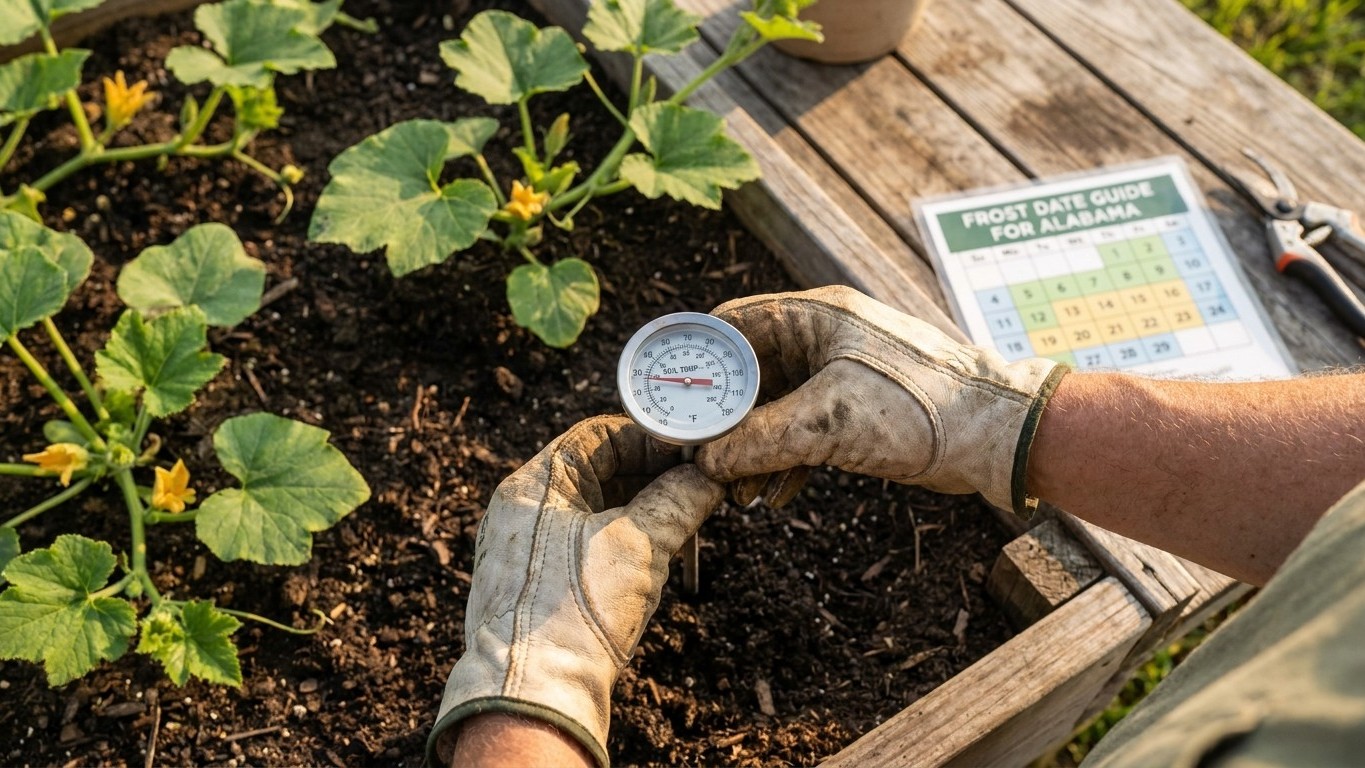
- Wait for the soil, not the calendar. Utah State University Extension specifies pumpkin seed wants soil at 65 F before it goes in the ground. Soil at seed depth warms far more slowly than the air above it, since it holds onto spring’s chill long after daytime highs feel like summer. In practice, that 65 F mark commonly isn’t reached until well into the second half of May or even early June on the Colorado plains, easily two to three weeks past the last frost window closing.
- Use a soil thermometer instead of guessing. A cheap probe pushed 3 to 4 inches down gives a real answer. Air temperature, sunny afternoons, and the urge to get planting done early are all unreliable substitutes for an actual reading.
- Consider row covers if the season feels tight. Floating row cover over freshly seeded ground traps heat and can buy roughly two weeks of head start, letting a gardener sow earlier than bare soil conditions would otherwise allow. That extra two weeks matters directly against the frost math above: it pushes the safe sowing date earlier without pushing the flowering deadline.
- Sow once soil hits 65 F consistently, not just on one warm afternoon. A single hot day can spike a surface reading without the deeper soil actually catching up.
The gap between “frost is over” and “soil is warm enough” is exactly where a lot of Colorado gardeners lose time they can’t get back later in the season. Treating May 11 as planting day, rather than as the earliest the countdown to 65 F soil can even start, is how a vine ends up flowering three weeks later than it needed to.
What goes wrong here
- A late flower that never colors. This is the direct result of the math in the first section going unheeded. A vine that doesn’t set its main flowers until early September, in a state where frost can arrive as early as September 30, is racing a 45-to-55-day clock it can’t win. The remedy is entirely preventive: sow as soon as soil legitimately hits 65 F, and consider row cover to move that date earlier rather than hoping for a mild fall.
- A fruit caught green by frost. Even a well-timed flower can produce a pumpkin that’s still pale orange or partly green when a hard frost is forecast. Utah State University Extension’s guidance is to harvest with the stem attached and get fruit somewhere it will not freeze; it doesn’t specify a storage temperature or a keeping time, only that freezing damage is the thing to avoid. Watching the forecast in the final two weeks before the frost window opens, and picking early rather than gambling on a few more days of color, is the only real safeguard.
- A vine that dies back before the skin hardens. Powdery mildew, squash vine borer damage, or just the natural end-of-season decline can take a vine down while the fruit’s rind is still soft. A soft rind won’t cure properly and won’t store. Once a vine is clearly failing, cutting the pumpkin free with several inches of stem and moving it somewhere warm and dry gives it the best remaining chance to finish hardening off the plant rather than on it.
- Pest pressure eating into the season’s margin. Squash bugs and cucumber beetles both show up on Colorado pumpkin vines and can weaken plants enough to push flowering later than it should be. Rather than re-covering that ground here, see this site’s dedicated pages on squash bugs in Colorado and cucumber beetles in Colorado for identification and control specific to this state.
Common questions
Can I sow pumpkin seed in April in Colorado?
Not outdoors on the plains. April sits well before the May 1-11 last frost window, and well before soil at seed depth reaches the 65 F mark Utah State University Extension calls for. Seed sown that early is far more likely to rot in cold, wet ground than to sprout.
What if my pumpkin flowers in early September?
It’s a tight race against the September 30-October 12 frost window and the 45-to-55-day maturation clock that Utah State University Extension outlines. Some years, with a late-arriving frost, that fruit finishes. Many years, it doesn’t. Watching the forecast and harvesting early rather than waiting for full color is the more reliable move at that point.
Do mountain towns and the plains share the same sowing window?
No. The frost dates in this article come from a Denver-area plains station. Colorado’s mountain towns can see frost as early as July, and the western slope runs on its own pattern entirely. Gardeners outside the Denver-area plains should treat these dates as a starting reference, not a direct match for their own conditions.
How do I know when my soil actually hits 65 F?
A soil thermometer pushed 3 to 4 inches deep is the only reliable way. Air temperature and how warm a day feels are poor substitutes, since soil at seed depth lags well behind the air, often reaching 65 F two to three weeks after Colorado’s last spring frost window has already closed.