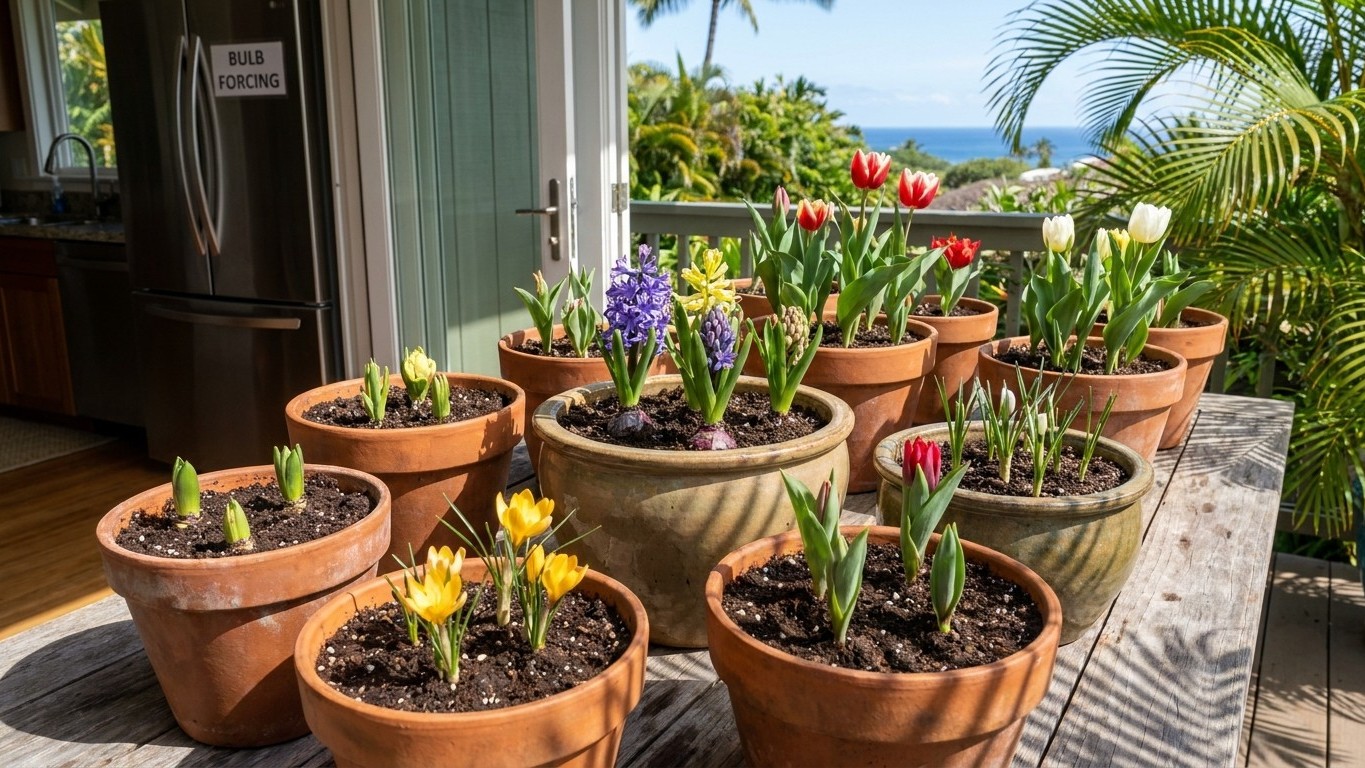

Short answer: in Hawaii, forcing is the whole game. The coldest month here averages a 66.8°F low, so no spring bulb ever gets the chill it needs from the yard. Containers, meanwhile, aren’t at risk from freezing here the way they are elsewhere, the danger shifts to heat, humidity, and drainage instead.
Why this matters in Hawaii

Start with the number that decides everything: 66.8°F. That’s the average daily minimum temperature during Hawaii’s coldest month, measured at the Honolulu reference station under NOAA NCEI’s 1991-2020 Climate Normals. It’s not a record low, and it’s not a seasonal average, it’s the typical overnight floor in the coolest stretch of the year. A tulip, hyacinth, or crocus needs twelve to fourteen weeks with temperatures consistently below 45°F to break dormancy and build a flower inside the bulb. Hawaii’s coldest nights don’t come within twenty degrees of that threshold, in any month, in any normal year.
That gap is decisive. It means natural chilling isn’t a weak option here, it’s not an option at all. Every spring bulb grown in Hawaii has to get its cold period from a refrigerator or some other artificial source, because the ground and the outdoor air simply never deliver it. This is different from a territory where winters flirt with the chill threshold and a gardener might get partial credit from a cold snap. In Hawaii there’s no partial credit. The forcing method isn’t a shortcut for impatient gardeners — it’s the only route to a bloom at all.
The container question plays out differently than it does in colder states. Where winter freezes are common, a potted bulb is more exposed than one planted in the ground, because a container freezes solid, roots included, while garden soil only freezes at the surface. That’s the reason a bulb rated hardy for a given USDA zone can still die in a pot in that same zone. Hawaii’s USDA hardiness range runs from 9a to 13a, with Honolulu itself sitting toward the milder end of that spread, and freezing temperatures simply don’t factor into the coldest-month numbers there. So the freeze-through risk that container gardeners worry about elsewhere doesn’t apply here. What replaces it is heat: a dark-colored pot sitting in direct sun can push root-zone temperatures well past what a chilled bulb wants after it’s forced, and Hawaii’s rainfall patterns make standing water in a saucer a much more common killer than frost ever will be.
How to do it here
Because ambient temperatures never approach the 45°F mark, an unheated garage or lanai in Hawaii won’t function as a chilling space the way it might in a temperate climate, it will simply stay too warm to do anything. That leaves the refrigerator as the only practical source of artificial cold for most households here. The sequence below assumes that starting point.
- Buy firm, disease-free bulbs suited to forcing and store them in a paper bag, not sealed plastic, until you’re ready to begin chilling.
- Place the bulbs in a spare refrigerator drawer or a dedicated bin, kept away from apples, bananas, or any ripening fruit, fruit releases ethylene gas, and ethylene damages the flower bud developing inside the bulb, so proximity really can ruin the bloom before it starts.
- Track the weeks on a calendar or phone reminder. Twelve to fourteen weeks is the window most spring bulbs need; write down the exact date you started so you’re not guessing later.
- After the chilling period is complete, pot the bulbs promptly in a container with drainage holes, using a fast-draining potting mix rather than garden soil, which holds too much moisture in Hawaii’s humidity.
- Move the potted bulbs to a cool, shaded spot to root and sprout, not the refrigerator, but somewhere out of direct sun, since abrupt heat after chilling stalls the process.
- Once shoots emerge and show color, shift the container to bright, indirect light indoors or on a covered lanai. Full tropical sun at this stage can scorch new growth.
- Water enough to keep the mix barely moist, and empty any saucer after rain or watering, standing water is the more common failure point here than cold ever will be.
Every step above can be checked with a calendar, a thermometer, or your own eyes. None of it depends on guessing at a frost date that Hawaii simply doesn’t have.
Which bulbs are worth it
Not every spring bulb rewards the effort of forcing, and the deciding factor is almost always the length of the chill requirement combined with how the plant holds itself up once it blooms. A bulb with a short cold requirement forces faster and finishes before a gardener’s patience runs out. A bulb that grows a tall, heavy flower stalk is more likely to topple in a lightweight container, especially indoors where there’s no wind to strengthen the stem.
- Paperwhite narcissus — needs no chilling period at all, making it the most forgiving forced bulb for a climate with zero natural cold.
- Hyacinth — responds reliably to a full refrigerator chill and produces a sturdy, compact flower stalk well suited to a pot.
- Crocus — short in stature and quick to finish once chilled, so it rarely has a chance to flop.
- Tulips — among the longest chill requirements of any spring bulb, and their tall stems tend to lean or collapse in a container without garden soil to anchor the roots.
- Large trumpet daffodils — chill slowly and grow tall, a combination that asks a lot of both the refrigerator and the pot.
Worth keeping in mind: in Hawaii, a forced bulb is essentially a one-season purchase either way. It was never going to naturally rebloom outdoors here without another full artificial chill cycle, so choosing a bulb purely for a strong first bloom, rather than for any hope of repeat performance, costs nothing extra in the long run.
What goes wrong, and when you can still fix it
Leaves but no flower
This means the chilling period ran short. The bulb had enough stored energy to push up foliage but never finished building the flower bud inside. There’s no fix for the bulb this season, the bloom simply isn’t coming. Note the exact number of weeks you chilled it and add at least two more weeks next time.
A flower on a stem too short to see
This happens when the bulb was moved into warmth and light too quickly after coming out of the refrigerator. The flower formed correctly during chilling, but the stem never got the gradual warm-up it needed to elongate. This season’s bloom will stay stunted; there’s no rescue once it’s underway. Next round, give the pot a few extra days in a cool, shaded spot before moving it into bright light.
Rot in a pot
Soft, discolored bulb tissue or a mushy base almost always traces back to standing water, whether from a clogged drainage hole, a saucer that never got emptied, or a potting mix that held too much moisture. Once rot sets in, the bulb is lost for this season, there’s no reviving it. The fix belongs to the next planting: drainage holes that actually drain, a fast-draining mix, and an empty saucer after every rain.