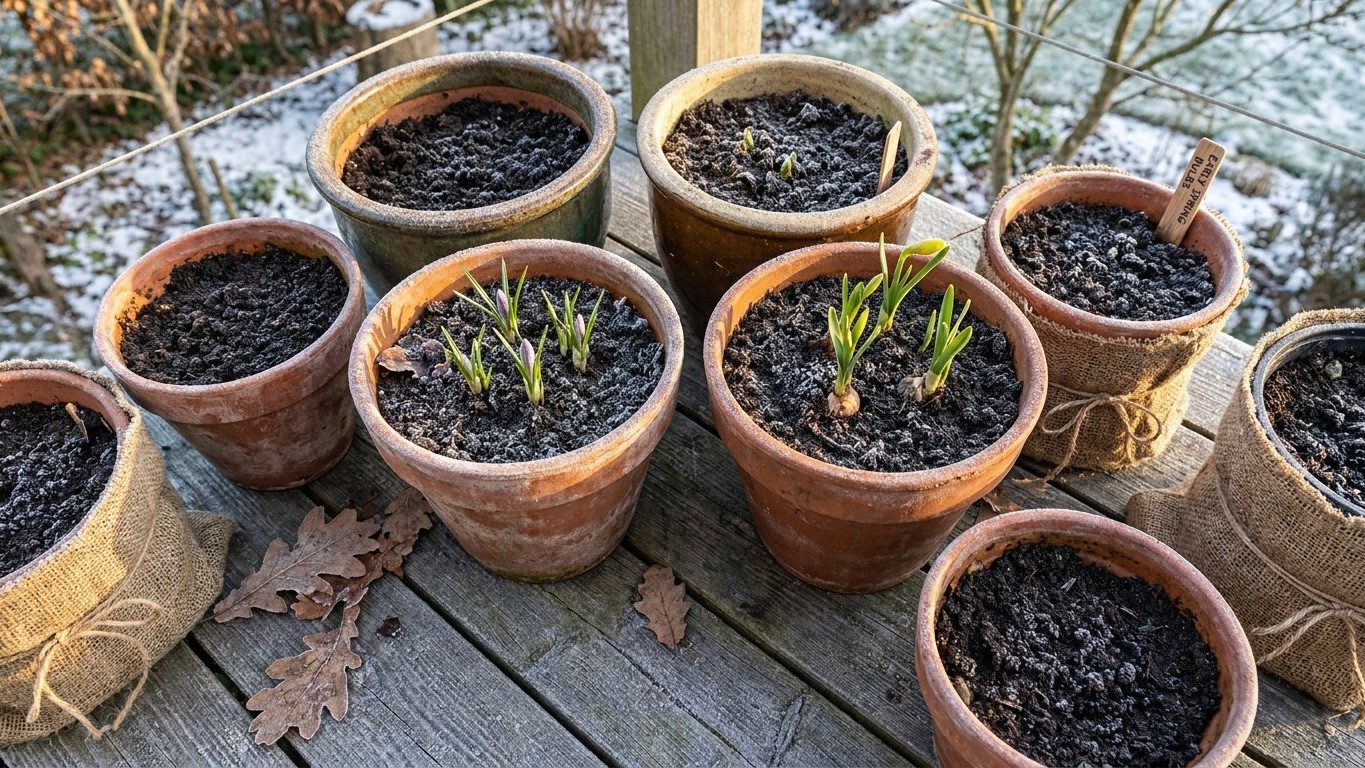

A container in Delaware doesn’t behave like a garden bed. Winter here is cold enough that potted soil can freeze solid, killing bulbs that would sail through the same winter in the ground. A container needs more than a general bulb-planting guide explains: how to bank the cold a bulb requires, which bulbs tolerate life in a pot, and how to read the signs when a forced or potted bulb fails.
Why this matters in Delaware

The mean daily minimum in Delaware’s coldest month sits at 25.6°F, measured at the Wilmington reference station over the 1991-2020 period (NOAA NCEI Climate Normals). That’s more than twenty degrees below the 45°F threshold a spring bulb needs to break dormancy on schedule, and it holds for weeks at a stretch across a winter that spans USDA hardiness zones 7a to 8a statewide (USDA Plant Hardiness Zone Map 2023). That range isn’t uniform: the Wilmington station sits at the cooler 7a end, while parts of southern Delaware run closer to 8a, so a container gardener near the coast can expect slightly milder minimums than the figure above. Ground beds in Delaware are not short on chill. A tulip or daffodil planted in the soil gets its twelve to fourteen weeks below 45°F without any help from the gardener.
Containers change the equation entirely. A garden bed’s soil freezes from the surface down, and the mass of earth below the frost line buffers the bulbs sitting a few inches deep. A pot has no such buffer. Once the mix around a container drops to the outdoor air temperature, it can freeze solid, roots and all, in a fraction of the time it takes ground soil to do the same. That’s why the USDA hardiness zone printed on a bulb label doesn’t transfer cleanly to a pot: a bulb rated for zone 7 in the ground behaves more like a zone 5 planting once it’s isolated in a container with four sides exposed to the air.
So the practical question for a Delaware gardener isn’t whether winter delivers enough cold, it does, comfortably. The question is whether a container can survive that cold without the insulation the ground provides for free. That reframes the whole project: instead of forcing bulbs because winter is too mild, the problem gardeners face further south in zones 8b and warmer, the Delaware container grower manages the opposite risk, a freeze intense enough to kill a bulb that would have been perfectly hardy six inches down in a garden bed.
Forcing still has a place here, but as a choice rather than a necessity. A gardener who wants blooms indoors ahead of the outdoor season, or who wants to grow a bulb in a pot without risking that freeze-through at all, can supply the twelve to fourteen weeks of cold artificially, in a refrigerator or an unheated garage, then bring the pot into warmth on a schedule of their own choosing. That’s a different motivation than forcing in a warm-winter state, but the mechanics are identical, and the payoff is a bulb that never has to survive an outdoor pot through a Delaware January.
How to do it here
Because Delaware’s outdoor cold is more than sufficient but a container can’t be trusted to hold bulbs safely through it, the method below treats the refrigerator or an unheated garage as a stand-in for the ground, then addresses what happens once the pot goes back outside or into a room to bloom.
- Pick bulbs rated for zone 7a or colder if the pot will stay outdoors through winter unprotected, since the container will run colder than the ground around it.
- Pot the bulbs in a container with drainage holes using a fast-draining mix before starting the cold treatment. Bulbs held bare-root in cold storage dry out faster than potted ones.
- Start the clock on twelve to fourteen weeks below 45°F. An unheated garage that stays above freezing works, as does a refrigerator’s crisper drawer, as long as no ripening fruit shares the space; apples and pears release ethylene, and ethylene kills the flower bud forming inside the bulb before it ever emerges.
- Check the pot’s exposure if it’s staying outside. A container needs to be treated as at least two USDA zones colder than the bulb rating inside it to survive uninsulated, meaning a zone 7 bulb effectively sits in zone 5 conditions unless it’s moved or mulched.
- Move or insulate the pot for the exposed months. Sinking the container into the ground up to its rim, pushing it against a heated wall, or wrapping it in several inches of mulch or straw all restore some of the insulation a garden bed provides naturally.
- Bring the pot into a cool room, not a warm one, once the cold weeks are met. A jump straight to a heated living room forces the flower stalk to shoot up before it has the structure to support the bloom, a common cause of flowers that flop over.
- Move it to full light and warmer temperatures gradually over several days once shoots reach a few inches, to finish the bloom.
A gardener can check whether the cold requirement is close to met without relying on a calendar. Tipping a bulb out of its pot and looking for white roots filling the container’s edges is a more reliable signal than counting weeks alone, since a garage or refrigerator rarely holds a perfectly steady temperature.
Which bulbs are worth it
Forcing and potting reward some bulbs more than others. Bulbs with a short cold requirement come out of storage and into bloom faster, which matters if a Delaware garage or refrigerator is being shared by more than one type of bulb at a time. Height matters just as much in a container: a bulb that sends up a two-foot stem is fighting gravity in a pot with a narrow base, and a stiff wind or an overwatered, top-heavy pot will tip it before the bloom opens.
Some bulbs are worth the effort even though they’ll never repeat the performance. Paperwhites and most large-flowered tulips grown this way are treated as a single season’s display in Delaware conditions; they either don’t reliably rebloom in a container’s shallow root run, or they need cold they won’t get sitting in a pot indoors. That’s not really a loss if the bulb was bought for one season of flowers in the first place. The gardener isn’t giving up years of repeat bloom, because those years were never realistically on offer.
Bulbs that force reliably in a container
- Crocus, short stems, short cold requirement, tolerates a shallow pot well
- Muscari (grape hyacinth), compact growth, rarely topples
- Hyacinths, sturdy stems for their size, dependable bloom timing once chilled
- Miniature daffodils, shorter than standard trumpet types, better balanced in a small pot
- Paperwhite narcissus, needs no cold treatment at all, though it’s a one-season bloom in this climate
Bulbs that sulk in a container
- Darwin and single late tulips, tall, top-heavy stems that lean or fall once the flower opens
- Giant alliums, stems reaching several feet, unstable in anything but a wide, heavy pot
- Fritillaria imperialis, long cold requirement paired with a tall, awkward growth habit that rarely suits a container
- Standard trumpet daffodils, taller and more prone to flopping than miniature types in the same size pot
What goes wrong, and when you can still fix it
Leaves but no flower
The bulb produces healthy green growth but never sends up a bud. This almost always means the cold treatment came up short of the twelve to fourteen weeks a spring bulb needs, so the flower bud inside never finished developing before the bulb was warmed. This season’s display is lost; there’s no way to send the bulb backward into a longer chill once growth has started. If it’s a hardy variety, planting it in the ground afterward lets it rebuild for a bloom next year with a full season of natural cold ahead of it.
A flower stem too short to see over the leaves
The bud opens, but low and buried in the foliage, or it flops sideways as soon as it’s fully open. This points to warming the pot too fast after the cold weeks, usually by moving it straight from a cold garage into a warm, bright room. The stem doesn’t have time to elongate normally before the flower forces itself open. There’s no way to lengthen the stem retroactively this season, but the fix for next time is simple: a few days in a cool, dim spot after the chilling period, before the pot goes anywhere near direct heat or bright light.
Mushy bulbs or rotten roots
A bulb that feels soft, smells sour, or pulls apart in wet, blackened layers has been sitting in mix that never drained. Containers without drainage holes, or mix packed too tightly, hold water against the bulb through the cold weeks, and rot sets in before growth ever starts. A rotten bulb cannot be saved this season, and it typically doesn’t recover for future years either. The only real fix applies to the next planting: drainage holes without exception, and a mix built for quick drainage rather than moisture retention.