
May is the month Connecticut gardeners shift from cautious cool-season sowing to full planting mode. Coastal ground near Long Island Sound typically clears its last spring frost between April 2 and April 12, so by the time May opens, most of the state is past that threshold and both cool-season crops and the first warm-season transplants can go in. Inland and higher-elevation spots sitting in the cooler end of the state’s zone range lag behind, so early May and late May call for different lists.
What goes in the ground in May

Soil temperature decides what survives outdoors this month, not the date on the wall. Peas and spinach germinate in soil as cold as 40°F. Tomatoes stall or rot if the soil sits below 60°F, no matter how warm the air feels on a sunny afternoon. That difference is why the same week in May can be safe for one crop and reckless for another.
The last spring frost window cited by NOAA NCEI’s 1991-2020 Climate Normals, April 2 to April 12, comes from a Bridgeport station sitting right on the Sound, the mildest ground in the state. Inland valleys and the northwest corner, both closer to the cooler end of Connecticut’s zone 6a-7b range, freeze later in spring than that window suggests. Treat it as the earliest boundary, not a statewide green light.
Early May, still playing it safe
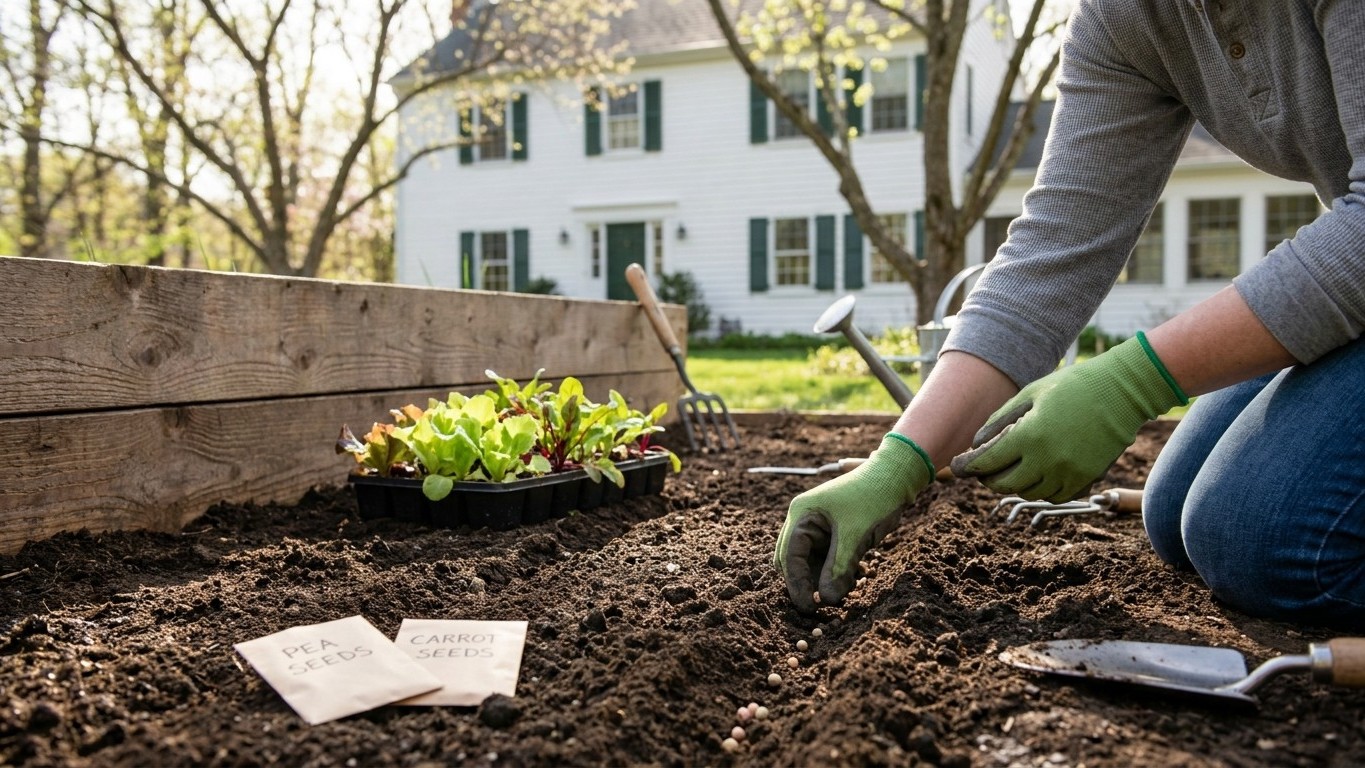
Direct-sow peas, lettuce, spinach, arugula, radishes, beets, and carrots. Onion sets and seed potatoes go in the ground now too. Brassica transplants, cabbage, broccoli, kale, can move outside once they’ve been hardened off over several days, since a light frost does them little harm.
Late May, once the soil has actually warmed
Tomatoes, peppers, and eggplant transplants, along with direct-sown squash, cucumbers, beans, and corn, wait for nighttime lows to hold above roughly 50°F and soil that stays warm to the touch a few inches down. Along the coast that often means the back half of May. In the northwest hills and low-lying inland valleys, where frost lingers past the Bridgeport window, holding warm-season crops until early June is the safer bet.
What to start under cover
Counting backward from the frost window works better than counting forward from a calendar date. Long-season crops like winter squash, pumpkins, and melons want three to four weeks of head start indoors before they move outside into warm soil, so seed started under cover early in the month lines up with a late-May or early-June transplant date, once the local last-frost risk has genuinely passed.
Tomatoes are a different story by this point. The standard indoor start for a main crop happens six to eight weeks before the last frost, which for most of Connecticut has already come and gone by May. Starting tomato seed under cover now still works for a second, later planting meant to bear in late summer, but it won’t produce the earliest harvest of the season.
The two ways this goes wrong are familiar to anyone who has started seed indoors before. Sow too early under grow lights and the seedlings turn leggy and rootbound long before the ground is ready for them. Sow too late, especially for anything with a long days-to-maturity number, and the plant runs out of season before the first fall frost, which arrives between October 28 and November 10 along the coast and sooner inland.
What is ready to pick
Established asparagus beds send up spears through May, and the harvest window is short: cut spears once they reach about 3/8 inch in diameter, before the tip starts to loosen and branch out. Rhubarb stalks are ready once they’ve reached 12 to 18 inches, pulled rather than cut, leaving the leaves behind since they’re toxic.
Overwintered spinach and kale, if they made it through winter under mulch or a low tunnel, are often the first real greens harvest of the season, usually ahead of anything sown fresh this spring. Scallions planted the previous fall come up early too. By the back half of the month, the earliest radish sowings start showing their shoulders above the soil line, a reliable sign they’re ready to pull.
Lettuce sown in April is usually big enough for a first cut-and-come-again harvest by mid-May, taking outer leaves and leaving the center to keep growing. None of this is a big harvest yet, more a trickle that builds through the month as everything else planted in April and May starts to catch up.
The jobs that matter this month
Several of May’s tasks have a narrow window where doing them now pays off and doing them later costs real yield.
Soil, staking, and mulch
Work soil only when it crumbles in your hand rather than clumping, since working wet clay soil now compacts it for the rest of the season. Stake peas and set tomato cages before plants sprawl, because untangling vines from a cage after the fact damages roots and stems. Once soil has warmed through, a layer of mulch locks in that warmth, holds moisture, and cuts down on the weeding that otherwise eats up the back half of spring.
Watering, succession, and pests
As temperatures climb through May, shift from occasional watering to a steady deep soak two or three times a week rather than a light sprinkle daily, which encourages roots to stay shallow. Sow another round of lettuce, radishes, or spinach every two weeks to keep a steady supply coming rather than one big flush that bolts all at once. This is also when flea beetles show up on brassicas and asparagus beetles appear on emerging spears, so a walk through the garden every few days to check the undersides of leaves catches an infestation while it’s still small enough to handle by hand.
What not to do in May
The most common mistake in Connecticut gardens this month is planting tomatoes or peppers into cold soil because the air finally felt warm. Air temperature swings fast; soil temperature lags behind by days or weeks. A transplant sitting in 55°F soil doesn’t die outright, but it stalls, turns yellow, and often gets outcompeted by weeds while it sulks. Check the soil itself with a simple soil thermometer before trusting the thermostat.
A related mistake follows a stretch of unusually warm days in early May: gardeners pull row covers and cold frames off hardened-off seedlings too soon, right before a cool night sneaks back in, especially inland or in the northwest hills where the frost window runs later than the coastal data suggests. Keep covers within reach through the first half of the month rather than storing them away after one warm weekend.
Feeding nitrogen at the wrong moment causes its own problems. A heavy dose of nitrogen on tomatoes or squash right as they start flowering pushes leafy growth at the expense of fruit set. Save the nitrogen for leafy greens and brassicas, and hold off on feeding fruiting crops until they’ve set their first flowers.
Checking this against your own county
A statewide frost window is a starting point, not an instruction for a specific yard. Elevation, distance from Long Island Sound, and even a nearby lake’s mild microclimate can shift these dates by weeks in either direction. A garden in the northwest hills and a garden on the coast are effectively gardening in different climates, even on the same calendar page.
For a planting date grounded in local data, the UConn Extension service is the right next stop, with county-level guidance that accounts for exactly these differences.
Common questions
Is it safe to plant tomatoes outside in Connecticut in May?
Along the coast, usually yes by the back half of May, once soil has warmed and nighttime lows hold above roughly 50°F. Inland and in the northwest hills, where frost risk runs later than the coastal window suggests, early June is often the safer call.
What vegetables can I direct-sow in Connecticut in early May?
Peas, lettuce, spinach, arugula, radishes, beets, and carrots all handle direct sowing in early May across most of the state, since they tolerate the cool soil and occasional light frost that can still show up before the month is out.
When does the last frost typically happen in Connecticut?
Coastal data from a Bridgeport station puts the last spring frost between April 2 and April 12. That’s the mildest part of the state; inland and higher-elevation areas typically see their last frost later than that window.
What Connecticut planting zone should I plant for?
The USDA Plant Hardiness Zone Map places Connecticut in zones 6a through 7b, depending on location. That range covers only average annual extreme minimum temperature, so pair it with your local last-frost date rather than relying on the zone number alone.