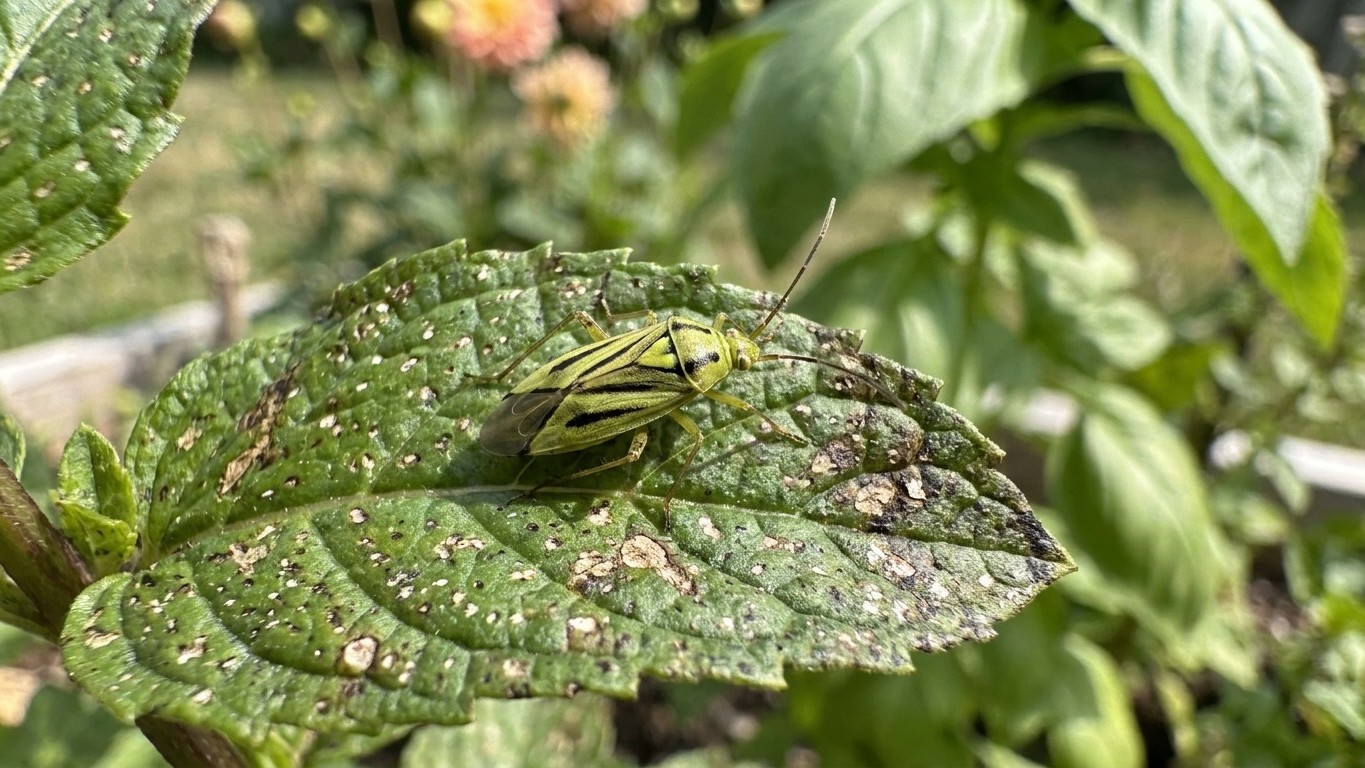

Fourlined plant bug shows up in Connecticut gardens once new growth on mint, basil, and other tender perennials reaches a few inches tall, generally within the first weeks after the last frost. The damage, small dark sunken spots that turn into ragged, papery holes, stops fast once you catch it early: hand-picking and fall stem cleanup do most of the work, no pesticide required.
The weeks to watch

The Connecticut extension service doesn’t publish a specific emergence window for fourlined plant bug the way it does for squash vine borer or Japanese beetle. UConn’s fact sheets and IPM vegetable pest messages track striped cucumber beetle, squash bug, and beetle emergence in detail, but this particular plant bug doesn’t get its own dated entry. So the useful thing to work from is the insect’s general life cycle, which is well documented nationally even where no state-specific date exists.
One generation, one window
Fourlined plant bug produces a single generation each year in the Northeast. Eggs overwinter inside slits the female cuts into plant stems the previous fall, then hatch as soil and air warm in spring. The nymphs feed for roughly three to four weeks, molting through five stages, before becoming winged adults. Adults feed for another few weeks and then die off by midsummer, meaning the entire visible feeding period, nymph and adult combined, runs for about six to eight weeks total starting in spring.
That’s a narrower and earlier window than most of the vegetable garden pests Connecticut gardeners track. Squash vine borer adults, by comparison, don’t emerge until mid to late June, and Japanese beetles not until the first week of July. Fourlined plant bug is typically finished doing its damage before those later pests even start.
Reading the calendar from your last frost

The one date most Connecticut gardeners actually track is the last spring frost, and NOAA’s 1991-2020 climate normals put that window at April 2 to April 12 for the Bridgeport station, the mildest, most coastal point in the state. That’s a normal, not a promise: a cold snap in late April can still hit, and inland or northwest Connecticut runs noticeably later than the coast.
Fourlined plant bug nymphs don’t answer to a date on a wall calendar. They hatch once the plant tissue they’re laid in warms enough to trigger both the eggs and the new growth the nymphs need to feed on. An early, mild spring pulls the whole cycle forward; a cold, wet April pushes it back by as much or more.
- Start from the local last frost window: April 2 to April 12 near the coast, later inland.
- Add the two to four weeks nymphs typically need after frost-free soil lets tender shoots emerge, putting the first stippled leaves somewhere from mid-April to mid-May depending on how far inland you garden.
That arithmetic matters for row covers. Anyone using them on mint, basil, or young perennials should have covers on before that window opens and off again once the plants start flowering, since pollinators need access and the nymphs will already have moved past their most vulnerable early stage by then.
What it attacks, and what the damage looks like

Most gardeners notice the damage before they ever see the insect. Leaves develop small, dark, sunken spots that look almost like a chemical burn or a fungal infection at first glance. Within days those spots dry out, turn papery, and either drop out to leave ragged round holes or merge into larger patches of black-speckled, stippled tissue. On a heavily fed plant, whole leaves can look scorched or lacy by early summer, even though the plant itself usually survives and pushes new growth later in the season.
Both the nymphs and the adults cause this damage. Their piercing-sucking mouthparts inject saliva that breaks down plant cells at the feeding site, which is why the injury shows up as dead spots rather than chewed edges. That matters for timing treatment, since there’s no single vulnerable life stage the way there is with a pest that only bores as a larva: nymphs and adults are both doing damage, back to back, through the whole feeding window.
The host list runs wider than most gardeners expect, and it leans heavily toward the herb garden and the perennial border rather than the vegetable patch:
- Mint, basil, and other mint-family herbs
- Dahlia, marigold, and chrysanthemum
- Hydrangea and forsythia
- Currant and gooseberry
- Sumac and viburnum
- Coleus and snapdragon
Mint tends to take the worst hits, which is one reason home herb gardens are often where this pest gets noticed first.
How Connecticut sits in this pest’s range

Fourlined plant bug is common across the eastern half of North America, from the Canadian Maritimes down through the mid-Atlantic, and Connecticut sits well within that range rather than near an edge of it. That means the question here isn’t whether the insect shows up, it’s when. The difference between one Connecticut yard and another comes down to local temperature, not presence or absence of the pest.
NOAA’s frost-date data already shows how much that timing can shift within a state this size. Bridgeport, on the Long Island Sound coast, is the mildest station and the earliest to lose its frost risk in spring. Inland and northwest Connecticut, by contrast, hold onto colder nights well after the coast has warmed, which pushes both the last frost and the fourlined plant bug’s spring emergence later by what can amount to a couple of weeks. A gardener in Litchfield County should expect this pest’s whole window, egg hatch through adult die-off, to run later than a gardener in Fairfield County working the same calendar.
What actually works against it

Because fourlined plant bug runs one generation a year and feeds entirely on the outside of the plant at every life stage, there’s no point in the cycle where treatment becomes pointless the way it does with a stem-boring pest. That gives home gardeners more room to work with cheap, low-effort methods before reaching for anything stronger.
- Inspect host plants weekly starting right after the last frost. Nymphs are small, wingless, and slow-moving on new growth, which makes this the easiest stage to catch early.
- Hand-pick nymphs and adults into soapy water. Because there’s only one generation, removing this year’s population has a real shot at reducing next year’s numbers too.
- Cut back and dispose of old stems in fall. Eggs overwinter in slits the female cuts into stem tissue, so removing and destroying spent stems from mint, perennials, and shrubs physically removes next year’s eggs before they ever hatch.
- Use row covers on herb beds through the nymph stage. Covers work as a physical barrier while nymphs are small and the plant isn’t yet flowering; they need to come off once blooms open so pollinators can reach the plant.
- Tolerate light damage rather than treating. Most established mint, hydrangea, and shrub hosts outgrow the cosmetic injury within a season, and the feeding rarely threatens the plant’s survival.
Skip anything sold as a set-and-forget deterrent for this pest specifically. There’s no published trial data on copper tape, ultrasonic repellers, or similar gadgets working against fourlined plant bug, and the insect’s biology (external feeding, eggs hidden inside stem tissue) doesn’t match the mechanism those products are typically marketed around for other pests.
Common questions
Does fourlined plant bug spread from one plant to the next in the yard? Adults can fly short distances once they mature, so a heavily infested mint patch can seed nearby host plants later in the season. Nymphs, being wingless, stay close to wherever they hatched until then.
Will the damage kill an established plant? Rarely. The injury is cosmetic on most perennials and shrubs, and plants typically push new, undamaged growth once the single yearly generation finishes feeding by midsummer.
Do I need to deal with it every single year? Removing and destroying old stems in fall, where the eggs overwinter, is the single most effective way to cut down next year’s population, so consistent fall cleanup matters more here than any in-season treatment.