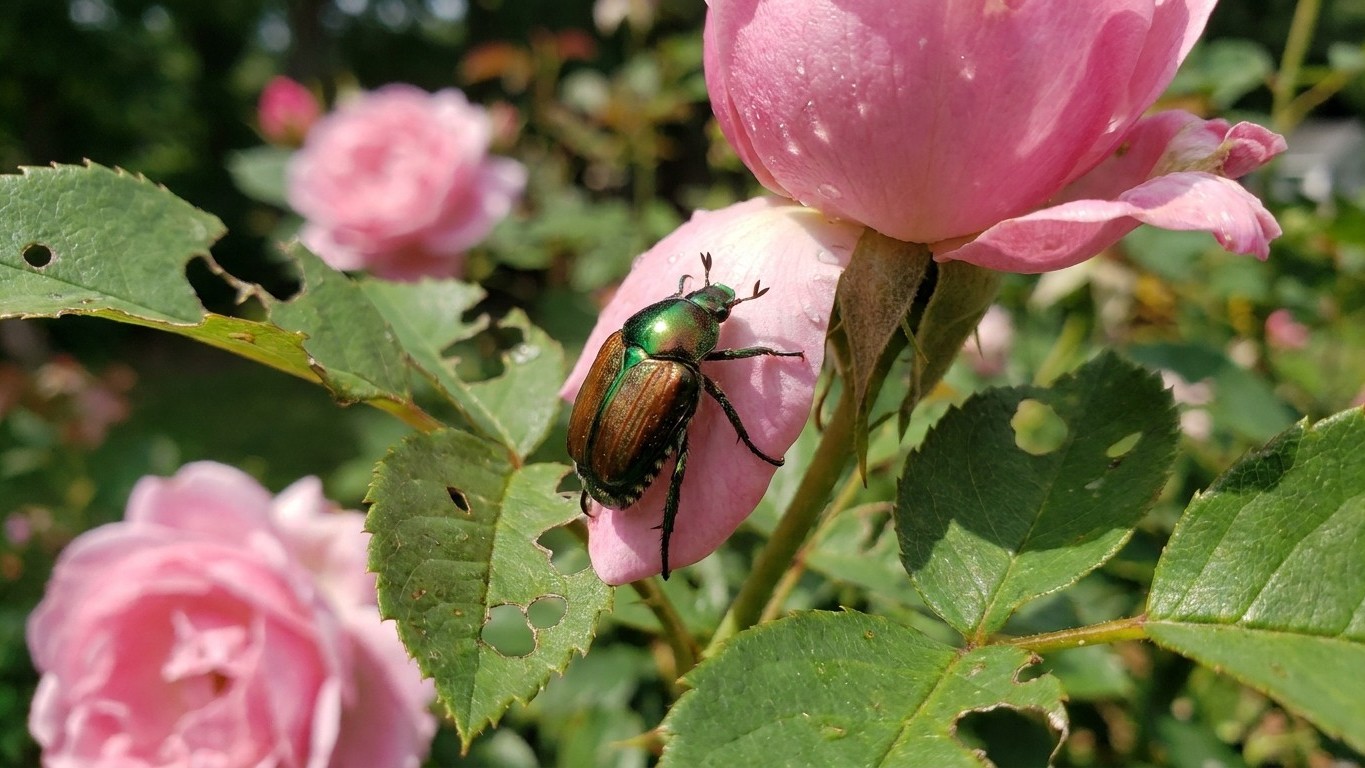

Japanese beetles start showing up in Connecticut in late June, with populations peaking through mid-July and feeding activity stretching into mid-August. What actually stops them isn’t a single spray, it’s timing two different attacks: one on the grubs hiding in your lawn each fall and spring, and one on the metallic green adults chewing through your rose bushes each summer. Miss the window on either end and you’re just managing symptoms.
The Connecticut Timeline: From Grub to Adult

Japanese beetles (Popillia japonica) run on soil temperature, not the calendar. Adults emerge from the ground once soil at a 2-inch depth holds steady around 70°F, which in most of Connecticut lands somewhere between the third week of June and the Fourth of July. Shoreline towns and the Connecticut River Valley tend to warm up first; the Litchfield Hills and higher elevations in the northwest corner often lag a week or two behind.
Once they’re up, adults live roughly four to six weeks. They feed, mate, and the females burrow back into turf to lay eggs, favoring lawns that are mowed short and kept moist through summer irrigation. Eggs hatch into grubs by early August, and those grubs spend the rest of the growing season feeding on grass roots before digging deeper as the ground cools in October and November. They overwinter below the frost line, then move back up toward the surface in April as soil warms, feeding again briefly before pupating in late May and starting the cycle over.
That means a Connecticut yard is dealing with two separate life stages at two separate times: root-feeding grubs in spring and fall, and leaf-and-flower-feeding adults for about six to eight weeks in summer. Treatments aimed at the wrong stage, or applied at the wrong month, tend to disappoint homeowners who assumed one product would handle both.
What Japanese Beetles Actually Damage in CT Yards
Adults aren’t picky. They’ve been recorded feeding on more than 300 plant species, but in Connecticut landscapes they show a clear preference. Roses are usually ground zero, along with linden trees, birch, Japanese maple, crabapple, grapevines, and raspberries. Vegetable gardeners often find them stripping bean plants and skeletonizing basil.
The damage pattern is distinctive once you know what to look for. Beetles feed on the tissue between leaf veins, leaving a lace-like skeleton behind rather than ragged holes. On a heavily infested linden or birch, entire branches can look bronzed and see-through by late July. That’s a different injury signature than deer browsing or caterpillar damage, and it’s usually the first clue homeowners use to confirm what they’re dealing with before reaching for a product.
Grubs, meanwhile, work underground on turf roots. A lawn with a heavy grub population develops irregular brown patches that peel back like loose carpet when you tug on them, because the roots holding the sod down have simply been eaten away. That symptom typically shows up in late summer or early fall, not in June, which is why a brown lawn in July is more likely drought stress than grub damage.
Signs You’re Dealing With Japanese Beetles Specifically
- Skeletonized leaves with intact veins, concentrated on roses, linden, and grapevines
- Clusters of shiny, copper-and-green beetles mating on sun-warmed foliage in July
- Irregular brown turf patches in late summer that lift easily, exposing chewed roots
- Heavier damage on the sunny, south-facing side of a plant or tree
What Actually Stops Japanese Beetles in Connecticut
The most common mistake is buying a pheromone trap and hanging it near the plants you’re trying to protect. Research from land-grant universities has shown these traps pull in more beetles than they capture, essentially inviting the neighborhood’s entire population to your yard before some of them wander over to your roses anyway. If you use a trap at all, hang it at least 30 feet from anything you value, on the far side of the property.
For adult beetles already on your plants, hand-picking in the early morning works better than most people expect. Beetles are sluggish in cool temperatures and drop easily into a bucket of soapy water when knocked off a branch. Doing this daily during the peak weeks (roughly the first three weeks of July in most of Connecticut) can meaningfully reduce damage on a handful of prized plants without any chemical input.
Contact insecticides containing pyrethrins or carbaryl kill adults on contact but need reapplication every few days during peak activity, since they break down quickly and new beetles keep flying in from neighboring yards. Systemic options absorbed by the plant offer longer protection but come with restrictions on flowering plants that bees are actively visiting, since Japanese beetles are most active in daylight when pollinators are also working the same flowers.
Grub Control: The Timing That Actually Matters
Preventive grub treatments work by targeting young grubs before they’ve done much root damage, and the application window is narrow. Products containing imidacloprid or chlorantraniliprole need to go down in late June through mid-July, before eggs hatch, so the chemical is already in the soil and root zone when grubs start feeding in August. Apply them in September and you’ve largely missed the point, since the grubs are already established and often heading deeper into the soil profile.
Curative treatments, usually based on trichlorfon or carbaryl, target grubs that are already feeding, and they work best in late August through September when grubs are young, close to the surface, and actively eating. Waiting until October, when Connecticut soil starts cooling and grubs retreat deeper, cuts effectiveness significantly.
Biological options have gained traction with homeowners who want to avoid synthetic pesticides on lawns where kids and pets spend time. Milky spore (Bacillus popilliae) is a bacterium specific to Japanese beetle grubs that, once established in soil, can provide control for several years, though it takes one to three seasons to build up enough spore density to be reliably effective. Beneficial nematodes, applied to moist soil in late summer, attack grubs directly and offer a faster but shorter-lived alternative that typically needs reapplication.
Why Some Connecticut Yards Get Hit Harder
Soil moisture is the biggest predictor of grub survival, and by extension, next year’s adult population. Female beetles seek out moist soil to lay eggs because dry soil kills eggs and young grubs before they can establish. That means irrigated lawns, especially ones watered on a regular automatic schedule through July and August, tend to attract more egg-laying than lawns left to go semi-dormant during dry spells. It’s a frustrating tradeoff for anyone maintaining a green lawn through a Connecticut summer, since the watering that keeps grass looking good is the same thing that makes it more attractive to beetles.
Proximity matters too. Japanese beetles are strong fliers and will move readily between adjacent properties, so a single neighbor with an untreated, heavily infested lawn or a beetle-magnet tree like a linden can supply adult beetles to several surrounding yards regardless of what any one homeowner does. This is part of why coordinated, neighborhood-level grub treatment tends to outperform one household acting alone, though that kind of cooperation is admittedly rare in practice.
Connecticut’s beetle population isn’t new or unusual. The species has been established across the eastern United States since arriving from Japan in the early 20th century, and Connecticut has dealt with regular seasonal outbreaks for decades. What varies year to year is mostly weather: a wet June that keeps soil moist through egg-laying season tends to produce a heavier adult flight the following summer, while a dry early summer can knock populations down noticeably without any human intervention at all.