
Yes, Insulation keeps a Delaware home cooler, though summer here is a moderate season rather than a punishing one. Wilmington averages about 17.6 days a year above 90°F, a real but modest heat load. Delaware sits entirely in IECC climate zone 4A, a mixed-humid zone that shapes how much attic Insulation actually earns its keep, and how the same material pulls double duty come winter.
The short answer for Delaware

Insulation helps in Delaware, and the honest way to size how much is to look at how many days actually get hot enough to matter. At the reference station in Wilmington, the average is 17.6 days a year reaching 90°F or higher. That’s not nothing, but it’s a fraction of what a homeowner in the Deep South or the desert Southwest deals with, where triple digits stretch across whole summers.
That number puts Delaware on a particular side of the country’s climate divide. The state falls under IECC climate zone 4A, a mixed-humid classification that isn’t the harsh cooling-dominated zone of the Gulf Coast, nor the heating-dominated cold of the northern tier. It’s a middle ground, and it’s worth saying plainly: Delaware is one of the small number of states where the entire territory sits in a single zone, with no county-by-county exceptions in the code table. That’s a convenience most states don’t get. A homeowner here doesn’t need to hunt down which side of a county line they live on to know which Insulation table row applies.
What that means practically is that summer cooling costs are a real part of the Delaware energy picture, but they aren’t the whole story the way they are in a hotter zone. Winter heating still carries significant weight in a mixed-humid climate. Insulation added for one season works for the other, so the return isn’t a single-season bet. With under three weeks a year crossing 90°F on average, this isn’t a house that needs to be over-engineered against extreme heat. It needs a solid, code-informed insulation level that handles both a cold January night and a sticky August afternoon without asking the equipment to work overtime in either direction.
What happens above the ceiling
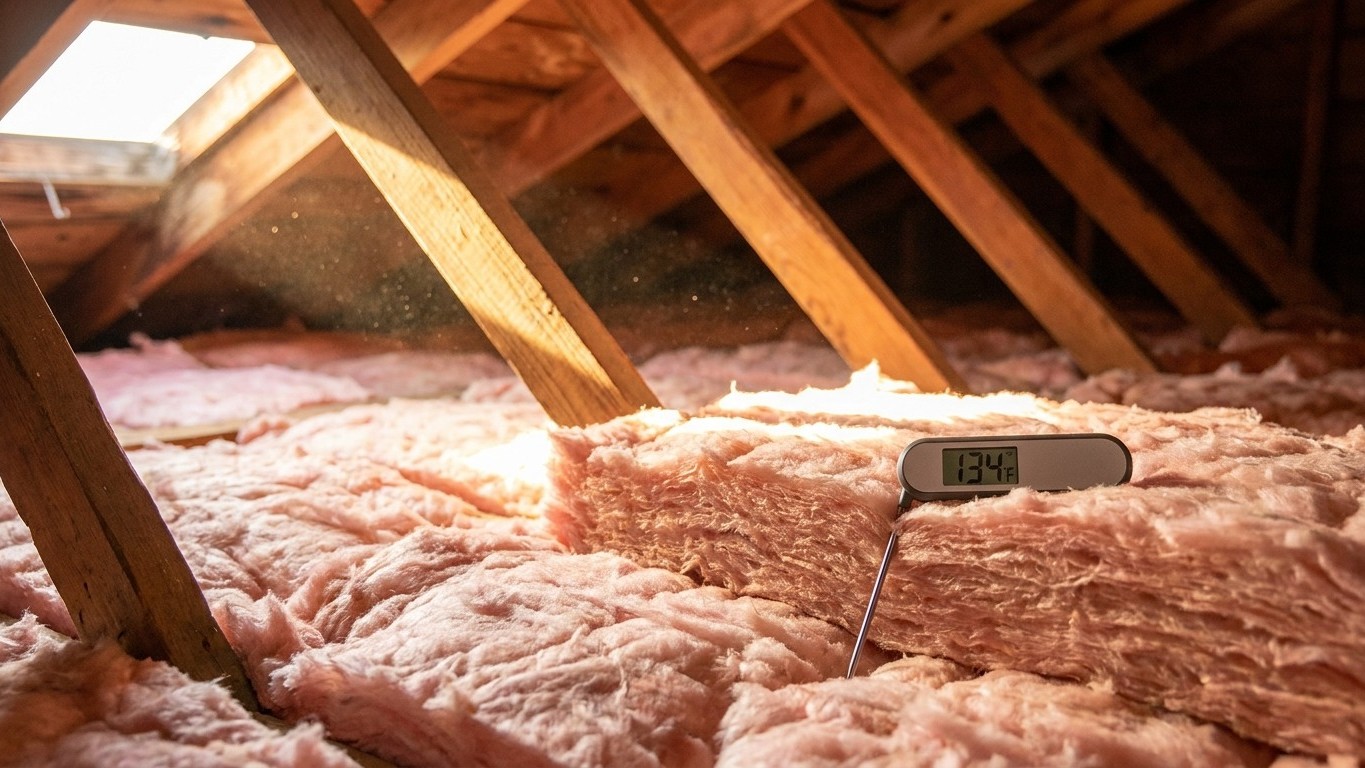
A sun-loaded roof deck can push attic air far above the outdoor temperature, sometimes by 40°F or more on a clear afternoon. Everything sitting under that superheated air, the ceiling drywall, any ductwork running through the space, stored boxes, is exposed to that heat load. Without a strong barrier between the attic and the living space, that heat works its way down into the rooms people actually occupy, and the air conditioner has to fight it constantly.
The insulation that resists that downward heat flow in July is the same material that resists upward heat loss in January. It isn’t a winter product pressed into summer service. It’s a resistance to heat movement in general, and which direction that heat happens to be moving depends entirely on the season. That’s what makes attic insulation the single upgrade that pays in both directions, rather than a seasonal compromise.
Recommended levels by zone
ENERGY STAR publishes retrofit insulation levels for existing wood-framed homes, broken out by climate zone, covering an uninsulated attic, an attic that already has 3 to 4 inches of material, and the floor over unconditioned space:
| Zone | Attic if uninsulated | Attic if you already have 3-4 inches | Floor |
|---|---|---|---|
| Zone 1 | R30 | R25 | R13 |
| Zone 2 | R49 | R38 | R13 |
| Zone 3 | R49 | R38 | R19 |
| Zones 4A and 4B | R60 | R49 | R19 |
| Zones 6, 5 and 4C | R60 | R49 | R30 |
| Zones 7 and 8 | R60 | R49 | R38 |
Because Delaware falls entirely under zone 4A, the row for “Zones 4A and 4B” is the one that applies statewide: R60 for an uninsulated attic, R49 if there’s already 3 to 4 inches in place, and R19 for the floor over a crawl space. These are retrofit targets for existing homes, not new-construction minimums, and the depth in inches depends on which material is used, so the code doesn’t translate the R-value into a thickness.
What homes in Delaware cool with
Insulation only does its job alongside whatever equipment is actually moving the cool air, and here the national RECS survey data gives a useful picture. Ninety-seven percent of households surveyed report using some form of air-conditioning equipment, and 85% use a central air-conditioning unit specifically. That gap, 12 percentage points, is the share of homes cooling with something other than a whole-house central system: window units, wall units, ductless mini-splits, or portables. Nineteen percent of households report using an individual air-conditioning unit of that kind, and 77% report using ceiling fans as a supplement. These are shares of households surveyed, not a count of every house standing, and any home marked as not reported in that survey isn’t the same as a home with zero cooling.
The connection to insulation splits along equipment lines. In a home with central air and ductwork running through the attic, that ductwork sits in the hottest space in the entire building, sometimes 130°F or hotter on a summer afternoon. Ceiling insulation slows heat moving into the living space below, but it does nothing to protect the ducts themselves sitting up there exposed. That’s a separate job, one covered in this site’s guide to duct insulation. In a home cooling with a window unit or a mini-split, there’s no attic ductwork in the equation at all. What matters there is the insulation and sealing of the room itself, a topic covered in the room air conditioner guides on this site.
What the heat asks for that the cold does not
Two tools belong specifically to hot climates, and neither is a fit for every house in every zone. A radiant barrier reflects radiant heat rather than resisting conducted heat the way insulation does. It carries no R-value of its own and isn’t a substitute for insulation. It earns its place under a roof deck that’s taking a heavy, direct solar load for long stretches of the day, the kind of situation more common in the harsher cooling climates of the Deep South or Southwest. With Delaware averaging under three weeks a year above 90°F, a radiant barrier isn’t the tool this house is asking for. The bigger, more consistent return here is simply getting the attic insulation up to the level the zone 4A table calls for.
The other summer-specific issue is moisture direction. In winter, water vapor generally moves from the warm indoor air toward the cold outdoors. In summer, in a humid climate, that direction reverses, and the damp air is often outside pushing in. That’s part of why the model energy code doesn’t require an interior vapor retarder in its warmest, most humid zones. Whether that applies to a specific Delaware home depends on wall assembly, cladding, and how the house is built, which is a question best settled on this territory’s vapor barrier page rather than in general terms here.
What the work is worth
ENERGY STAR puts a number on all this: “EPA estimates that homeowners can save an average of 15% on heating and cooling costs (or an average of 11% on total energy costs) by air sealing their homes and adding insulation in attics, floors over crawl spaces, and accessible basement rim joists.” Both figures matter, and neither stands alone. The 15% applies to combined heating and cooling costs together, and the 11% applies to total energy costs, a broader category that includes things like water heating and appliances.
That combined framing is exactly why this figure fits a Delaware home. It isn’t a winter number that happens to apply in summer as an afterthought. It’s modeled across both seasons at once, which lines up with a zone 4A climate where both heating and cooling carry real weight over the course of a year. The estimate comes from energy modeling of a “typical” existing U.S. home, an average across many houses, not a guarantee for any single one, and it applies specifically to work done in attics, floors over crawl spaces, and accessible basement rim joists, not to walls, windows, or doors. There’s no federal tax credit tied to this work anymore; the relevant credit closed at the end of 2025. What’s left is the insulation itself, sized to the zone 4A table, doing its job in both directions through the year.