
Delaware’s apple season runs through seven visible bud stages, from dormancy to harvest, and the calendar that matters is the stage, not the date on a wall. At the Wilmington reference station, NOAA’s 1991-2020 climate normals put the last spring freeze between April 3 and April 14, and the first fall freeze between October 26 and November 7. Check those windows against your own county before you decide when to prune, spray, or expect bloom to open.
The short answer for Delaware
Chill accumulation, not cold, is what actually shapes a Delaware apple year. Wilmington’s coldest month averages a mild 24.6°F at its lowest, well inside what nearly every cultivar tolerates, so winter rarely kills a tree here. What it can do is under-deliver the cold hours a northern-bred variety expects, leaving buds to break unevenly once spring arrives. That single fact, more than any date, sets the rhythm every stage below has to answer to.
Winter cold itself is rarely the limiting factor here. NOAA’s 1991-2020 normals put the coldest month’s average daily minimum at Wilmington at 24.6°F, which sits comfortably within the cold-hardiness range of nearly every apple cultivar sold in the mid-Atlantic. Chill accumulation, not survival, is the number to watch in a mild winter, because a cultivar bred for a colder region can sit in a kind of suspended dormancy if it never banks enough cold hours, and then break bud unevenly in spring.
Harvest for most midseason cultivars falls comfortably before the first fall freeze, which the same NOAA normals put between October 26 and November 7 at Wilmington. Late-season types push closer to that window and carry more risk if a cold snap arrives early. Anyone setting up an orchard for the first time should treat this calendar as a companion to Growing Apples in Delaware, which covers site selection and rootstock choice, decisions that need to be settled before any of the stages below become relevant.
Working through it

Each stage below is triggered by accumulated warmth and daylight, not a fixed date, so a warm March or a cold April can shift the whole sequence by a week or more. Watch the buds themselves rather than the calendar page.
Dormancy

From leaf drop in fall through late winter, the tree sits fully dormant, bark tight and buds closed. This is the window for structural pruning, while you can see the branch架构 without leaves in the way and before sap starts moving. Wounds made now heal over the following growing season instead of bleeding sap.
Green tip

Buds swell and split just enough to show a thread of green leaf tissue. This is the last easy window for a dormant oil spray against overwintering mites and scale, applied before tender green growth is exposed and can be burned by the oil.
Pink

Blossom clusters show full color but haven’t opened. Growers watch the forecast hardest here, because pink buds are more frost-tolerant than open blossoms but still vulnerable, and this stage usually falls inside or just before the Wilmington frost window of April 3 to April 14.
Bloom

Open blossoms are the most frost-sensitive stage in the whole calendar. A freeze during bloom can kill the flower’s reproductive parts even if the petals look fine the next day. Because this stage tends to land near the tail end of NOAA’s 1991-2020 frost-probability window at Wilmington, a late-blooming cultivar buys real insurance against a cold spring, while an early bloomer opens its flowers right into the risk window most years.
Petal fall

Petals brown and drop, and the frost risk to the flower itself has mostly passed, though a hard late freeze can still damage the young, unfertilized fruitlet. This is when thinning sprays or first hand-thinning passes usually start, since the tree has already set more fruit than it can properly size.
Fruit set

Fertilized flowers swell into pea-sized green fruitlets. A second thinning pass, by hand, typically happens three to six weeks after this point to space fruit along the branch and improve size and color at harvest.
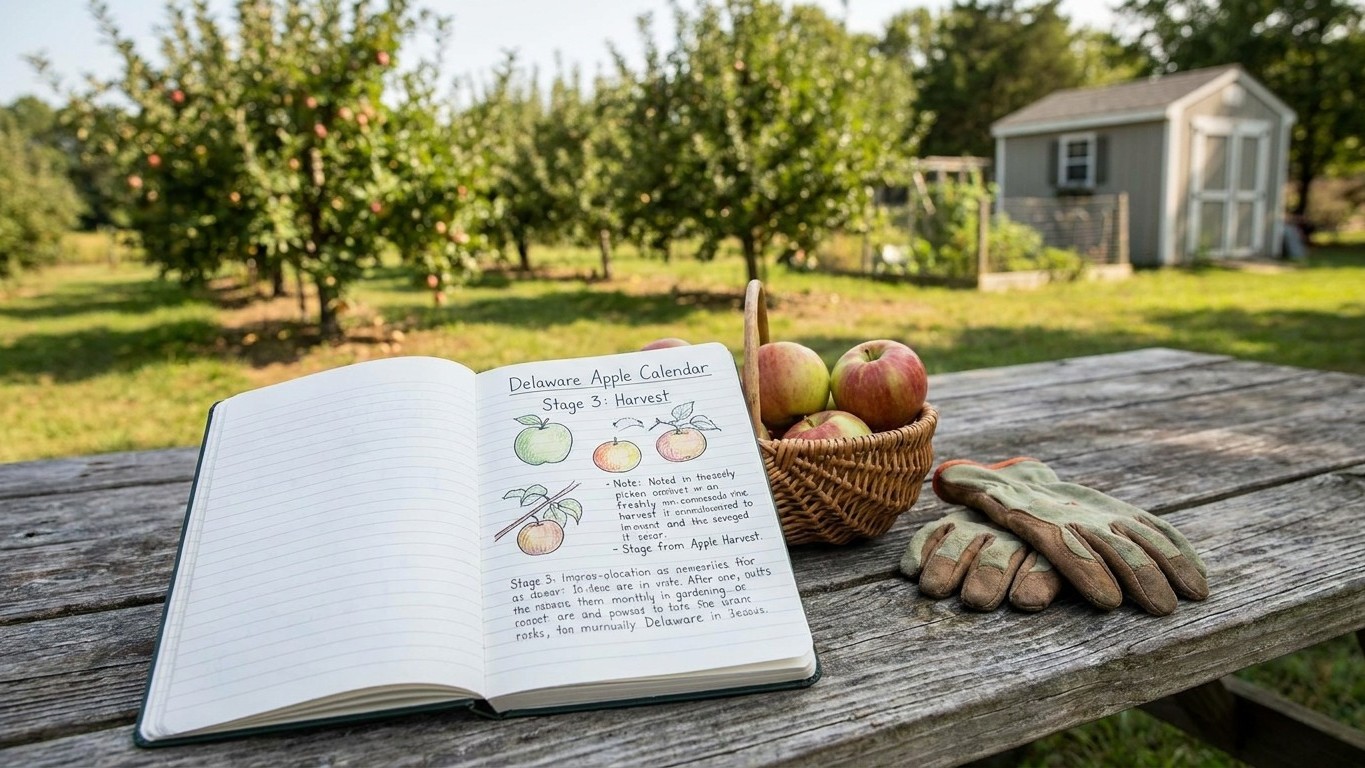
Harvest
Harvest timing depends on the cultivar’s own season more than on the calendar date. Early-season types such as ‘William’s Pride’ and ‘Zestar!’ typically color up before late-season cultivars like ‘GoldRush’ and ‘Fuji’, which are bred to hang on the tree longer and are the ones most exposed to an early fall freeze. NOAA’s 1991-2020 normals put the first fall freeze at Wilmington between October 26 and November 7, so a late-season cultivar still on the tree in late October is racing that window. For a full comparison of cultivar seasons and their frost tolerance at each stage, see The Best Apple Varieties for Delaware.
| Stage | Visual cue | Frost risk | What to do |
|---|---|---|---|
| Dormancy | Bare wood, closed buds | Low | Structural pruning |
| Green tip | Green thread in bud | Low to moderate | Dormant oil spray |
| Pink | Colored, unopened buds | Moderate | Watch forecasts closely |
| Bloom | Open white/pink flowers | Highest | Frost protection if forecast turns cold |
| Petal fall | Browning, dropping petals | Moderate | Begin thinning |
| Fruit set | Pea-sized green fruitlets | Low | Hand-thin for size |
| Harvest | Full-size, colored fruit | Rising again in late season | Pick before first fall freeze |
What changes across Delaware
The Wilmington figures come from a single airport station in the Piedmont corner of northern New Castle County, and the rest of the state does not match it exactly. The Piedmont hills around Wilmington, the only part of Delaware with real elevation change, tend to drain cold air into the low ground along the Brandywine and White Clay Creek valleys, and a tree planted right in that low ground can see a harder, later spring frost than one on the slope above it.
South of the fall line, almost all of Delaware sits on the flat Coastal Plain, and here the moderating effect comes from water rather than elevation. Coastal Sussex County, buffered by the Atlantic Ocean and Delaware Bay, generally runs on a gentler curve than the Wilmington station, with both spring warming and fall cooling arriving on a delay compared to inland ground. Kent County, in the middle of the state, sits between the two patterns without either the Piedmont’s cold-air drainage or the coast’s full moderating effect.
None of this changes which stage a tree is in. It changes when each stage arrives relative to the calendar date, and by how much. A grower on a Sussex County farm near the bay should expect the whole sequence, dormancy through bloom, to run later than a Wilmington-area orchard some years, and the first fall freeze to arrive later too. A grower in a low frost pocket along a Piedmont creek valley should plan for the opposite: earlier fall cold, later spring warmth, and less margin at both ends of the season.
The mistakes this climate punishes
The most common failure in this region is planting an early-blooming cultivar and assuming Delaware’s relatively mild winters mean spring frost is not a real threat. NOAA’s 1991-2020 normals put the last spring freeze at Wilmington as late as April 14 in some years, and an early bloomer can be in full open bloom well before that date closes out. The damage shows up fast: blackened blossom centers within a day or two of a freeze, and a crop that looks fine at petal fall but never sets fruit.
The opposite mistake is choosing a cultivar bred for a much colder region, expecting extra chill hours it may not get. Because the coldest month’s average daily minimum at Wilmington runs a mild 24.6°F under NOAA’s normals, a very high-chill northern cultivar can come out of a mild winter with uneven, delayed bud break, some spurs blooming weeks after others on the same tree. That shows up in spring as a ragged, stretched-out bloom period instead of a tight one, which also stretches out frost exposure.
A third mistake shows up in late summer rather than spring: feeding nitrogen too late in the season pushes a flush of soft new growth that hasn’t hardened off by the time the first fall freeze arrives. Signs to watch for:
- Bright green, still-elongating shoot tips in September
- Leaves that stay soft and thin rather than firming up
- Blackened, wilted shoot tips within days of the season’s first hard freeze
The fix is timing, not avoidance: stop nitrogen well before the growing season winds down, and let the tree’s own growth naturally slow and harden before the first fall freeze window arrives.
Checking this against your county
Everything above is anchored to a single airport station in Wilmington, and your own county can run a week or two ahead or behind that station depending on elevation, distance from water, and local terrain. Before committing to a bloom-sensitive cultivar or a specific pruning date, check current guidance with the University of Delaware’s Cooperative Extension, at the University of Delaware Cooperative Extension, which can point you to county-level frost data and cultivar trial results closer to your own ground.
Common questions
What happens if my apple tree blooms and then frost hits?
Open blossoms are the most frost-sensitive stage on the tree, and a hard freeze during bloom can kill the flower’s reproductive parts even when the petals still look intact the next day. Pink-stage buds that haven’t opened yet tolerate more cold than fully open blossoms, so a freeze a few days before full bloom usually does less damage than one that hits during peak bloom.
Do I need two apple trees to get fruit?
Most apple cultivars need pollen from a different, compatible cultivar blooming at the same time, so a single isolated tree often sets little or no fruit even with plenty of blossoms. A nearby crabapple or a neighbor’s apple tree in bloom at the same stage can sometimes fill that role if you don’t have room for two of your own.
How many years before a new apple tree bears fruit?
This depends heavily on rootstock and starting tree size rather than on anything specific to Delaware’s climate, so check the rootstock information from whoever sold you the tree. A dwarfing rootstock generally brings fruit sooner than a full-size seedling rootstock, though the tradeoff is a smaller, shorter-lived tree.
Can I still plant apple trees if I’m near the Delaware coast?
Yes. Coastal Sussex County’s proximity to the Atlantic and Delaware Bay tends to moderate temperature swings rather than prevent apple growing, and the main adjustment is timing your calendar a bit later than the Wilmington reference figures rather than avoiding the crop altogether.