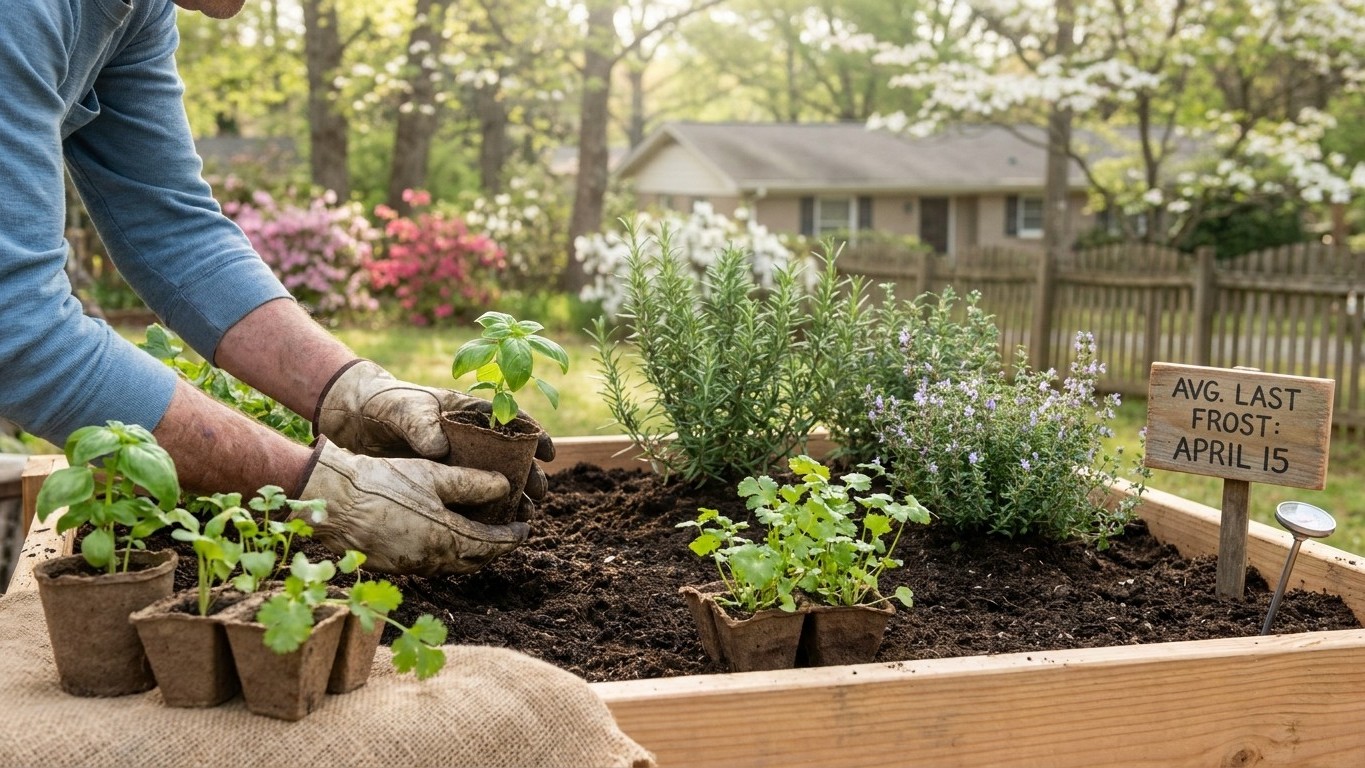

In Delaware, warm-season herbs like basil and cilantro-for-seed go into the ground after the last spring frost, typically between April 3 and April 14 near Wilmington. Cool-season herbs like parsley, chives, and dill tolerate a lighter frost and can go in two to three weeks earlier. Everything depends on which herb you’re planting and how much risk you’re willing to take with a late cold snap.
The short answer for Delaware
The frost window that anchors this whole calendar comes from NOAA’s 1991-2020 Climate Normals at station USW00013781: the last spring frost falls somewhere between April 3 and April 14, and the first fall frost arrives between October 26 and November 7. Those aren’t fixed dates. They mark a 30-70% probability band for a 32°F freeze, which means even after April 14 there’s still a real chance of a cold morning that can nip tender seedlings.
For frost-tender annuals, basil chief among them, wait until you’re past that window entirely, closer to the April 14 end if you want a safety margin. Basil seedlings sulk or die outright below 40°F, so pushing the date earlier just to get a head start usually backfires. Cilantro grown for leaf can go in earlier since it actually prefers cooler soil and bolts fast once summer heat arrives; treat it as a cool-season crop and start it two to three weeks before the earliest frost date, around late March.
Parsley, chives, and dill sit in between. They shrug off a light frost but not a hard freeze, so the safest window is right at the start of the probability band, early April, with some floating row cover on hand in case a cold night sneaks through. Perennial woody herbs like thyme, sage, and oregano are best transplanted as nursery starts once soil has warmed past the frost risk, generally the same window as basil, because young root systems need consistent warmth to establish before the growing season really gets moving.
Fall planting matters here too. The window between the two frost dates gives roughly six and a half to seven months of frost-free growing near the reference station, enough time for a second sowing of quick cool-season herbs like cilantro or dill in late summer, timed to mature before the first fall frost arrives in that late-October-to-early-November band. Anything planted after early October is racing a clock that closes fast.
What will not work here

The coldest month here averages a daily minimum of 25.6°F, and that single number rules out leaving tender perennial herbs outdoors unprotected through winter. Bay laurel, tender rosemary varieties, and lemon verbena are commonly grown as perennials in warmer climates, but 25.6°F as an average night low, not even the record cold, means unprotected plants face repeated stress that kills roots over a season, not just a single freak night. If you want rosemary to survive winter outside here, you need a genuinely cold-hardy cultivar and a sheltered spot, not the average nursery rosemary sold in spring.
Starting slow-germinating herbs from seed and expecting them to be transplant-ready right at the frost window is another common failure. Rosemary and thyme from seed can take four to eight weeks just to germinate reliably, then more time to build a root system sturdy enough for the garden. If you’re counting on an April 14 outdoor date, seed needs to go under lights in February, not March. Buying starts sidesteps this problem entirely, which is why most Delaware gardeners transplant these species rather than direct-seed them.
Delaware’s summer humidity, especially across the Delmarva Peninsula, defeats basil planted at tight, magazine-photo spacing. Downy mildew and other fungal issues spread fast in still, damp air between crowded plants. Herbs that would be fine at close spacing in a drier climate need extra room here, plus morning watering instead of evening, so foliage dries before nightfall instead of staying damp for hours.
A weekly watering habit also fails during the hottest, driest stretches of July and August. Container herbs in particular can go from thriving to wilted within two or three hot, sunny days, especially basil and cilantro, which have shallow root systems and no reserve capacity. This isn’t a special quirk of Delaware weather so much as a mismatch between a rigid schedule and actual soil moisture, but it shows up hardest during the mid-summer heat spikes typical of the mid-Atlantic.
What changes across Delaware
The USDA Plant Hardiness Zone Map places Delaware across a 7a-8a range, and that spread is bigger than it sounds for herb growing. A full zone difference translates to roughly a 10°F gap in the average extreme minimum winter temperature, which decides whether a marginally hardy perennial herb, rosemary, certain sages, French tarragon, survives the winter outdoors or needs to come inside or get mulched heavily.
There is no single answer for the whole state. Areas closer to the Delaware Bay and the Atlantic coast tend to run warmer in winter, buffered by the water, which pushes them toward the 8a end of the range. Inland and northern areas, away from that coastal moderation, run colder and sit closer to 7a. That difference matters most for anyone trying to overwinter a woody perennial herb rather than replanting it as an annual each spring.
It also affects timing at the margins of the season. A slightly warmer coastal pocket may see soil warm a few days earlier in spring and stay warm a few days longer in fall than an inland spot at the same latitude, shifting both the safe transplant date and the last realistic date for a fall herb sowing. None of this shows up on a statewide frost-date chart, because those numbers come from one reference station, not from every backyard in the state.
Elevation, tree cover, proximity to water, and even which direction a slope faces all nudge a specific property one way or the other. Check the USDA Plant Hardiness Zone Map directly for your zip code before deciding whether a perennial herb needs winter protection where you garden.
Where to check this for your own county
One weather station reference and one statewide hardiness range are useful for a first pass but not a substitute for county-level data. The University of Delaware Cooperative Extension is the place to check next, available at udel.edu’s Cooperative Extension site. Look specifically for two things there: a county-adjusted planting calendar, and any variety trial results for herbs grown in your part of the state.
County offices track local frost patterns that differ from the airport-based NOAA figures cited above, sometimes by a week or two in either direction, and they usually know which herb cultivars have actually performed well in local trial gardens rather than just on a seed packet’s national averages. That kind of ground-level testing catches things a statewide frost-date range never will, like which basil variety resists downy mildew best in a particularly humid pocket of Sussex County, or which sage cultivar reliably survives winter in a colder inland spot in New Castle County.
A county recommendation beats a state one every time, because it accounts for the local soil, local humidity patterns, and local microclimate quirks that a single reference station can’t capture. The statewide starting point gives you the general shape of the season and the range of conditions you’re working with. Your county extension office fills in the specifics that actually decide whether a given planting date works in your own soil.
Checking this against your own garden
Every date is a probability, not a promise, and your own garden will tell you more than any calendar once the season actually starts. Soil warmth is the first signal worth trusting. Push a finger a couple of inches into the bed in early spring: cold, clumping soil that sticks together means it’s still too early for tender herbs, while soil that crumbles and feels merely cool means it’s warming toward transplant range.
Watch the first true leaves on any seedlings you’ve started indoors or direct-sown. The initial pair that emerges from a seed, the cotyledons, don’t count. Wait for the next set, the true leaves that actually look like the mature plant’s foliage, before judging whether a seedling is strong enough to handle a transplant shock. Herbs pushed into the ground too early, before true leaves appear, tend to stall rather than grow.
For perennial herbs already established from a previous year, the first flush of new growth at the base of the plant tells you the roots have survived winter and woken up. Thyme, sage, and oregano all show this as small new leaves appearing low on old woody stems, usually a week or two before it’s safe to prune back winter damage or divide the plant. That timing shifts every year with the weather, sometimes by two or three weeks compared to the year before, which is exactly why a fixed date on a page like this one is a starting point, not the final word.
Some gardeners also time this by the Moon: when to plant herbs by the moon, as almanac tradition rather than fact.