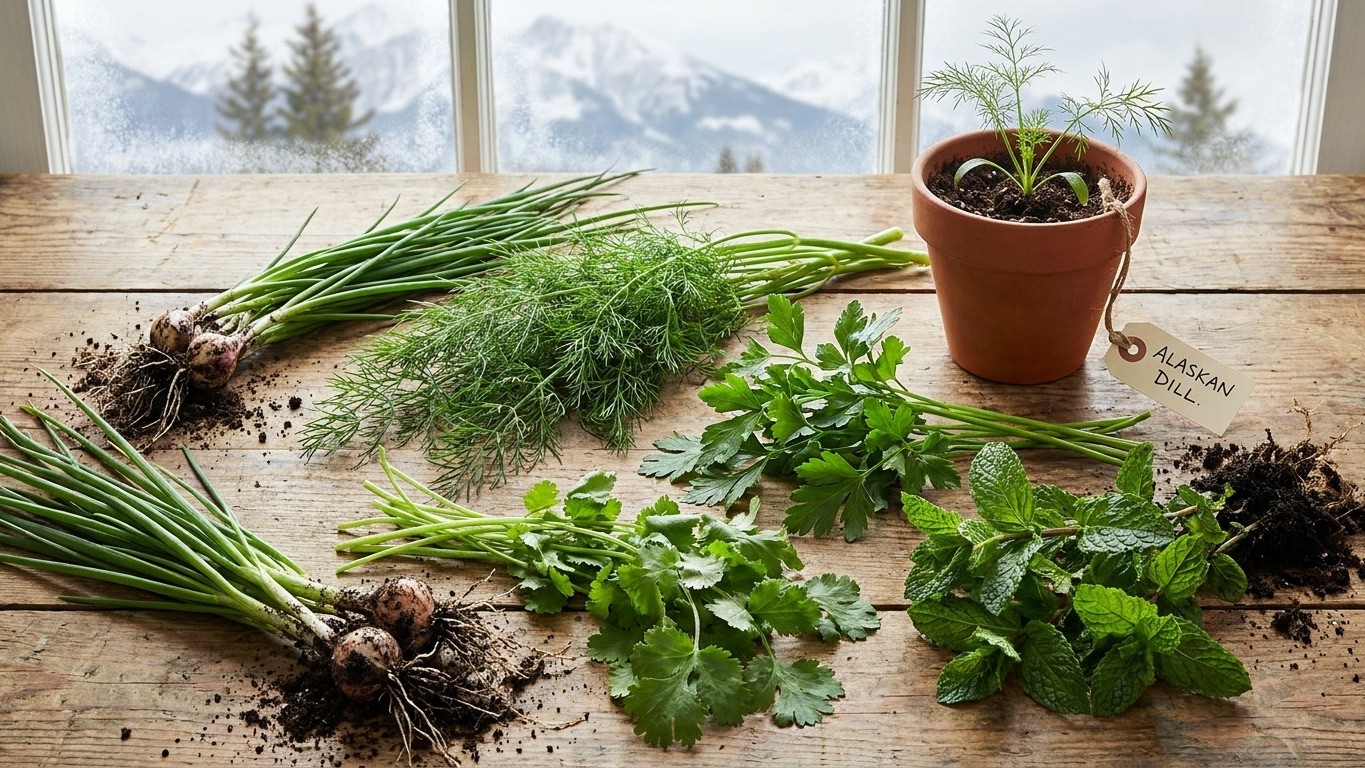

Delaware’s growing season runs long enough for a full lineup of annual herbs, and the state’s mild-to-moderate winters keep several perennials alive outdoors without much fuss. Basil, dill, cilantro, and parsley thrive as summer annuals, while thyme, oregano, and chives hold on year after year. Rosemary is the wild card, hardy in the warmer pockets, iffy everywhere else.
The short answer for Delaware
Delaware sits in USDA hardiness zone 7a-8a, with the Wilmington reference station recording a last spring frost between April 3 and April 14, and a first fall frost between October 26 and November 7. That stretch, close to seven months at the long end, is enough to run two full herb cycles in a single year if you’re organized about it: a spring planting of cool-tolerant herbs followed by a summer succession of heat lovers.
For annual culinary herbs, the answer is simple. Basil, dill, cilantro, and parsley all fit comfortably inside that window. Basil wants the soil good and warm, so it should go in after the frost date has passed at your location, not on the calendar date alone. Cilantro and dill actually prefer the cooler shoulders of the season, meaning an early spring sowing and another round in late summer beats one long midsummer planting, since both bolt fast once daytime highs sit in the 85F range for more than a few days running.
For perennial herbs, the decision hinges on that coldest-month figure: a mean daily minimum of 25.6F in the coldest month at the Wilmington station. That’s cold enough to kill back tender perennials to the ground most winters, but not usually cold enough to kill the roots of the truly hardy ones. Thyme, oregano, chives, sage, and mint all read as safe bets across most of the state, coming back reliably from the root crown even after a hard freeze knocks the top growth flat.
Rosemary is the herb that separates a general answer from a useful one. Standard rosemary struggles below 10F to 20F depending on the cultivar, and Delaware’s coldest-month average minimum of 25.6F means most winter nights won’t kill it outright, but the occasional cold snap below that average could. Treat it as a herb for a sheltered spot near a south-facing wall or foundation, or plan on bringing a potted plant indoors for winter rather than betting on it surviving in the open ground everywhere in the state.
Bay laurel doesn’t belong in this lineup at all here. It’s rated hardy only to about zone 8b or warmer in most nursery guides, and Delaware’s 7a-8a range falls short of that threshold across the entire state. Grow it in a container you can move indoors, not in the border.
What will not work here

Basil planted on a fixed spring date instead of a frost date is the most common failure story in this state. The Wilmington reference station’s last spring frost falls between April 3 and April 14, but that’s an airport measurement, and airport sites tend to run warmer than the surrounding countryside. Suburban and rural gardens in Delaware typically see their own last frost run one to two weeks later than that window, sometimes more at elevation or in low-lying frost pockets. A basil seedling set out on April 15 because a calendar said so can still get nipped in a colder yard a county over.
Rosemary left unprotected through a full Delaware winter is the second failure pattern. The 25.6F coldest-month average minimum sounds mild, and most winters it is. But that’s an average, not a floor. Cold snaps that dip well below that figure happen in most years, sometimes for multiple nights in a row, and an unprotected in-ground rosemary plant without mulch or wind shelter can lose its roots even if the top growth looks fine at Thanksgiving. Gardeners who’ve had rosemary survive one winter and die the next aren’t imagining things.
Herbs planted too close together run into trouble with Delaware’s humid summers rather than drought. Mid-Atlantic summer humidity sits high enough that oregano, thyme, and other Mediterranean natives, which evolved in dry, airy conditions, develop powdery mildew and root rot when crowded. Spacing that would be fine in a drier western state isn’t generous enough here. Give these herbs more room between plants than the seed packet suggests, and skip the mulch right up against the stems.
Cilantro sown in July fails almost every time. This herb bolts to seed once soil and air temperatures climb, and Delaware’s summer heat arrives well before the first fall frost in late October or early November. A single midsummer sowing gives you a few weeks of usable leaf before the plant switches to flowering and seed production. The fix isn’t a different variety so much as a different schedule: sow in early spring, again in late summer once the heat starts breaking, and skip the deep summer window entirely.
What changes across Delaware
Delaware’s hardiness range spans zone 7a to zone 8a, and that gap matters more than the state’s small size suggests. A 7a winter and an 8a winter are not the same growing conditions for a perennial herb like rosemary or sage, and a state-wide recommendation has to acknowledge that spread rather than pretend one number covers the whole map.
Generally, the coastal and southern parts of the state trend toward the warmer end of that range, buffered somewhat by the Atlantic and the Delaware Bay, while inland and northern areas run cooler. That’s a general pattern, not a guarantee for any specific yard. Local terrain, elevation, and how close a garden sits to open water all shift the actual conditions on the ground.
What this means practically: a gardener near the state’s southern coast might get away with rosemary in open ground more years than not, while a gardener in the northern interior should treat the same plant as a container specimen to bring indoors each winter. The frost dates shift with this same pattern, meaning a garden at the milder end of the range could reasonably expect a slightly later first fall frost and slightly earlier last spring frost than the Wilmington station’s April 3 to April 14 and October 26 to November 7 windows.
Check the USDA Plant Hardiness Zone Map directly, using your ZIP code, to see where your specific location lands before deciding whether rosemary, bay, or other borderline perennials are worth planting in open ground versus in a pot.
Where to check this for your own county
The figures come from a single weather station and a state-wide hardiness range. Neither one replaces a recommendation built for your own county’s soil, microclimate, and growing history. That work has already been done by the University of Delaware Cooperative Extension, and it’s worth using before you finalize a planting plan.
Start at the University of Delaware Cooperative Extension site and look specifically for two things. First, a county-level planting calendar, which will translate the state’s broad frost-date range into a working schedule based on local records rather than one airport station. Second, any list of herb varieties that extension agents have actually trialled in Delaware conditions, since a variety bred for a different climate zone can underperform here even if the species itself is well suited to the state.
The state-level picture includes the general frost windows, the hardiness range, and which herb types make sense given Delaware’s season length and winter minimums. Your county extension office fills in the details that actually apply to your specific piece of ground.
If you’re growing herbs alongside other crops, most extension office also maintain broader vegetable and fruit planting calendars worth cross-referencing, since herb timing often lines up with companion vegetables like tomatoes or peppers that share the same frost sensitivity.
Checking this against your own garden
Every frost date is a probability built from thirty years of weather records at one airport station. Your own garden will tell you something more specific and more current than any historical average, if you know what to watch for.
Soil warmth by feel is the first and most reliable check. Push a finger a few inches into the bed on a sunny mid-morning. If it feels genuinely warm rather than merely cool, basil, dill, and other warm-season herbs are more likely to germinate and grow rather than sit stalled in cold ground waiting for conditions to improve, regardless of what the calendar says.
The first true leaves on any direct-sown herb seedling matter more than the sowing date itself. The initial pair of leaves that emerge from a seed are seed leaves, not the plant’s actual foliage. Once true leaves appear, looking like a miniature version of the mature plant, that seedling has confirmed the soil and air conditions in your specific spot are workable for that herb right now.
New growth at the base of overwintered perennial herbs, like thyme, sage, or chives, is the third signal worth tracking. When fresh green growth pushes up from the root crown after a winter of dormancy, it tells you that particular plant survived the cold-month minimums in your yard, which is more useful information than any state-wide hardiness zone, since it’s a direct result of your soil, your drainage, and your specific microclimate rather than an average drawn from an airport thirty miles away.