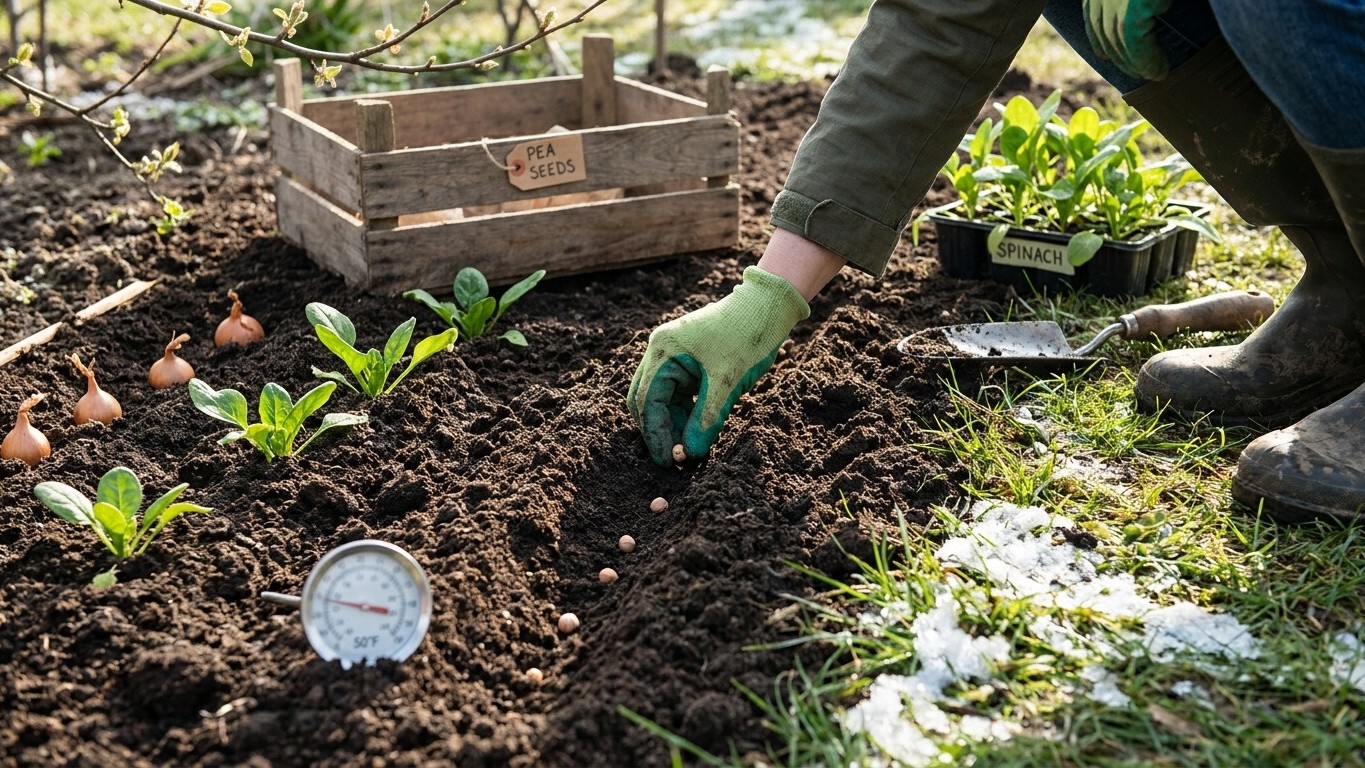

April in Delaware splits into two halves. Before the state’s last frost window clears, cold-hardy crops like peas, spinach, and onion sets go into open ground while soil is still cool. After that window passes, gardeners can start hardening off transplants and direct-sowing tender annuals. The exact split depends on soil temperature far more than the date on the calendar, and it shifts by up to two weeks depending on where in the state you garden.
What goes in the ground in April

The frost data for the Wilmington-area station (USW00013781) puts the last spring freeze somewhere between April 3 and April 14, based on NOAA’s 1991-2020 Climate Normals. That’s a window, not a date, and it matters more than any line on a seed packet calendar. Soil temperature, not the reading on a porch thermometer, decides what survives outdoors this month.
Cold-hardy crops don’t care much about that window. Peas sown directly into the ground germinate fine in soil as cool as 40°F, and they actually sulk if you wait for warmth. Spinach, lettuce, kale, and chard, whether transplanted or direct-seeded, tolerate light frost once true leaves have formed. Onion sets and shallots can go in as soon as the ground is workable, and radishes germinate quickly enough in cool soil to reward planting on the early side of the month.
Potatoes sit in the middle. Seed potatoes planted two to three weeks before the last frost window usually push through before any hard freeze, and a light frost on emerging foliage rarely kills the plant outright, though it can set growth back. Asparagus crowns, if a bed is being started fresh, should go in now while they’re still dormant.
Everything else is a gamble until the frost window has passed and soil has warmed into the 60s. Tomatoes, peppers, corn, beans, cucumbers, squash, and melons planted into cold, wet April soil don’t die from a stray 45°F night, but they stall. Seeds rot before germinating, and transplants sit without growing for two or three weeks, erasing whatever head start the gardener thought they were getting. If soil temperature at a 4-inch depth hasn’t cleared 60°F, hold those crops regardless of how mild the afternoons feel.
What to start under cover
Work backward from the frost window instead of a fixed date on the calendar. Tomatoes and peppers need six to eight weeks indoors before they’re sturdy enough to transplant, and the outdoor move should wait until a week or two after the frost window clears to build in margin against a late cold snap. If frost risk fades toward the middle of April in your area, that pushes the transplant date into early May, which means seed should have started indoors back in early or mid-March. Anyone starting tomato and pepper seed now, in April, is running behind that math, though fast-maturing varieties and nursery-bought transplants can still close the gap.
Squash, cucumbers, and melons run a shorter clock. They need only three to four weeks under cover before transplanting, and they resent being started too early since their roots hate disturbance and their vines outgrow small pots fast. Starting these now lines up almost exactly with a transplant date in early May, which makes this month the right one for them rather than a late one.
Two mistakes show up every spring. The first is starting long-season crops too early, ending up with leggy, rootbound plants that stall for weeks after transplanting because their roots never recovered from being cramped in a 4-inch pot. The second is starting too late and running out of growing season before fall frost returns, particularly with peppers and melons, which need every week of warmth they can get. A seedling that looks small and slow in April is usually in better shape than one that looks tall and thin.
What is ready to pick
Established asparagus beds, three years old or more, start sending up spears this month, ready to cut once they reach 6 to 8 inches and before the tips loosen and start to fern out. Rhubarb stalks thicken enough to pull once they’re a foot or more long; twist and pull rather than cut, and leave at least a third of the stalks on young plants to keep the crown strong.
Overwintered kale, collards, and leeks that made it through winter under mulch or row cover put out new growth this month, and that regrowth is often sweeter than fall foliage because cold exposure converts starches to sugar. Green onions planted from sets earlier in spring are ready to pull as soon as they’re pencil-thick. Radishes from the earliest April sowings mature fast, often in 25 to 30 days, which puts the first pulls near the end of the month for anyone who seeded on schedule.
Stored crops from the previous season deserve a check now, before warmer weather accelerates any rot that’s been sitting quiet. Potatoes that have started sprouting eyes should be used first or moved to a colder, darker spot to slow them down. Onions with soft necks or a sour smell need to be pulled from storage and used immediately rather than left to spread to the rest of the batch. Winter squash still holding on should be checked at the stem end, where soft or sunken spots show up first.
The jobs that matter this month
Soil that crumbles in your hand when squeezed is ready for compost and amendments; soil that clumps into a mud ball is still too wet to work, and turning it now compacts structure that takes a full season to recover. Wait for a dry stretch before digging in humus or flipping beds that held a winter cover crop.
Pea trellises and other supports need to go up before the vines start reaching, not after. Peas grow fast once they get going, and tying up sprawling vines after the fact damages stems that would otherwise have climbed cleanly on their own. The same logic applies to any perennial that leans, like raspberry canes needing a wire strung along the row before new cane growth gets tangled.
Dormant pruning of fruit trees and berry canes needs to wrap up before buds swell and break; cuts made after leaf-out cost the plant stored energy it needed for the coming season. If apple, pear, or stone fruit trees haven’t been pruned yet, this is close to the last clean window before growth resumes in earnest.
Mulch is worth holding back on warm-season beds until soil has had a chance to warm in the sun; a thick layer laid too early insulates cold soil and slows the very warming a gardener is trying to speed up. Garlic and overwintered onion beds are the exception, since a light mulch there suppresses spring weeds without needing the soil underneath to warm first.
Succession sowing pays off starting now: a second and third round of lettuce, spinach, and radish sown two to three weeks apart stretches the harvest window instead of dumping the whole crop at once. Pest scouting matters just as much, since aphids and flea beetles show up on brassica transplants almost as soon as they’re set out, and catching the first few is far easier than treating an infestation later.
What not to do in April
The classic April mistake is trusting the air instead of the ground. A run of 70°F afternoons can feel like summer arrived, but soil four inches down often sits 15 to 20 degrees cooler than the air above it, especially in shaded or heavy clay beds. Tomato and pepper transplants set out during a warm spell can survive the air temperature and still stall for weeks because their roots are sitting in soil too cold to support growth.
Pulling row covers and cold frame lids off too soon after a mild stretch is the second trap. The frost window for this state’s reference station runs from April 3 to April 14, but that’s a 30 to 70 percent probability band, not a guarantee that freezing stops on the later date. A cold snap after a week of warmth catches exposed brassica and lettuce transplants that had been hardening off nicely, and it can also nip flower buds on fruit trees that broke dormancy early.
Nitrogen timing trips people up too. Feeding a heavy dose of nitrogen to fruit trees or berry canes right as they’re breaking dormancy pushes soft, leafy growth at the expense of flower and fruit set, and that same soft growth is more vulnerable to a late frost than growth that’s had time to harden. A light, balanced feeding once growth is clearly underway works better than a heavy dose the moment buds swell.
Working wet soil rounds out the list. A bed that’s still soggy from spring rain compacts under a shovel or tiller, squeezing out the air pockets roots need, and that damage can take a full growing season to reverse.
Checking this against your own county
Everything above is anchored to one weather station, not the whole state. Delaware’s hardiness zones run from 7a to 8a on the USDA Plant Hardiness Zone Map, and that range alone tells you the coastal south and the inland north don’t warm up on the same schedule. Elevation, distance from the Delaware Bay, and how exposed a yard is to wind can shift a local frost window by a week or two in either direction from the April 3-14 range cited here.
The University of Delaware Cooperative Extension tracks local frost data and planting guidance specific to New Castle, Kent, and Sussex counties, and it’s the better source for adjusting any date in this article to a particular yard: University of Delaware Cooperative Extension.
Common questions
Is it too early to plant tomatoes in Delaware in April?
Outdoors, yes, in most cases. Soil needs to clear roughly 60°F at a 4-inch depth and the April 3-14 frost window needs to have passed with margin. Starting tomato seed indoors now works only for fast varieties, since standard tomatoes need six to eight weeks under cover before transplanting.
Can I plant grass seed in April in Delaware?
Cool-season grasses like tall fescue and Kentucky bluegrass can be overseeded in April, though early fall remains the stronger window for full lawn establishment since spring seedlings compete with summer heat and weeds shortly after germinating.
What vegetables can I plant in April in Delaware?
Peas, spinach, lettuce, kale, chard, radishes, onion sets, shallots, and seed potatoes are the safe direct-sown or planted crops this month. Tomatoes, peppers, beans, corn, squash, cucumbers, and melons should wait until after the frost window clears and soil has warmed.
When is the last frost date in Delaware?
At the Wilmington-area reference station (USW00013781), NOAA’s 1991-2020 Climate Normals put the last spring freeze between April 3 and April 14. That’s a probability band for one station, and rural or inland gardens often see frost linger later, so check the local extension service for a county-adjusted estimate.