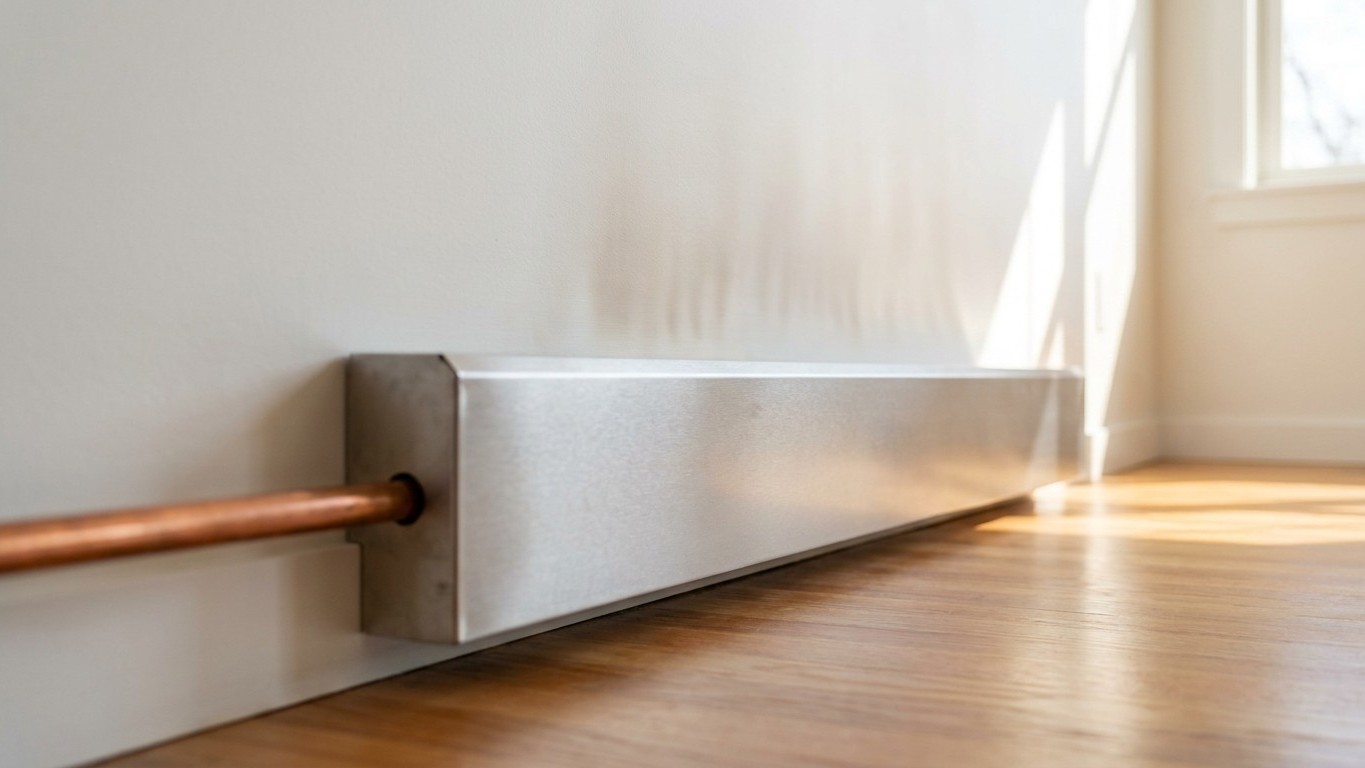

Hydronic baseboard heating is a wall-mounted emitter, not a self-contained heater. A boiler somewhere in the house heats water, a circulator pump pushes it through a loop of pipe, and the finned copper tube behind the metal cover along your wall is simply where that hot water gives up its heat to the room. This differs from electric baseboard heating, a resistance element wired at line voltage with no boiler and no water anywhere in the system.
A boiler, ending at your wall
Start with the plumbing, not the metal box. A boiler, gas, oil, or occasionally electric, raises the temperature of water in a closed loop. A circulator pump keeps that water moving whenever the zone calls for heat. The loop runs through the walls and floors and surfaces at intervals as baseboard: a length of finned copper tube, usually aluminum fins pressed onto copper pipe, tucked inside a thin metal enclosure along the base of the wall. Water enters one end, gives off heat to the fins, and the fins give off heat to the room air rising past them, then the cooler water continues around the loop back to the boiler.
Nothing in that baseboard enclosure generates heat. It has no element, no Thermostat of its own, no electrical connection beyond, in some installations, a wire to a zone valve or circulator relay elsewhere in the system. The metal along your wall is a radiator in the literal sense: it gives off heat it received from somewhere else. This matters because it sets where a fault actually lives. If a run of baseboard is lukewarm, the problem is in the water moving through it, or failing to, not in the metal itself.
Worth being blunt about a naming trap here. There is an electric baseboard heater filled with a heat-transfer fluid, sold under the word “hydronic,” with no boiler, no loop, and no connection to any other unit in the house. It’s a self-contained electric appliance that uses fluid inside its own sealed casing to even out heat output. If your unit isn’t fed by pipes running to a central boiler, that’s what you have, and the diagnostic steps here, which assume a shared loop, do not apply.
Confirm what’s actually in the wall before troubleshooting. True hydronic baseboard has supply and return pipe fittings connecting it to the rest of the house, usually visible at one or both ends of the enclosure. If those pipes aren’t there, and the unit stands alone on its own wiring, you’re dealing with an electric appliance at line voltage, with a different set of rules and hazards entirely.
Zones, and why one room is cold
A house on hydronic baseboard rarely runs on a single loop. Most systems are divided into zones, each with its own Thermostat and usually its own zone valve or circulator, so the living room can call for heat without the bedrooms doing the same. That division is also the fastest diagnostic tool a homeowner has, because where the cold shows up tells you where to look before you touch anything.
One baseboard cold while the rest of the room and zone runs warm points to something local: air trapped in that run, a closed damper, or sediment narrowing flow at that unit. A whole zone cold while other zones heat normally points higher up, at that zone’s valve or thermostat, since something is stopping water from entering the loop rather than affecting one emitter within it. Every zone cold, the whole house without heat, points past all of that to the boiler or main circulator, since nothing downstream can be at fault if nothing is leaving the source.
| What you observe | Where the problem most likely sits |
|---|---|
| One baseboard cold, room and zone otherwise warm | That emitter or that section of pipe (air, damper, blockage) |
| Entire zone cold, other zones heating normally | That zone’s valve or its thermostat |
| Every zone cold, no heat anywhere in the house | The boiler or the main circulator pump |
This logic works because a hydronic system is a series of gates. Water has to pass a boiler, then a circulator, then a zone valve, then travel a length of pipe, before it reaches the fins behind a cover plate. A failure early in that chain takes everything downstream with it; a failure at one baseboard unit stays contained there. Reading the pattern of what’s cold and what isn’t is reading which gate failed, and it costs nothing but a walk through the house with a hand on each cover.
It also saves a service call from becoming a guessing game. Telling a technician “the whole upstairs zone is cold but downstream is fine” points them at a valve or thermostat before they’ve opened a panel. Telling them “one baseboard in the corner never gets warm” points them at that six feet of pipe instead of the boiler across the house.
Air in the loop, and balancing
Air trapped inside a hydronic loop is the most common everyday complaint, and it announces itself before you ever open anything. A baseboard that used to run warm along its whole length but now stays cool at the far end is a classic sign, since the air pocket sits at the highest point the water reaches and blocks flow past it. A trickling or gurgling sound from inside the wall or enclosure, especially right after the system starts a heating cycle, is air moving through water rather than water moving smoothly on its own. Uneven heat within a single run, warm near the supply end and progressively cooler toward the return, points the same direction.
Bleeding a hydronic loop follows a routine sequence, though the exact valve location and boiler behavior during the process should be checked against that boiler’s own manual, since procedures vary by make and by whether the system is designed to be bled while running or while off.
- Locate the bleed valve, usually near the top of the emitter or at a high point in the loop, and have a small container ready to catch water.
- With the system running and calling for heat in that zone, open the bleed valve slightly, just enough to release trapped air.
- Listen and watch for a hissing release of air followed by a steady stream of water with no bubbles, then close the valve.
- Check the boiler’s pressure gauge afterward and, if it reads low, follow that boiler’s manual for bringing the system back to its normal operating range.
- Confirm the previously cool section of baseboard now warms evenly along its length.
A loop that needs bleeding once in a while, particularly after plumbing work, is normal. A loop that keeps re-introducing air every few weeks with no plumbing work in between is a symptom, usually of a slow leak or a failing automatic air vent, and is worth having looked at rather than bled again and again.
Balancing is the separate, quieter issue on long loops. On a run feeding several baseboard units in series, the first unit will always give off more heat than the last, simply because the water has already shed some heat by the time it arrives further down the line. Some systems include balancing valves precisely to correct for this, letting more flow through the far units to even out temperature across the run. Not every installation has this adjustment, and where it’s absent, a slightly cooler last baseboard on a long loop is often just the physics of the layout rather than a fault to chase.
The damper is not a thermostat
The narrow metal flap running along the top of a baseboard enclosure gets treated, in a lot of households, as an off switch. It isn’t. That damper adjusts how much room air moves up through the fins and out the top, which changes how much heat the unit gives off, but it does nothing to the water inside. Closed all the way, that baseboard is still full of hot water at whatever temperature the boiler is sending through the loop; the metal is simply less effective at moving that heat into the surrounding air.
This distinction matters for two reasons. First, closing a damper to make a room feel cooler doesn’t save the boiler any work, since the water still has to be heated and pumped through that section of pipe regardless of whether the damper lets the heat escape efficiently. Second, a damper closed too far can make a room feel underheated even though the boiler, zone, and loop are all functioning as intended. Check the damper position before assuming a mechanical fault, because the fix might be a two-second adjustment rather than a service call.
What the damper is genuinely good for is fine adjustment, nudging one room slightly cooler than its neighbors without touching the thermostat for the whole zone, or opening it fully in a room that runs consistently colder than the rest of the house. It’s a comfort dial, not a valve, unable to stop a leak, clear an air pocket, or fix a zone that isn’t calling for heat. For keeping that flap and the fins behind it free to move air, the cleaning and clearance guides elsewhere on this site cover how dust buildup and blocked airflow affect output independent of anything happening in the loop.
Common questions
Can I bleed a hydronic baseboard myself without draining the whole system?
Yes, bleeding a single zone or run typically only releases trapped air and a small amount of water, not the full contents of the loop. Follow the boiler’s manual for the specific sequence, since some systems expect the zone to be actively calling for heat during the process and others don’t.
Why is only the last baseboard in a long row always a bit cooler?
Water loses some heat to every unit it passes before reaching the end of a series loop, so the last emitter receives slightly cooler water than the first. Where the system includes balancing valves, this can be adjusted; where it doesn’t, a modest temperature drop along a long run is often just how that loop was designed.
Is it safe to close the damper completely in a room I don’t use?
Closing the damper fully reduces heat output from that unit but doesn’t stop water from flowing through it, since the loop still carries hot water to and past that baseboard regardless of damper position. It won’t create a hazard on its own, but it also won’t reduce boiler run time the way turning down a zone thermostat would.
How do I know if my baseboard is hydronic or electric before I try to fix anything?
Look for pipe connections at the ends of the enclosure feeding into the wall toward a boiler; that’s hydronic. A unit with only an electrical cord or hardwired line-voltage connection and no pipes, even one labeled “hydronic” on its packaging because it uses internal fluid, is an electric appliance and should be treated as one.