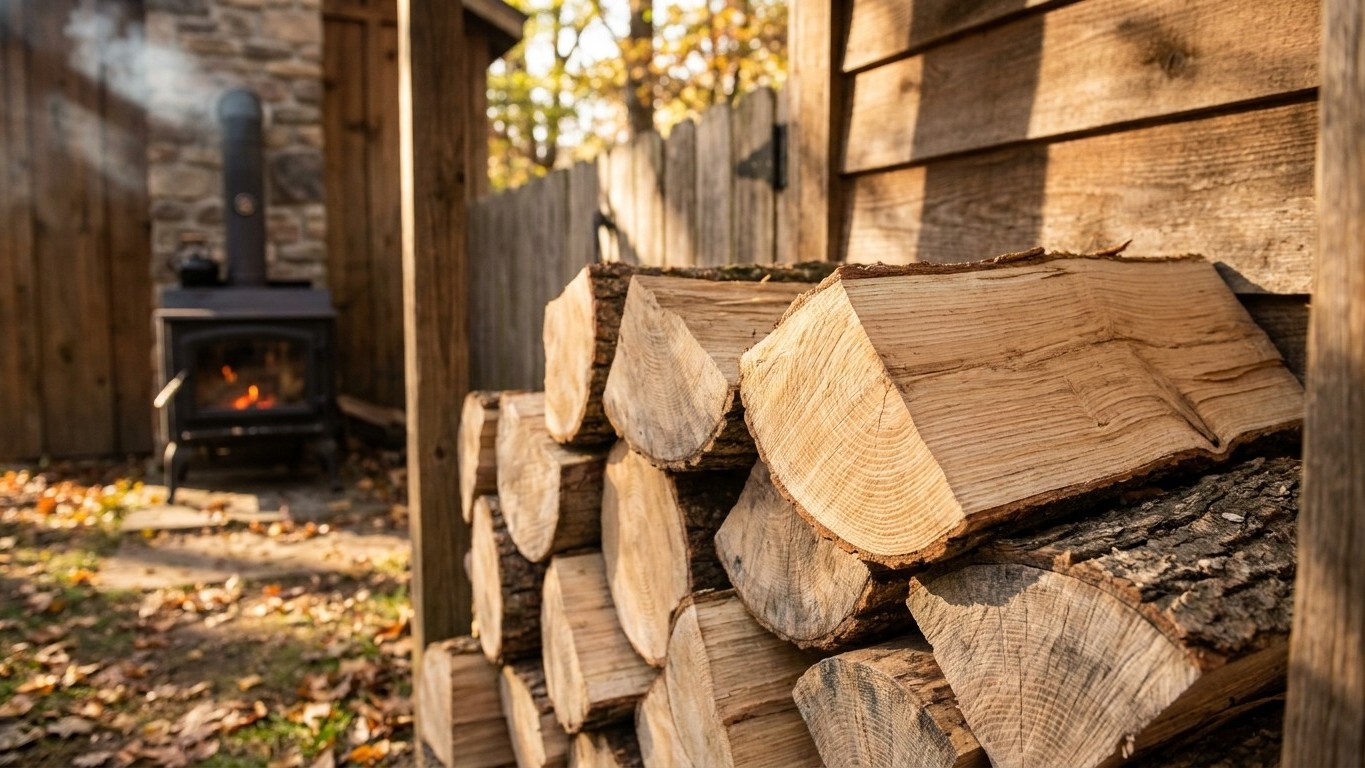

Bur oak burns hot, clean, and steady once it’s properly seasoned, putting it in the same high-performance tier as white oak and hickory. According to SDSU Extension, expect 25 million BTUs per cord, a slow burn that holds coals overnight, minimal sparking, and a smoke profile that’s mild compared to resinous softwoods. The catch is time: bur oak’s dense, thick-walled wood needs a full year or more of drying before it earns that reputation.
Heat Output: How Bur Oak Stacks Up

Bur oak belongs to the white oak family (Quercus macrocarpa), the same genetic branch as white oak and chestnut oak, and it shares their dense cellular structure. That density is what makes oak firewood valuable in the first place. A cord of well-seasoned bur oak delivers heat output comparable to white oak, generally landing in the 26 to 27 million BTU range per cord, which puts it ahead of red oak and well ahead of softer hardwoods like ash or maple.
For a homeowner running a wood stove through a Midwest winter, that difference matters. Burning bur oak instead of a mid-range hardwood can mean one less trip to the woodpile per day, and a firebox that’s still holding coals at 6 a.m. instead of needing kindling to restart. The wood’s specific gravity, in the neighborhood of 0.58 to 0.64 depending on growing conditions, tells the story: denser wood packs more stored energy per split log, so you’re burning less volume to get the same warmth.
That density comes with a tradeoff. Bur oak takes longer to catch and needs a hotter bed of coals to really get going compared to something like birch or cherry. Once it’s burning, though, it settles into a long, even heat curve rather than a quick spike and fade, which is exactly what you want for an overnight burn in a wood insert or a cast iron stove.
Smoke and Creosote: What to Expect
Properly seasoned bur oak produces a clean-burning fire with a moderate amount of smoke, nowhere near the heavy, resinous smoke of pine or spruce. The wood’s tight grain and low sap content mean less particulate buildup in the flue when moisture content is where it should be, generally below 20 percent.
The real risk with any oak, bur oak included, is burning it too green. Freshly cut oak can carry 40 to 60 percent moisture content, and forcing that into a firebox creates a cooler, smokier fire that deposits creosote in the chimney faster than a well-seasoned log ever would. That’s not a quirk unique to bur oak, it’s true of every dense hardwood, but oak’s slow drying time makes the temptation to burn it early a bigger problem than with faster-seasoning species.
A moisture meter is the cheapest insurance policy here. Split a piece, press the meter’s pins into the freshly exposed face rather than the weathered exterior, and don’t load the stove until readings consistently sit under 20 percent. Chimney sweeps in oak-heavy regions of the Midwest routinely point to unseasoned oak as the top cause of glazed creosote calls each fall.
How Bur Oak Compares to Other Common Firewoods for Smoke
Compared to red oak, bur oak burns marginally cleaner thanks to slightly tighter pore structure typical of the white oak group. Compared to hickory, the smoke output is similar, though hickory carries a stronger, more distinctive aroma that some people specifically seek out for cooking fires. Compared to softwoods like pine, there’s no real contest, bur oak produces a fraction of the smoke and none of the sticky pitch residue that builds up fast in a flue.
Sparks and Fire Behavior
Bur oak throws few sparks once it’s dry, another advantage of its dense, tight grain. Species that spark aggressively, like sweetgum or some softwoods, tend to have trapped moisture pockets or resin channels that pop under heat. Oak’s structure doesn’t have those weak points, so a well-seasoned bur oak fire is a reasonably safe choice for an open hearth or an outdoor fire pit without a screen, though “reasonably safe” still means keeping a spark guard handy, especially with any log that hasn’t fully dried through its core.
Where sparking does show up is with wood that’s still holding moisture in pockets near knots or branch unions. Bur oak trees are known for low, spreading branches, especially the open-grown specimens common on old prairie farmsteads, and that growth habit means more knots and reaction wood in the trunk than you’d find in a tall, straight forest-grown tree. Those knotty sections dry unevenly and can pop and spit even after the surrounding wood tests dry on a moisture meter.
The upside of that same branching habit is coal retention. Denser, knottier wood tends to hold a coal bed longer, which is part of why bur oak has a reputation among longtime burners for being a solid choice to bank a fire overnight.
Splitting and Seasoning Bur Oak
Bur oak splits reasonably well along straight-grained sections but turns stubborn fast around knots and crotches. Because open-grown bur oaks branch low, a lot of usable firewood-length rounds come from sections with grain that twists around old branch stubs. A hydraulic splitter handles this without much trouble, but hand-splitting knotty bur oak rounds with a maul is genuinely hard work compared to a straight-grained ash or ambrosia-free ash round.
Seasoning time is the biggest planning factor. Bur oak, like other white oaks, needs 12 to 24 months of covered, well-ventilated drying to reach usable moisture levels, longer than ash (about 6 to 12 months) or silver maple (also faster). Splitting the rounds promptly after cutting speeds the process considerably, since the tight bark and dense wood structure slow moisture loss when logs sit whole. Stacking with good airflow, off the ground on pallets or rails, and covering only the top of the stack, lets rain run off while air still moves through the sides.
A practical benchmark: wood cut and split in late winter or early spring won’t be ready to burn well until the following fall at the earliest, and a second winter of seasoning produces noticeably better performance. Anyone buying “seasoned” bur oak from a supplier should ask when it was cut and split, not just when it was delivered, since a pile that’s been sitting whole in log form for a year is nowhere near as dry as one split and stacked for the same stretch.
Identifying Bur Oak Before You Buy or Cut
Bur oak is easy to recognize in the field even before it’s cut into rounds. The bark is thick, deeply furrowed, and often has a corky, almost armored texture, a trait that helps the tree survive prairie fires in its native range. The acorns are the giveaway if any turn up in a load of wood, they’re some of the largest of any North American oak, with a shaggy, fringed cap that covers up to half the nut. Leaves have deep, rounded lobes with a distinctive narrow waist near the base.
Geographically, bur oak dominates in the upper Midwest and Great Plains, states like Iowa, Nebraska, Minnesota, Kansas, and parts of Texas, where it tolerates drought and poor soil better than most other oaks. If you’re sourcing firewood in that region, bur oak is often more available and sometimes cheaper than red oak, simply because it’s more common on the landscape.
Storage and Burning Tips Specific to Bur Oak
Because bur oak’s knots and branch unions dry unevenly, it pays to sort a load by piece quality when stacking. Set aside the straighter, cleaner splits for overnight burns where you want predictable, long-lasting coals, and use the knottier, twisted pieces for daytime fires where you’re tending the stove anyway and can react to any unexpected spitting or popping.
Mixing bur oak with a faster-igniting species like ash or cherry solves the slow-start problem without giving up any of oak’s heat output. Start the fire with the lighter wood, then add bur oak splits once there’s a solid coal bed established, typically after 20 to 30 minutes of active burning. This approach also stretches a smaller supply of oak further across a heating season, since you’re not relying on it for every phase of the fire.
One detail that catches people off guard: bur oak’s thick bark holds onto moisture longer than the bark of thinner-barked hardwoods like birch or beech, so a round that looks weathered and gray on the outside can still have a damp, tannin-heavy core well past the one-year mark. Splitting a test piece and checking the exposed heartwood, not just the bark, is the only reliable way to confirm a bur oak stack is actually ready to burn.