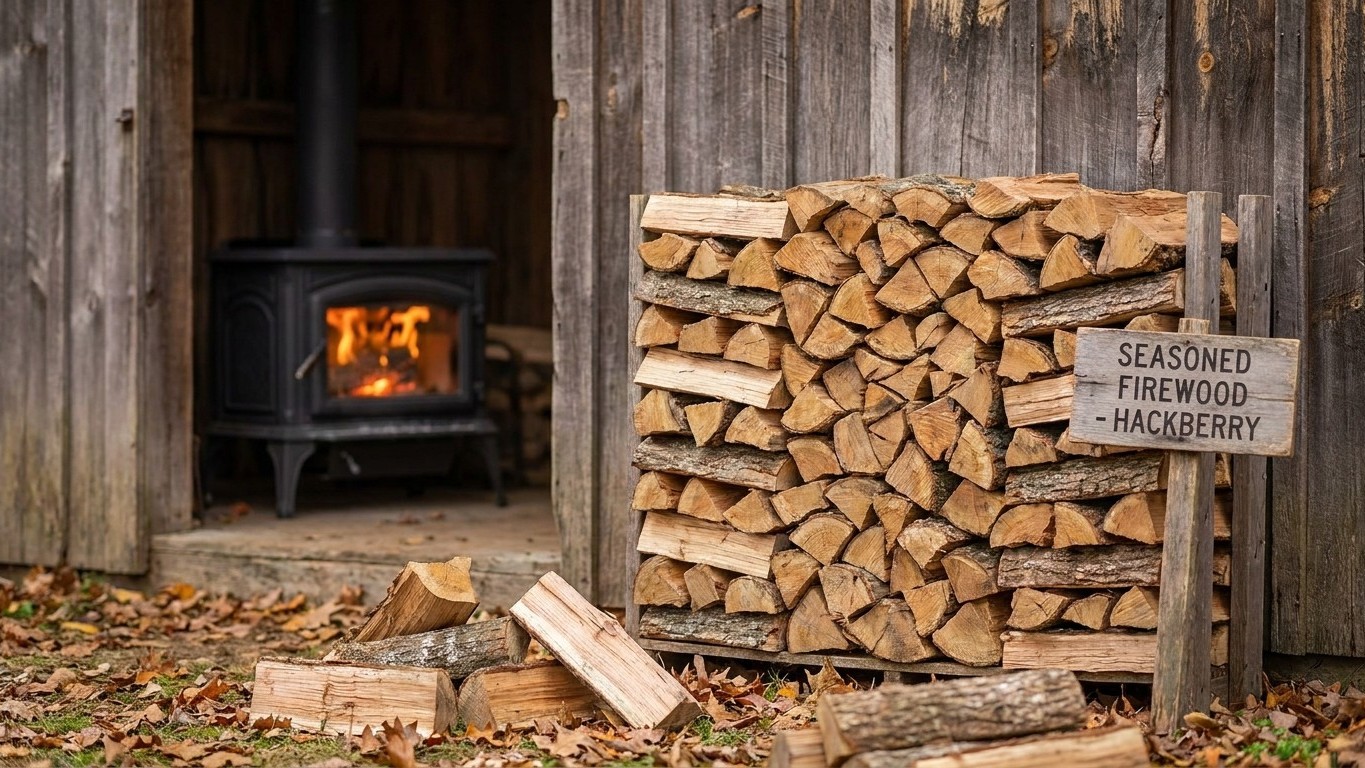

Hackberry burns hot enough to heat a home through a Midwest winter, splits easier than most hardwoods once it’s dry, and produces a clean, low-spark fire that’s safe for open hearths. It’s not the heavyweight champion like oak or hickory, but it lands solidly in the middle of the pack, which makes it one of the more underrated firewood options growing in backyards from Nebraska to Georgia.
Heat Output: How Hackberry Stacks Up

According to SDSU Extension, a full cord of seasoned hackberry produces somewhere around 20 to 21 million BTUs. That puts it in the same neighborhood as red maple, black cherry, and American elm, roughly 15 to 20 percent less heat than white oak or shagbark hickory, but noticeably better than softwoods like pine or spruce.
For a typical wood stove insert, that translates to a fire that holds a bed of coals for several hours without demanding constant reloading. Hackberry won’t scorch you out of the living room the way hickory can, but it won’t leave you cold at 2 a.m. either. Think of it as a dependable middle-of-the-road choice: not the wood you brag about at the hardware store, but the wood that quietly gets the job done night after night.
Density is the reason for that middle-tier performance. Dry hackberry weighs in around 45 pounds per cubic foot, lighter than oak (about 47-55 lbs) but heavier than most pines. Less mass per log means less stored energy, but it also means the wood ignites faster and responds quicker when you open the damper for more heat.
Smoke and Sparks: What to Expect Burning Hackberry
Here’s where hackberry earns real points. Properly seasoned, it burns with minimal smoke and produces very few sparks, a combination that makes it one of the better choices for fire pits, open fireplaces, and anyone burning near dry grass or wood decking. Compare that to green pine or wet elm, which can pop and throw embers several feet, and hackberry starts to look like the responsible neighbor at the campfire.
The catch is moisture. Hackberry has a fairly high water content when freshly cut, and if you burn it before it’s properly dried, you’ll get the opposite experience: heavy white smoke, hissing logs, and a chimney that clogs with creosote faster than it should. The wood itself isn’t smoky by nature. Unseasoned hackberry is.
Ash production is another small win. Hackberry leaves behind a moderate, manageable amount of ash, not the fine, dusty residue some hardwoods produce, and not the heavy clinker buildup you get from certain softwoods burned at high heat. Cleanup after a weekend of steady burning is quick, usually just a light shovel-out rather than a full ash-pan overhaul.
Splitting and Seasoning Hackberry
Hackberry has a reputation among firewood cutters for splitting easier than its density would suggest, especially once it’s had a few weeks to dry after cutting. Fresh-cut, green hackberry can be stringy and a little stubborn on a maul, with fibers that tear rather than snap clean. Give it time to lose some moisture, or run it through a hydraulic splitter, and the logs come apart with far less effort.
Seasoning time runs 6 to 12 months under normal conditions, faster than dense hardwoods like oak, which can take a full 18 to 24 months to drop below the 20 percent moisture threshold most stoves want. Splitting hackberry into smaller pieces (roughly 4 to 6 inches across) speeds up drying considerably, since more surface area gets exposed to airflow.
Stack it off the ground on pallets or rails, top-covered but with open sides so wind can pass through the rows. A moisture meter is worth the twelve dollars it costs at any hardware store. Hackberry that reads above 20 percent will smoke and hiss no matter how good the species’ reputation is. Below that mark, it burns clean and predictable.
Signs Your Hackberry Is Ready to Burn
- Cut ends show visible cracks radiating from the center
- Bark starts to loosen or peel away easily
- Logs sound hollow and sharp when knocked together, rather than a dull thud
- Weight has noticeably dropped compared to when it was freshly split
Identifying Hackberry Before You Cut
Hackberry (Celtis occidentalis) grows across a huge swath of the United States, from the Great Plains through the Midwest and down into the Southeast, which means plenty of homeowners have one in the yard without realizing it. The tree is easiest to spot by its bark: warty, corky ridges that look almost diseased, covering a trunk that otherwise resembles elm or ash. Leaves are asymmetrical at the base, serrated along the edges, and turn a dull yellow in fall rather than putting on a bright show.
One quirk worth knowing before you fire up the chainsaw: hackberry wood grain runs somewhat interlocked, similar to elm, which is part of why green rounds resist splitting by hand. It’s not nearly as stubborn as elm, but if you’ve fought with elm rounds before, you’ll recognize the family resemblance the first time your maul bounces instead of splits clean.
Hackberry also tends to develop “witches’ brooms,” dense clusters of twiggy growth caused by a mite and fungus combination, visible high in the canopy year-round. It’s a helpful identifying feature in winter when leaves are gone and bark alone isn’t quite enough to confirm the species.
Is Hackberry Worth Burning? Pros and Cons
For anyone with a hackberry tree coming down, whether from storm damage, disease, or simple yard clearing, the wood is absolutely worth stacking rather than hauling to the curb. It won’t replace oak or hickory as your primary heating wood if you have a choice, but as a supplemental or secondary species, it performs well above what its low profile in firewood conversations would suggest.
The advantages line up clearly: manageable splitting once dried, faster seasoning than premium hardwoods, low smoke and spark output, and heat production solidly in the “good, not great” tier. The downsides are modest but real, a shorter burn time per log compared to denser woods, and a genuine need for proper seasoning since green hackberry punishes impatience with smoke and poor combustion.
Mixed loads work particularly well here. Pairing hackberry with a denser wood like oak or hickory gives you fast, responsive heat from the hackberry up front and long-lasting coals from the hardwood to carry the fire overnight. It’s a combination plenty of rural households already use without necessarily knowing the science behind why it works so well.
One detail often missed: hackberry’s inner bark and small branches were historically used by some Native American communities as an emergency tinder source because they catch a spark even when slightly damp, a trait that carries over to the seasoned firewood today. If you’re building a fire in less-than-ideal conditions, a few slivers of hackberry kindling can get things going faster than most other hardwood scraps sitting in the woodshed.