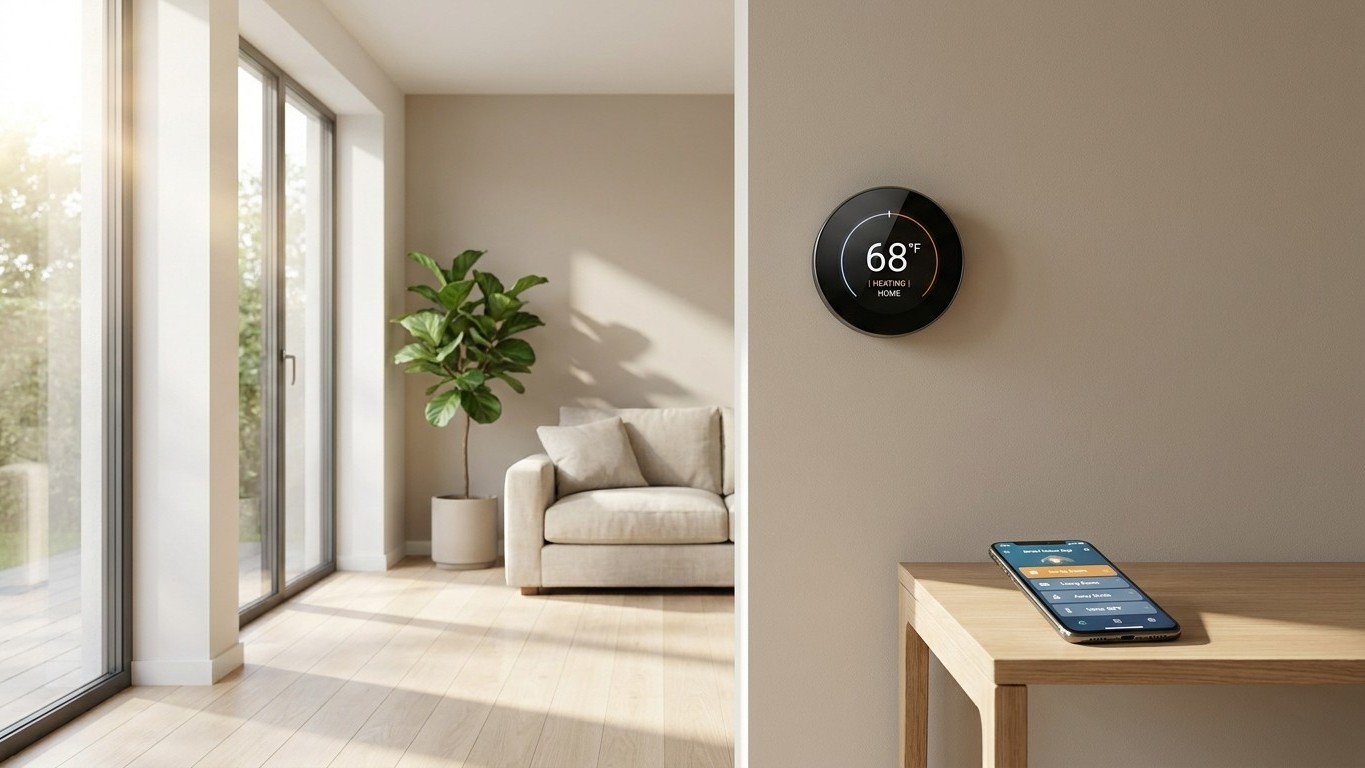

A programmable Thermostat runs the schedule you typed in, nothing more. A smart Thermostat also reacts to things you never told it: an empty house, a heat wave, a furnace that takes longer to catch up on a cold morning. Whether that reaction is worth paying for depends less on the device and more on how predictable your household actually is. For an irregular schedule, it usually pays off. For a disciplined one already running a tight program, the gain shrinks fast.
The actual difference
A schedule is a set of instructions written in advance: 68 at 7 a.m., back to 62 at 9, up again at 5 p.m. A programmable thermostat executes that plan with total loyalty and zero judgment. If you leave for the weekend and forget to change it, it keeps heating an empty house at full comfort settings until Monday. It has no way of knowing the house is empty, because nobody told it, and it can’t ask.
A smart thermostat adds a layer of decision-making on top of the schedule. Some models track whether a phone associated with the household is near the house and pull the temperature back automatically once everyone’s gone. Others use built-in sensors to notice a room has been unoccupied for hours and adjust. Some watch outdoor weather data and start the heating cycle earlier on a cold morning so the house hits target temperature exactly on time, instead of thirty minutes late. None of that requires you to reprogram anything. The device is making a call your original schedule couldn’t make, because your schedule was written days or weeks before the actual weather or the actual day happened.
The four broad families below cover most of what’s on the market, and the distinction that matters is what decides the temperature at any given moment.
| Type | What decides the temperature |
|---|---|
| Manual | Whoever last touched the dial, in real time, with no memory of past settings |
| Programmable | A fixed schedule entered once and repeated exactly, regardless of what actually happens that day |
| Connected (remote control) | Still your schedule, but you can override it from a phone; the logic itself doesn’t adapt on its own |
| Learning or sensing | The schedule plus live inputs: occupancy, room sensors, outdoor conditions, or how the household actually behaves week to week |
A connected thermostat sits in an odd middle spot worth naming separately. It lets you nudge the temperature from an app while you’re stuck in traffic, which is genuinely convenient, but the underlying decision still comes from a schedule a person wrote. It doesn’t notice patterns and it won’t correct a program you forgot to update. That’s the real dividing line: remote access is convenience, adaptive behavior is the feature that actually changes energy use.
What the ENERGY STAR label certifies
The U.S. ENERGY STAR program states it plainly: “Smart thermostats that earn the ENERGY STAR label have been independently certified, based on actual field data, to deliver energy savings.” That sentence is doing specific, limited work. It says certified products were tested against real household data, not lab simulations alone, and that the tested models did produce savings. It does not attach a number to that claim on the page where it appears, and it does not rank one certified model above another. If you’ve seen a savings percentage floating around online next to the ENERGY STAR name, it came from somewhere else, not from this certification statement.
That distinction matters because it’s easy to round “certified to save energy” into “will cut your bill by X percent,” and the certification simply doesn’t make that promise. What it does confirm is a baseline: a certified thermostat has passed an independent test, using actual homes rather than only bench conditions, and demonstrated it can reduce energy use compared to leaving a system on a static setting. That’s a meaningful floor, but it’s a floor, not a guaranteed outcome for every house, every climate zone, and every occupancy pattern.
To understand why even a modest, unquantified improvement is worth chasing, look at the size of the target. ENERGY STAR notes: “For the average American household, almost half of the annual energy bill goes to heating and cooling – that’s more than $900 a year.” Heating and cooling isn’t a small line item tucked in with everything else. It’s close to half the total bill for a typical household, which means any device that reliably improves how a system runs is working on the largest single piece of home energy spending, not a rounding error. Whether a specific household captures a meaningful slice of that $900 depends entirely on how the house is used, which is the subject of the next section.
Who gains from one, and who does not
This is the section that actually decides whether the purchase makes sense, and the honest answer is that it doesn’t make sense for every household. The benefit of adaptive behavior is proportional to how much your real schedule deviates from a fixed one. If your household is unpredictable, the gap between “what a static program assumes” and “what’s actually happening” is large, and that gap is exactly what a smart thermostat closes. If your household is steady and already well-managed, the gap is small, and so is the payoff.
| Household situation | Expected benefit |
|---|---|
| House empty on an irregular schedule (shift work, frequent travel, kids in and out) | Highest: a fixed program can’t track irregular absences, so adaptive setbacks catch waste a schedule misses |
| House occupied nearly all day, most days | Lowest: there’s little idle time to trim, since the system needs to condition the space most hours anyway |
| Household already running a disciplined manual or programmed setback | Already captured: if someone consistently pulls the temperature back before leaving and restores it before returning, the automation is mostly replicating a habit that already exists |
| Multiple occupants with conflicting comfort preferences | Moderate: sensor-based models that track which rooms are used can reduce arguments over the single house thermostat, though this is a comfort gain more than a guaranteed dollar one |
| Renters or short-term occupants | Low to moderate: benefit depends on whether the unit stays with the property or has to be reinstalled elsewhere, and on landlord permissions for wiring changes |
The clearest way to self-assess: think about the last time the house sat empty for six or more hours during a heating or cooling season. Did the system keep running on the normal schedule anyway? If that happens often, a smart thermostat has real work to do in your home. If it almost never happens, because someone is nearly always around to notice and adjust manually, you’re not the household this device was built to help most, and a well-set programmable model may already be doing the job for less money and less setup.
The three checks before you buy
Before deciding, three practical questions settle whether a smart thermostat will even work in the house, independent of whether it’s worth the money.
- Check the wiring behind the current thermostat, specifically the common wire. Many older heating and cooling setups were wired without one, because older analog thermostats didn’t need it, but most smart models require a steady power source that only a common wire reliably provides. Before opening the wall plate, cut power to the system at the breaker or furnace switch, and photograph the existing wire terminals so you have a reference if anything needs to go back exactly as it was. The full mechanics of that wire and what to do if it’s missing are covered in a dedicated guide.
- Confirm exactly what system the thermostat will be controlling. A heat pump with auxiliary or emergency heat strips needs a thermostat built to understand that staging, so it doesn’t trigger the expensive backup heat unnecessarily every time the temperature is nudged up a couple of degrees. A thermostat designed only for a standard gas furnace or a single-stage AC unit may not manage that staging logic correctly, which can quietly inflate the electric bill instead of lowering it.
- Count the zones. A house with more than one heating or cooling zone, controlled by separate thermostats for different floors or wings, needs a model or a set of models built to coordinate zoned systems. Installing a single-zone smart thermostat as a straight swap in a multi-zone house can leave the other zones running on their old logic while only one part of the house gets the benefit.
None of these three checks cost anything beyond a few minutes with a flashlight and the existing wall plate off. Getting them wrong is what turns a smart thermostat from a genuine upgrade into a return trip to the store, or worse, a system that runs auxiliary heat far more than it should.
Common questions
Does a smart thermostat work with an older furnace?
Often yes, but compatibility depends on the wiring behind the existing thermostat, not the age of the furnace itself. The common wire check above is the first thing to confirm.
Will a smart thermostat definitely lower my bill?
The ENERGY STAR certification confirms that certified models are tested to deliver savings based on real field data, but it does not publish a guaranteed percentage, and the actual result depends on how the house was being run before the switch.
Is a smart thermostat the same as a Wi-Fi or connected thermostat?
Not necessarily. A connected thermostat mainly adds remote access to a schedule a person still writes. A smart or sensing thermostat adds automatic adjustments based on occupancy, sensors, or weather, on top of that remote access.
How much of a temperature setback actually saves energy?
The U.S. Department of Energy states you can save as much as 10% a year on heating and cooling by Turning the Thermostat back 7-10 F for 8 hours a day from its normal setting. That figure applies to heating and cooling combined over a year, not to each degree individually.