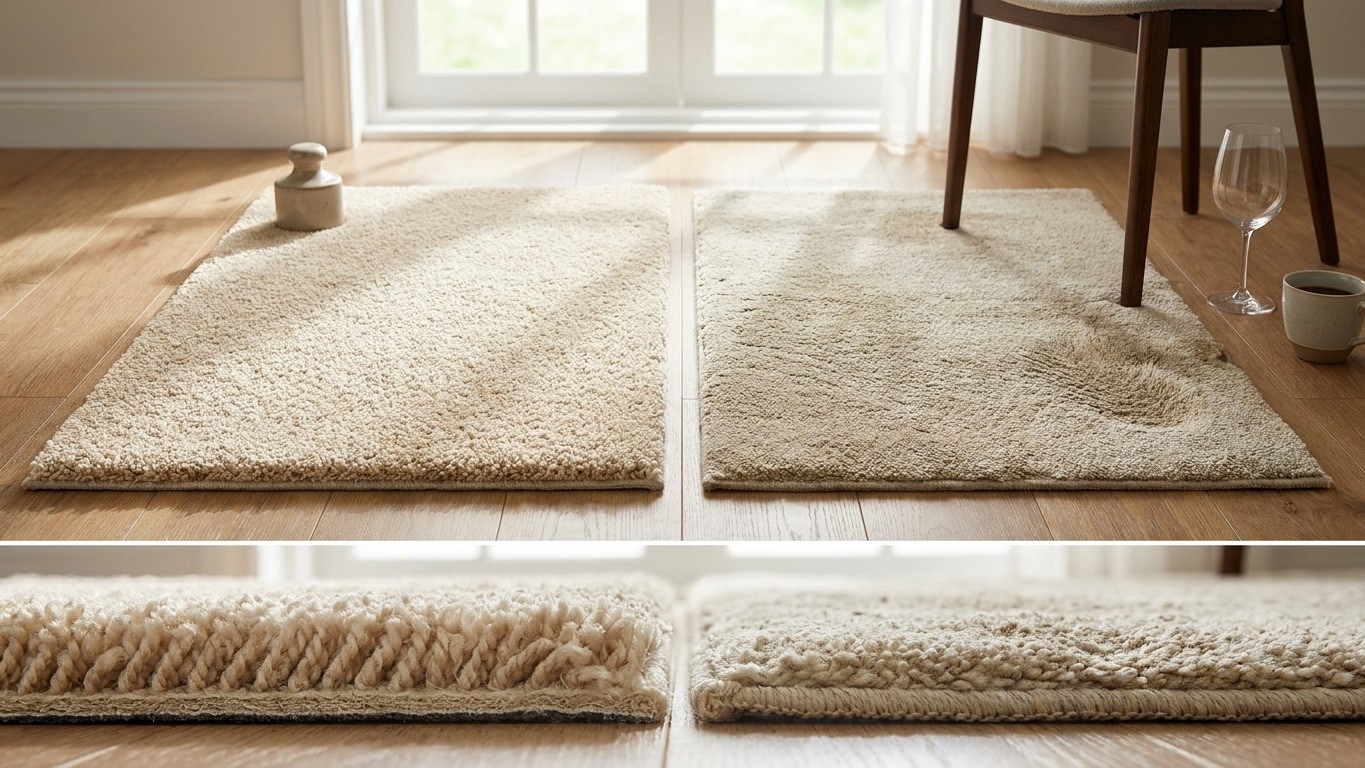

A carpet that looks pristine in the living room can be flat and shiny by the front hall in under two years, while an identical roll two doors down still looks fresh after five. The difference almost never comes down to how it was cleaned. It comes down to what the carpet is made of, how it was built, and what’s happening underneath it that nobody thought to check.
What is actually happening
Two carpets that feel the same in the shop can behave completely differently after two winters, and the reason splits into two separate questions that most shoppers never separate. The first is about the fiber itself: what it’s made of determines how well it holds color, how it reacts to spills, and whether it bounces back after something heavy sits on it. The second is about construction, meaning how that fiber is twisted, tufted, and packed into the backing. That’s what determines whether the carpet crushes flat in traffic lanes.
Fiber chemistry governs two things a homeowner notices right away. One is stain behavior. Some fibers resist water-based stains because they don’t absorb liquid easily, so a spill sits on the surface long enough to blot up. Others are more porous and grab onto dyes from wine, coffee, or pet accidents almost on contact. The second is resilience, which is the fiber’s ability to spring back after being crushed. A fiber with good memory pops back up after a chair leg or a suitcase compresses it. A fiber with poor memory stays dented, and that dent becomes permanent once enough fibers in that spot have given up.
Construction is a separate variable, and it’s where matting comes from. Matting is what happens when individual fibers untwist and tangle together under repeated foot traffic, turning a defined pile into a flat, fuzzy surface that catches light differently than the rest of the room. Dense, tightly twisted pile resists this because there’s less room for fibers to shift and lean on each other. Looser, higher pile with less twist looks plush on day one but has more surface area exposed to friction, so it mats faster in the exact spots where people actually walk: the path from the couch to the hallway, the pivot point at the top of the stairs, the three feet in front of a favorite recliner.
This is why a hallway runner and a bedroom carpet from the same fiber family can age at completely different rates. The hallway gets concentrated, repetitive foot traffic in a narrow lane. The bedroom gets occasional, distributed traffic. Same material, same finish, wildly different wear pattern. When a flooring contractor or a moisture testing technician evaluates a subfloor before installation, they’re checking something else entirely: whether the slab or wood subfloor underneath has dried out enough to safely accept adhesive and padding, not how the carpet on top will wear over time. Those are two independent questions, and conflating them is how people end up blaming a carpet for a problem that started two layers down.
The covering, or what is under it
The carpet you see and the structure underneath it fail for completely different reasons, and mixing them up leads to fixes that don’t fix anything. A worn traffic lane calls for a different response than a soft spot near the wall, even though both show up as “something’s wrong with the floor.”
| What you notice | Likely layer | What’s actually happening |
|---|---|---|
| Flattened, shiny traffic lanes and stair edges | The covering | Pile fibers have untwisted and matted from repeated friction; this is fiber and construction behavior, not a subfloor issue |
| Fading or color shift near windows | The covering | UV exposure breaking down dye or fiber chemistry over time |
| Ripples or loose sections across a room | The covering | Stretching failure or pad shift during installation, usually unrelated to what’s beneath |
| Persistent musty smell that cleaning doesn’t remove | What’s under it | Moisture trapped in the pad, backing, or subfloor, often with biological growth |
| Soft, spongy feel underfoot in one localized spot | What’s under it | Subfloor material weakened by sustained moisture, sometimes extending to framing |
| Rust-colored stains that reappear after cleaning | Both | Wicking, where moisture below pulls dissolved residue up through the pad into visible fiber. Surface treatment won’t stop it because the source is beneath |
| Seams that peak, curl, or separate | The covering | Installation or adhesive issue at the seam itself, not a structural concern |
The wicking row is the one that trips people up most often, because the stain is visible on the surface and the instinct is to treat the surface. Cleaning it, even professionally, can lift the color for a week or two before it comes right back, because the water pulling that residue upward is still down there doing its job every time humidity shifts. A carpet that keeps producing the same stain in the same spot after repeated cleaning is telling you the problem isn’t the carpet at all.
The soft-spot row matters for a different reason: it’s the one case on this list where the flooring itself is essentially a bystander. Carpet doesn’t rot, and pad doesn’t rot in any structural sense either. If pressing down on a section of floor gives noticeably more than the surrounding area, the give is coming from wood that has absorbed moisture over time, not from anything happening at the fiber level. That distinction decides who you call next, and it’s covered in the next section.
What to check, in order
None of the following requires pulling up a room. Each check either narrows the problem or rules something out before anyone reaches for tools.
- Look at the wear pattern in daylight. Traffic lanes, stair noses, and the area in front of frequently used furniture will show matting first if the issue is fiber and construction. If the wear is even across the whole room instead of concentrated in traffic paths, that points toward something else, like sun exposure or a defect in the original material rather than everyday use.
- Press firmly across the floor with your palm or a bare foot, moving room by room. This rules in or out localized softness. A floor that feels consistent everywhere, even where it’s worn on the surface, suggests the subfloor is sound and the problem stops at the carpet. Any spot that gives more than the rest deserves attention before it’s ignored.
- Check accessible edges: closets, HVAC vent covers, and thresholds where carpet meets another flooring type. These spots often let you see the pad or the top of the subfloor without lifting a whole room. Discoloration on the pad or a visible tide line on the subfloor edge tells you moisture has been present at some point, even if it isn’t active now.
- Do a smell check at baseboards and low corners, especially in rooms below grade or near plumbing lines. A musty smell that persists after the room has aired out points toward moisture below the surface. No smell doesn’t guarantee a dry subfloor, but a strong, consistent one is a reliable early signal.
- Look for efflorescence, the white or grayish mineral residue that appears on masonry after water has moved through it and evaporated. If it’s visible on an exposed slab edge near a closet or utility opening, that’s a sign the slab has carried moisture before, which matters for anything installed directly on it.
- If the checks above raise a real question, a flooring contractor or moisture testing technician can test the subfloor or slab directly. This is the point where a small section of carpet typically needs to come up so the surface underneath is exposed. It’s the natural stopping point for a homeowner working through this alone: everything before it can be done by eye, hand, and nose. This step is where the room actually gets opened.
When this stops being a flooring job
Three things end this page and hand the problem to a different trade entirely. The first is anything structural: joists, beams, or support posts that have weakened, sagged, or shifted. A floor that feels bouncy across a wide area, not just soft in one spot, or one that visibly slopes, is a framing question, not a flooring question, and it calls for a structural engineer or a foundation specialist who can evaluate load-bearing members, not a flooring fitter.
The second is active water. If a leak is still running, whether from a supply line, a drain, or a roof penetration, no flooring decision matters until that source is shut off and repaired. A plumber handles supply and drain issues. A roofer handles anything coming from above, including flashing, valleys, and penetrations around vents or chimneys. Carpet and pad installed over an active leak will fail again regardless of how the subfloor was addressed, because the water hasn’t stopped, it’s just been covered.
The third is moisture that’s been sitting long enough to smell. That smell is usually biological growth, and at that point the job shifts from flooring to remediation. A flooring fitter can remove and replace carpet and pad. What they generally can’t do, and shouldn’t be asked to do, is address contamination in subfloor material or framing, or track down where water is entering the structure in the first place. That’s a separate scope, often involving a remediation specialist working alongside whichever trade fixed the source, whether that turns out to be a plumbing failure or a roofing failure.
The practical way to think about it: a flooring fitter deals with what’s visible and replaceable. A plumber or roofer deals with where the water came from. A structural engineer deals with whether the frame underneath can still be trusted. Getting the order right, source first, structure second, surface last, is what keeps a carpet replacement from becoming the second replacement instead of the only one.