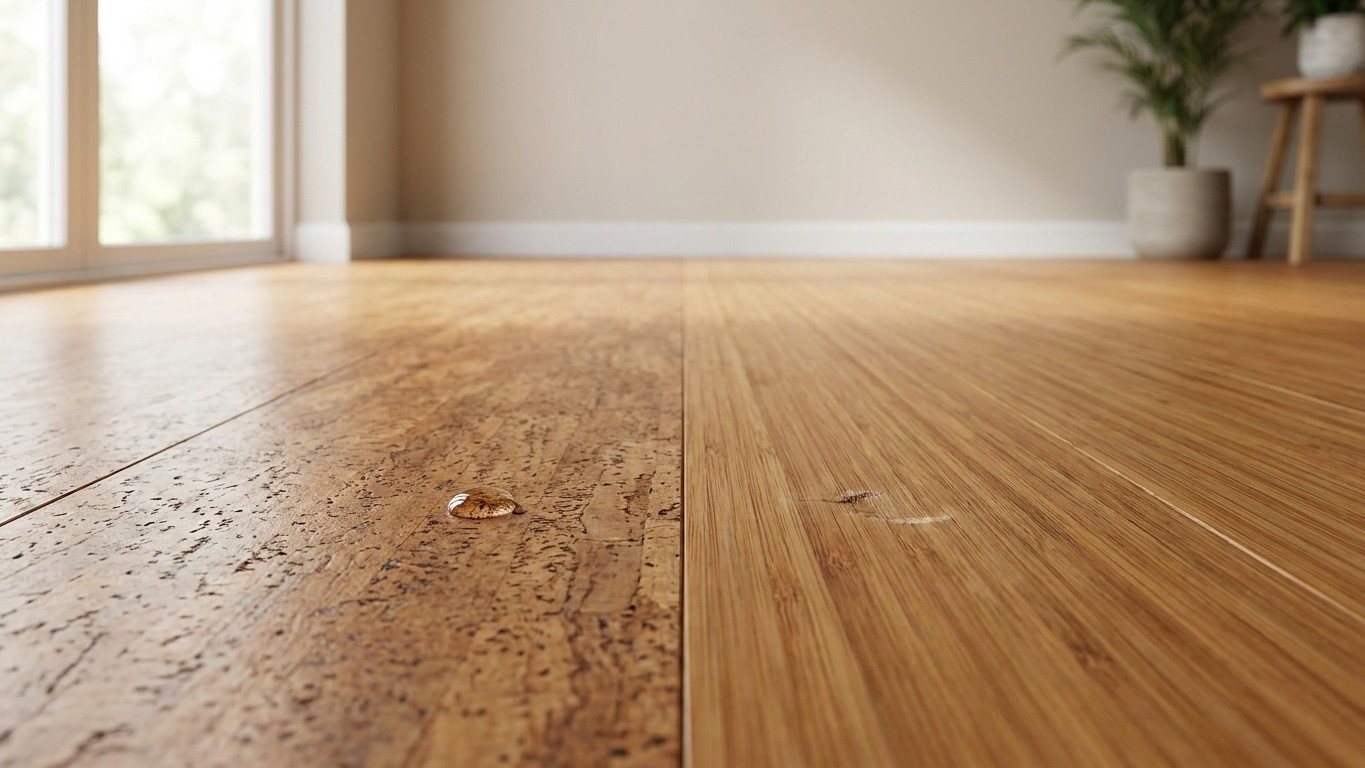

Both materials get sold on the same promise: eco-friendly, harder than oak, immune to the problems that plague traditional hardwood. Neither claim holds up cleanly. Cork and bamboo are genuinely different products with genuinely different failure points, and most of what goes wrong with them traces back to installers and buyers treating them like solid wood when they aren’t.
What is actually happening
The thing to understand here is that bamboo is a grass, not a tree, and cork is bark, not lumber. That single fact explains almost every misunderstanding that follows.
Bamboo flooring starts as stalks that get sliced, boiled or carbonized, then pressed and glued under heavy pressure into strands or fibers that are fused into a board. This is why bamboo flooring is closer, in manufacturing terms, to an engineered product than to a plank cut from a log. The strand-woven method compresses shredded fibers so tightly that the resulting board can test harder than oak on a standardized hardness scale. That hardness number gets marketed heavily, but it describes resistance to a steel ball pressed into the surface in a lab, not how the floor behaves when it absorbs moisture, expands, or gets dragged across by a kitchen chair for a decade.
Cork works on the opposite principle. It’s harvested from the bark of the cork oak without cutting down the tree, and its cellular structure is made of tiny, closed air pockets sealed by a waxy substance called suberin. That structure is why cork compresses under weight and springs back rather than denting permanently the way solid wood does. People assume cork is fragile because it feels soft underfoot compared to oak. In practice, that same softness is what lets it absorb impact, muffle sound, and resist the kind of surface cracking that shows up in harder materials when a subfloor shifts slightly.
Both materials are also far more sensitive to how they were manufactured than to what they’re made of. The resin content in a bamboo board, or the density of a cork sheet, matters more to how it will hold up than whether the package says “bamboo” or “cork” at all. This is also where a moisture test becomes relevant before either material goes down. That test exists to compare the moisture condition of the subfloor against the flooring material itself, so an installer can judge whether the two are close enough in equilibrium to be installed safely together. It isn’t a single number a homeowner reads off a screen and acts on alone. It’s a comparison, run before installation, meant to catch a mismatch that would otherwise show up months later as cupping or gapping.
The covering, or what is under it
Almost every complaint about cork or bamboo floors gets blamed on the material itself, when the real cause is either normal behavior of the covering or a condition happening underneath it. Separating those two things is the entire point of diagnosing a floor correctly. Sanding, refinishing, or replacing planks without figuring out which layer is actually responsible just guarantees the same problem returns.
| What you observe | What it usually means | Which layer it belongs to |
|---|---|---|
| Boards cupping upward at the edges across a whole room | Moisture imbalance between the top and bottom of the plank | Subfloor / moisture layer |
| Small gaps opening between boards in dry winter months | Normal seasonal shrinkage of the fiber | Covering layer, expected behavior |
| Dents or compression marks under furniture legs on cork | Cellular compression, not damage to the finish | Covering layer, cosmetic |
| Bamboo strands separating or delaminating at seams | Adhesive failure, sometimes accelerated by chronic dampness | Covering, unless moisture is the driver, then subfloor |
| Musty smell rising from a click-together floor | Trapped moisture or early mold growth beneath the surface | Subfloor layer |
| A soft, spongy feel when walking across a section | Deterioration of the subfloor panel or the framing beneath it | Subfloor or structural layer, not the flooring itself |
Cupping is the clearest example of why this distinction matters. A board cups when the underside is absorbing more moisture than the top, which pulls the edges upward. Sanding that board flat treats a symptom on the covering while the actual imbalance keeps sitting in the subfloor. Once the moisture source is addressed and the wood or bamboo equalizes, a board that was sanded while cupped will often reverse and cup the other way, or crown, because material was removed unevenly across a plank that hadn’t finished moving.
Gapping, on the other hand, is frequently just the covering doing what it’s supposed to do. Bamboo and cork both react to seasonal humidity swings, shrinking slightly in dry months and swelling back in humid ones. A homeowner who caulks or fills every seasonal gap is fighting a normal cycle rather than a defect.
The delamination case is the trickiest because it can start on either side. Adhesive that was applied poorly during manufacturing can fail on its own, but the same failure shows up faster and worse when a subfloor is feeding moisture into the glue line from below. That’s why any repeated pattern of separation, especially along one wall or in one corner of a room, deserves a look underneath before assuming it’s a manufacturing flaw.
What to check, in order
None of these checks require pulling up flooring. They’re ordered from the simplest observation to the point where the next step does involve opening something, and that boundary is worth stopping at until a professional is involved.
- Map where the problem shows up. Is it confined to one room, one wall, or does it follow an exterior wall, a bathroom, or a kitchen appliance line? A localized pattern points toward a specific source; a floor-wide pattern points toward general humidity or a subfloor installed before it was fully dry.
- Check the history of that spot. Ask whether there’s been a known spill, a slow appliance leak, a roof leak from a prior storm, or recent plumbing work nearby. This rules out or confirms whether the issue is a one-time event that’s already resolved versus something ongoing.
- Look at transitions and baseboards closely. Cupping severity, discoloration, or gaps that widen near a threshold or wall often reveal more than the open floor field, because edges react first to moisture changes.
- Walk the exterior of the house along that same wall. Check grading, downspout discharge points, and whether soil or mulch is piled against the foundation. This step rules out surface water being pushed toward the house as the outside driver of an inside problem.
- Have a moisture comparison run across the affected area. This is the same kind of test used before installation, but applied here to compare the flooring and subfloor at the problem spot against an unaffected area of the same room. The value isn’t a number to memorize, it’s the differential between a healthy section and a suspect one, and it’s typically read by whoever is diagnosing the floor rather than interpreted casually.
- If there’s crawlspace or basement access beneath the affected area, look for visible staining, standing water, or damp insulation from below. This is the point where the investigation moves from surface-level checking into an area that usually needs a flashlight, a flooring professional, or both, and it’s a reasonable place to stop before going further alone.
When this stops being a flooring job
Three situations move a problem out of flooring territory entirely. The first is anything structural: sagging that traces back to a joist, a beam, or a support post rather than the floor covering itself. The second is active water, meaning a leak that’s currently happening rather than a past event that’s already dried out. The third is any subfloor or framing that’s been wet long enough to develop a smell, because that points to material breakdown or mold that flooring replacement alone won’t fix.
Each of these calls for a different trade, and knowing which one to call saves time. A flooring installer can assess whether a cork or bamboo floor’s covering is the source of a problem and whether it can be relaid once conditions are corrected, but installers aren’t equipped to diagnose why a joist is sagging or where a hidden leak originates. A structural engineer evaluates framing, load paths, and whether a sagging area is a cosmetic dip or an early sign of a failing support. A plumber traces active water back to its source, whether that’s a supply line, a drain, or a fixture, and confirms the leak has actually stopped before any flooring work makes sense.
Persistent moisture reaching a floor from above or behind the wall usually isn’t a flooring problem at its root at all. A leak working its way down from a bathroom, a roof, or a poorly flashed window will keep resurfacing under a floor no matter how many times the covering gets replaced, which is why tracing water back to a roofing or plumbing source matters more than treating the floor repeatedly. Anyone dealing with a floor that keeps reacting the same way in the same spot is better served checking the systems above and behind that wall before touching the flooring again.
The floor itself, cork or bamboo, is rarely the actual malfunction. It’s usually the most visible part of a system that includes a subfloor, a moisture source, and sometimes framing, and reading it correctly means figuring out which of those three is actually talking before deciding what to fix.