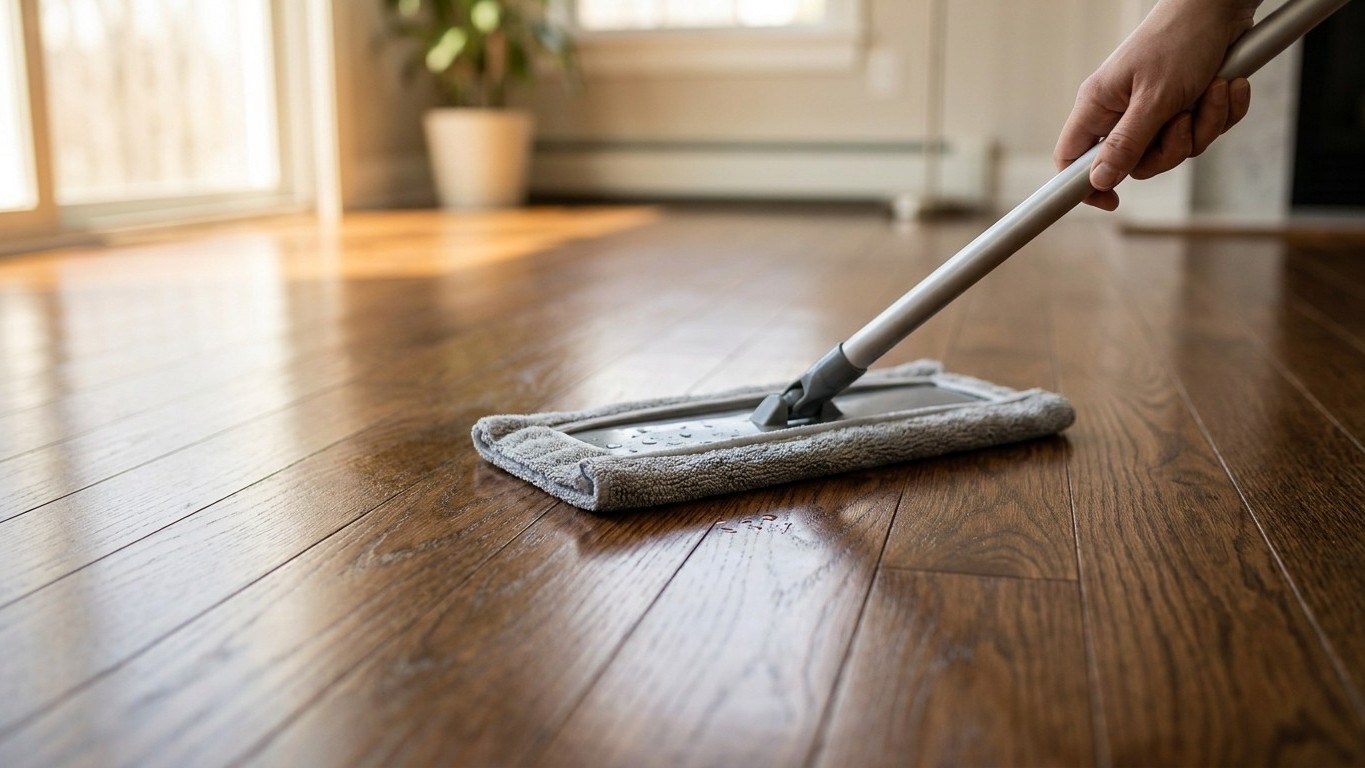

The safest way to clean a wood floor is with the least water possible: a barely damp microfiber mop, a cleaner made for the finish already on the floor (polyurethane, wax, or oil), and quick attention to spills. Skip steam mops, ammonia-based cleaners, and oil soaps that leave a film. Wipe with the grain, never let water sit, and let the floor dry within minutes.
What is actually happening

The thing to understand here is that a wood floor is sealed on top and open at every seam. The finish, whatever it is, forms a barrier across the face of each board. But between boards, at the edges of the room, and around any fixture that pierces the floor, there is no barrier at all. Water doesn’t damage the wood by sitting on the finish. It damages the wood by finding one of those gaps and moving sideways and down, into material that was never meant to get wet.
That’s why a floor can look fine right after you mop it and show a problem three days later. The surface dried. The seam didn’t. Wood pulls moisture in through capillary action the same way a paper towel pulls up a spill, and once water is inside a seam it travels along the grain far faster than it travels across it. A puddle left for twenty minutes at a doorway can end up wicking a foot or more under adjacent boards before anyone notices anything wrong.
The visible result is usually cupping: the edges of a board sit slightly higher than its center because the underside, closer to the moisture source, swells faster than the top. Persistent cupping, especially in a line that follows a wall or a plumbing run, is the wood telling you where the water got in, not necessarily where it’s pooling now. That’s a different problem than a dull or sticky finish, which lives entirely on the surface and has nothing to do with moisture underneath.
This is also where a moisture meter comes in, and it’s worth being precise about what the tool actually does. A flooring inspector or contractor uses one to compare readings across a room, checking a suspect area against a dry control area elsewhere in the same house. The value isn’t in a single number, it’s in the difference between the two spots. A meter reading on its own, without that comparison, tells you almost nothing, which is why this isn’t something to chase with a hardware-store version and a guess at what’s normal. The comparison is the test. The number by itself is not.
The covering, or what is under it
Routine cleaning problems and moisture problems get confused constantly, because both can leave a floor looking off. Separating them starts with asking whether what you’re seeing is a change on the finish, or a change in the shape of the boards themselves. One is a covering issue. The other is a wood-and-subfloor issue, and no amount of cleaning technique fixes it.
| What you observe | What it usually means | Which layer it belongs to |
|---|---|---|
| Dull, hazy finish after mopping | Cleaner residue building up on top of the sealant | Covering only |
| Floor feels sticky or tacky | An oil soap or wax-based cleaner left a film | Covering only |
| Fine grit under bare feet | Dry debris wasn’t swept or vacuumed before wet mopping | Covering only |
| Edges of boards raised, center lower | Water reached the underside of the board and swelled it | Wood core and possibly subfloor |
| Dark lines between specific boards | Moisture sitting at the seam, sometimes reaching the subfloor | Border case, worth checking further |
The products that quietly cause the first three rows are more common than people expect. Oil-based soaps marketed for wood floors often leave a residue that builds with every pass, dulling the finish over months rather than damaging it in one cleaning. Vinegar-and-water mixes, a popular homemade fix, are mildly acidic and will etch some finishes over repeated use, leaving a hazy look that gets mistaken for wear. Steam mops are the biggest single risk in the covering category, not because steam is uniquely damaging to a sealed surface, but because the heat and moisture together are far more likely to find their way into a seam than a damp cloth ever would.
A once-a-week dry pass with a vacuum or dust mop, followed by an occasional damp (not wet) cleaning with a product matched to the specific finish, handles nearly everything in the covering category. None of that routine has any bearing on cupping, dark seam lines, or boards that feel soft underfoot. Those symptoms point down, past the finish, into the wood itself and whatever is beneath it, which is a separate question the next section walks through.
What to check, in order
Start with the checks that need nothing more than your eyes and hands. Each one either rules a cause in or rules it out before you move to anything more involved.
- Map the location. Is the affected area isolated to one spot, like a doorway, a window wall, or a stretch near a kitchen or bathroom plumbing run? A problem confined to one location rules out cleaning technique as the sole cause, since a mopping habit would show up across the whole floor, not in one line.
- Run a hand across the finish. Grit, tackiness, or a hazy film under your palm points to product buildup or insufficient dry cleaning beforehand. This rules in a covering fix and rules out anything structural, at least for that particular symptom.
- Check whether the sheen change matches a recent product switch. If the dullness or stickiness started after trying a new cleaner, that’s close to confirmation on its own. This step rules out coincidence and points straight at the covering.
- Press gently on any cupped boards once the area has had a few dry days. Boards that flatten back out as they dry were reacting to a temporary spill or humidity swing. Boards that stay cupped after drying time have taken on moisture at the core, which rules out a simple surface explanation and rules in something happening underneath.
- Bring in a flooring professional with a moisture meter for a comparison reading. This is the point where the check moves from what a homeowner can do with a cloth and a flashlight to what requires equipment and training to interpret. It’s also, for this page, where the checklist stops. Confirming what’s happening below the boards, and deciding whether anything needs to come up, is a separate step handled by someone qualified to open the floor if that turns out to be necessary.
Notice that none of the first four checks require lifting a single board. That’s deliberate. Most cleaning-related complaints resolve at step two or three, once the product or the habit is identified. The cases that make it to step five are the minority, and they’re also the ones where guessing further on your own risks doing more damage than the original problem.
When this stops being a flooring job
Three things end this page and hand the problem to someone else. The first is anything structural: joists, beams, or support posts that have shifted, sagged, or softened. A flooring fitter can replace boards and refinish a surface, but joists and beams are the territory of a structural engineer, and no amount of careful cleaning or careful sanding touches that problem.
The second is active water. If a leak is still running, whether from a supply line, a drain, or a roof, cleaning the floor is treating a symptom while the cause keeps working underneath. That call goes to a plumber for anything involving pipes or fixtures, and the source often traces back further than the floor itself. If the water is coming from above or from an exterior wall rather than a pipe, the more useful next stop is a guide on roof leaks and how they travel through a structure before ever reaching a floor.
The third is smell. Wood that has been wet long enough to develop a musty or sour odor under the floor is describing a timeline, not a one-time spill. That smell usually means moisture has been present for days or weeks, long enough for mold or mildew to establish itself in the subfloor or framing, and that’s no longer a cleaning question at all. It’s a remediation and drying question, and it belongs to whoever handles moisture intrusion and repair, not to a floor-care routine.
A flooring fitter, a plumber, and a structural engineer solve three different problems, and mixing them up wastes time on the wrong fix. If the water is coming from inside the house’s plumbing, a home guide on tracking down plumbing leaks is the more useful next read. If it’s coming from outside, through the roof or an exterior wall, the roofing and water-intrusion guides on this site pick up exactly where this page’s boundary sits.