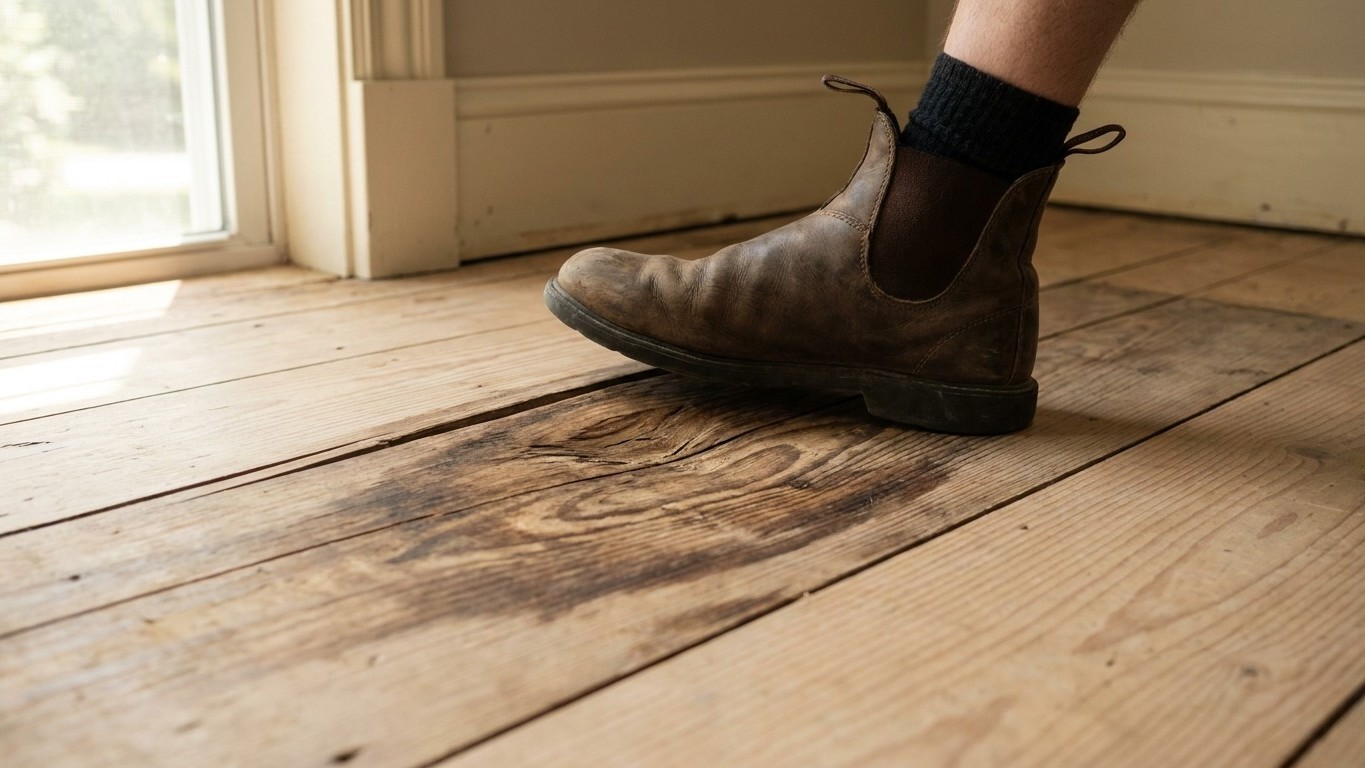

A soft spot in a floor means water got into the subfloor at some point and never fully dried out, softening the wood or particleboard until it flexes under your foot. The spot you feel is where the damage collected, not necessarily where the water first got in. That distinction changes Everything about how you find the source.
What is actually happening
Wood and wood-based panels get their strength from fiber that stays rigid when dry. Add sustained moisture and that fiber softens, swells, and eventually breaks down. This is rot, and it doesn’t need standing water to happen. A slow, repeated dampness, condensation under a fridge, a hairline crack in grout, a gap where a sink drain passes through the floor, can do the same job as an obvious flood, just more slowly.
The subfloor is usually plywood or oriented strand board (OSB) fastened to the joists below. It’s built to be stiff, spreading your weight evenly across a wide area. Once a section of that panel absorbs enough water and starts to break down, it loses that stiffness locally. The panel around it is still doing its job, so you get a small zone that flexes while everything next to it stays solid. That’s the mechanical reason a soft spot feels like a distinct, bounded thing rather than a general sagging.
Why the surface can lag behind
Flooring coverings, whether it’s vinyl, laminate, tile, or hardwood, sit on top of that subfloor and often have some cushioning or flexibility of their own. A thin vinyl sheet can tolerate a surprising amount of subfloor give before it shows any visible sign. Tile is stiffer and will usually crack or pop a grout line sooner, because the grout has almost no tolerance for movement. Hardwood sits somewhere in between: boards can cup or separate at the seams while the finish on top still looks intact.
That lag is why the first person to notice a soft spot is often stepping on it barefoot, not looking at it. The eye picks up color changes, staining, or a slight rise where flooring has lifted, but those signs frequently show up well after the flex is already there. By the time a soft spot is easy to feel, the subfloor has usually been compromised for a while, not days.
None of this tells you yet how bad the damage is or how far it has spread. It tells you what’s mechanically happening: water reached wood, the wood softened, and the panel above it stopped resisting your weight the way it should. Everything that follows, how to check it and when to call someone, builds on that one fact.
The covering, or what is under it
The single most useful habit when you find a soft spot is to ask which layer is actually talking. The flooring covering can look, and even feel, perfectly fine while the subfloor underneath has already failed. Sanding, refinishing, or replacing the visible surface without addressing that lower layer just resets the clock on the same problem.
| What you observe | Layer it points to | What it does NOT tell you |
|---|---|---|
| Floor flexes or gives when you press with your foot or hand | Subfloor (panel has softened) | Whether the source of water is still active |
| Boards or planks cupped, with edges higher than the center | Covering reacting to moisture, but often driven by subfloor dampness below | How deep the moisture has gone into the subfloor |
| Grout cracked or tile sounding hollow when tapped | Covering has debonded, usually because the subfloor moved or softened beneath it | Whether the joists themselves are affected |
| Vinyl or laminate bubbled, or seams separated | Covering only, can happen from surface moisture without subfloor rot | Whether there’s a deeper problem at all |
| Discoloration or a dark ring visible through a seam or transition strip | Subfloor, staining usually means the wood itself has absorbed water | How large the affected area is |
The pattern worth noticing is that a soft, spongy feel almost always means the subfloor, while a hollow sound or bubbling more often means the covering is reacting to something happening below it, without necessarily meaning that panel has lost structural integrity. Those aren’t the same repair. A flooring covering that has debonded from a sound subfloor is a smaller, more contained job than a subfloor panel that needs to be cut out and replaced.
This is also where people go wrong by working backward from the visible damage. Cupped boards get sanded flat, tile gets re-grouted, a bubbled vinyl seam gets glued back down, and the soft spot returns within a season because the water source and the softened panel underneath were never addressed. The covering is often just reporting on a condition set by the layer beneath it, so treating the report instead of the condition rarely holds.
If you’re trying to read a floor’s other signals before you even get to soft spots, the companion piece on reading what the surface is telling you walks through the broader set of visual clues, cupping, gapping, staining, that show up before a spot ever gets soft enough to feel.
What to check, in order
Work from the least invasive check to the most, and stop as soon as you have enough information to know whether this is contained or spreading. None of the following requires removing flooring or opening a wall.
- Walk the whole room, not just the spot. Press with your foot in a grid pattern around the soft area. This tells you the size of the affected zone. A soft spot the size of a dinner plate rules out a widespread subfloor failure; a soft area that keeps expanding as you press outward suggests the damage is larger than what you originally felt.
- Check directly below, if there’s a basement or crawlspace. Look at the underside of the subfloor and the joists for staining, sagging, or a musty smell. This is the single fastest way to see whether water is still reaching that area, because active drips or damp wood underneath will be visible even when the top of the floor looks fine.
- Trace the plumbing and fixtures nearby. Soft spots cluster near bathrooms, kitchens, laundry connections, and exterior walls below windows or doors. If the soft area lines up with a supply line, drain, or an exterior wall, that narrows down where to look for an active or past leak rather than treating the whole floor as suspect.
- Look for a pattern tied to weather. Note whether the spot feels worse after rain or humid stretches versus dry weeks. A spot that changes with the weather points to an ongoing source, while one that stays constant regardless of conditions is more likely old damage that has already stabilized.
- Bring in a moisture meter, or someone who has one. This tool doesn’t diagnose the cause, it tells you whether the wood in that area currently holds more water than the surrounding, unaffected wood. That comparison is what separates a stable, dried-out soft spot from one still being fed by an active source, and it’s usually the last check a homeowner can do before deciding whether to open the floor.
Once a check requires cutting into the subfloor, removing a section of flooring to inspect the panel directly, or accessing a joist bay from below by opening a ceiling, you’ve crossed from checking into repair. That’s a reasonable stopping point for a homeowner assessment, and it’s exactly the information a flooring contractor or inspector will want when you call them: where the spot is, how big it’s gotten, whether it tracks with weather, and what the moisture comparison showed.
When this stops being a flooring job
Three things move a soft spot out of flooring territory and into something else entirely. The first is anything structural: if the joists themselves are sagging, cracked, or visibly rotted rather than just the subfloor panel resting on them, that’s a load-bearing concern, not a surface repair. A structural engineer or a foundation specialist evaluates joists and beams. A flooring contractor does not, and shouldn’t be asked to.
The second is active water. A soft spot that’s still damp, still growing, or that reappears shortly after drying means something is currently supplying moisture, whether that’s a slow plumbing leak, a roof or flashing failure sending water down inside a wall, or grading outside that pushes water toward the foundation. That’s a plumbing call or a roofing call depending on where the water traces back to, and it needs to happen before any flooring work, because new flooring over an active leak just hides the problem again. The site’s guides on tracing plumbing leaks and roof and flashing water intrusion cover how to find the source when it’s coming from above or from behind a wall rather than from the floor itself.
The third is smell. Wood that’s been wet long enough to develop a persistent musty odor, or visible mold on the underside of the subfloor or on joists, has usually been damp for an extended stretch, long enough that the moisture has had time to work into surrounding material and possibly into insulation or wall cavities nearby. That’s a job for a remediation specialist first, someone equipped to assess and contain mold growth, before any carpenter or flooring installer touches the area.
A flooring contractor’s job, once these three things are ruled out, is straightforward: cut out the compromised section of subfloor, replace it with sound material fastened properly to the joists, and reinstall or replace the covering above it. That’s a contained, well-understood repair. What a homeowner can’t safely judge from the surface is whether the framing underneath is still doing its job, or whether the water that caused the soft spot in the first place has actually stopped.