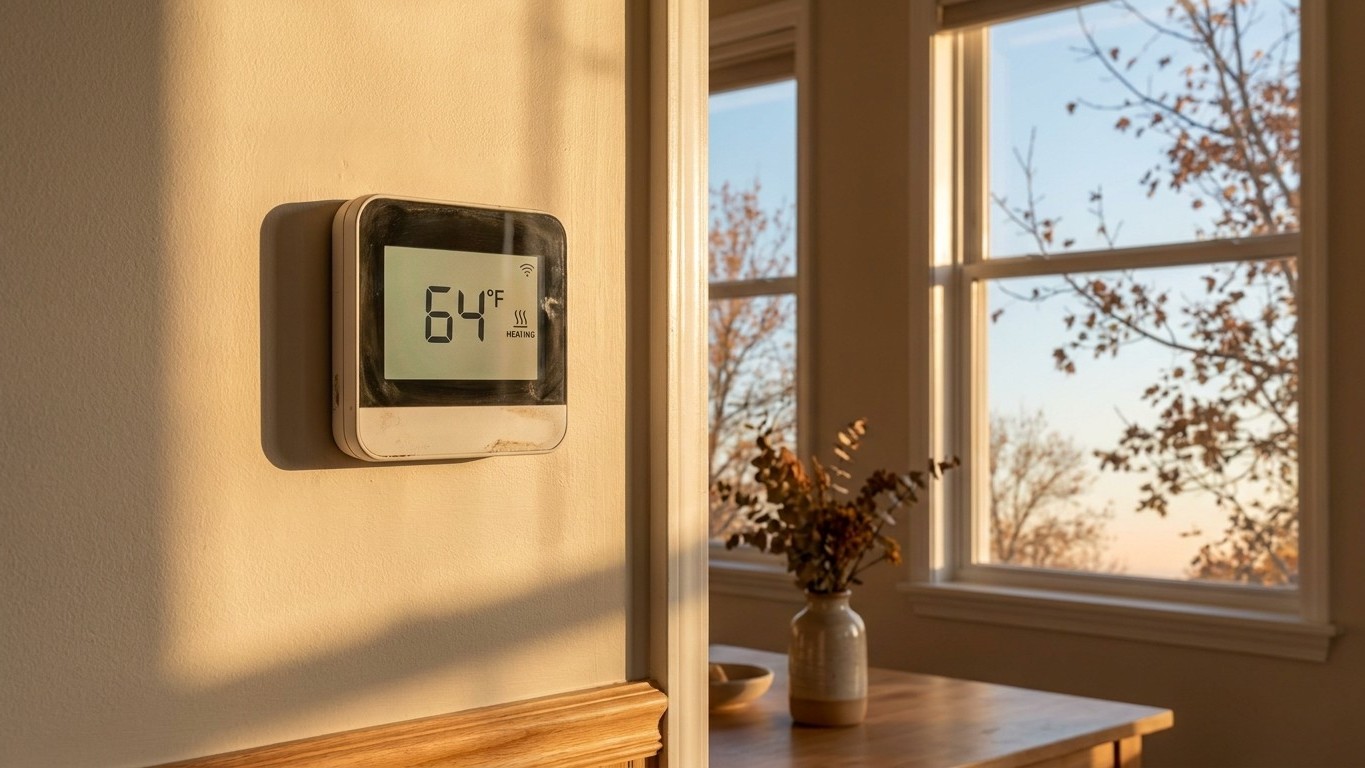

Florida’s heating season opens in November, when the average temperature at the Jacksonville reference station dips to 62.3°F, just below the 65°F line used to count heating degree days. Demand peaks in January, and the whole season runs about five months before the state warms back above that threshold in April.
When the heating season starts in Florida

That November start isn’t a date on a calendar. It’s the month where the 30-year average temperature crosses below the 65°F baseline the National Oceanic and Atmospheric Administration uses to calculate heating degree days. A heating degree day measures how far below 65°F a day’s mean temperature falls; add up every degree, every day, and you get a number that tracks fuel use far better than a simple “cold or not” guess. Because this is a 30-year average, the first genuinely cold night in any given year almost always arrives before the calendar tips into November. A stray cold front in late October is common; the monthly normal just doesn’t show it.
January is the coldest month on the 30-year normal, with 350 heating degree days, more than any other month on the books. The season itself stretches from November through April, about five months, though the demand inside that window is far from even. Here’s the monthly breakdown for the Jacksonville station, the reference point NOAA uses for this part of the state:
| Month | Heating degree days |
|---|---|
| January | 350 |
| February | 234 |
| March | 143 |
| April | 43 |
| May | 4 |
| October | 25 |
| November | 144 |
| December | 285 |
The table carries no month from June through September: heating has nothing to do in Florida’s mid-summer stretch, and NOAA’s monthly product reports no degree days there. That gap is the clearest picture of what a Florida winter actually looks like: a real season, but a short and lopsided one, front-loaded into December and January and mostly gone by spring.
One more caveat worth repeating: this is one station, Jacksonville, chosen as the state’s reference point. A cold snap in the Panhandle or the northern interior counties can run colder and longer than these numbers suggest, while South Florida rarely sees heating degree days worth mentioning at all.
How hard the winter works here
Add up every month on that table and the Jacksonville station lands at roughly 1,228 heating degree days a year, against roughly 2,803 cooling degree days. That imbalance tells you something plain: this is a state built to cool, where heating is a side job the house does for a few months and then forgets about.
Heating degree days work as a rough stand-in for fuel use. Twice the degree days means roughly twice the fuel burned to keep the same house at the same temperature, all else equal. A Florida homeowner running the numbers against a colder state isn’t just imagining a milder winter, they’re looking at a fraction of the heating load a northern furnace carries over a full season.
What the annual total can’t tell you is shape, and that’s exactly what the monthly table above is for. Two places can share the same yearly figure and still feel completely different: one stretches a mild chill across six or seven months, the other slams a short, sharp cold snap into six or eight weeks. Florida’s table shows the second pattern, a real peak in December and January bracketed by months that barely register. That shape matters more than the annual number when it comes to deciding how seriously to take the system that’s about to sit idle for half the year.
What most homes in Florida actually heat with
Federal survey data on Florida’s housing stock shows a state split fairly evenly between two main approaches, with electricity as the dominant fuel behind both of them.
| System or fuel | Share of homes |
|---|---|
| Furnace | 33% |
| Central heat pump | 31% |
| Steam or hot-water boiler | none reported |
| Natural gas | 5% |
| Electricity | 66% |
| Fuel oil or kerosene | none reported |
| Propane | not reported (estimate suppressed) |
Two of those rows need a plain-language flag. “None reported” doesn’t mean zero homes in Florida use boilers or fuel oil, it means the survey sample turned up too few to publish a reliable figure. “Not reported” for propane means an estimate existed but was judged too unreliable to release. Neither line means nobody in the state uses that equipment, only that the national survey can’t say how many.
Central heat pumps show up in nearly a third of Florida homes, which fits a state where the same equipment needs to cool a house for seven months and heat it for a much shorter, milder stretch. A heat pump does that job well, moving heat rather than generating it, which keeps operating costs down in a climate this mild. Where it struggles is the rare hard freeze, when outdoor temperatures drop low enough that the unit leans on backup resistance heat strips, a far less efficient mode that most owners never notice until their bill does. The one maintenance item that punishes neglect is the outdoor coil and the air filter, both of which need to stay clear for the system to pull heat efficiently instead of straining for it.
None of this is a recommendation. A system share reflects what got installed when a neighborhood was built and what fuel was cheapest at the time, not what’s actually best for a given house today. A furnace and a heat pump answer different questions, and the equipment already bolted to a particular home is the one worth understanding, not the one with the bigger slice of the pie chart.
Run it once before you need it
A heating system that hasn’t run since spring tends to reveal its problems on the first genuinely cold night, which in Florida usually means sometime in November or December, exactly when every HVAC technician in the region is already booked solid. The fix is to test the system weeks ahead, before the cold arrives, not during it.
- Set the thermostat to heat and let the system run a short cycle, five or ten minutes, listening for grinding, rattling, or a burning smell that doesn’t fade.
- Expect a faint burnt-dust odor on the very first firing. That’s normal, it’s just dust that settled on the heat exchanger or coil over the summer burning off, and it should clear within a few minutes.
- Check the filter and replace it if it’s visibly gray or clogged. A blocked filter chokes airflow and makes the whole system work harder for less heat.
- Clear the space around vents, registers, and, for heat pump households, the outdoor unit. Leaves, furniture, and storage boxes block airflow and can trip the system into shutting down.
- Test the carbon monoxide alarm using its test button and confirm the battery is fresh. Any fuel-burning heating equipment can produce carbon monoxide if it malfunctions, and a working alarm is the cheapest insurance against it.
- Look over any accessible ductwork for obvious gaps, disconnected joints, or crushed sections. The U.S. Department of Energy notes that “in a typical house, about 20%-30% of the air that moves through the duct system is lost due to leaks, holes, and poorly connected ducts,” which means a system running perfectly can still leave a room cold simply because the air never gets there.
- Call a licensed technician if the system won’t start, trips a breaker, makes a grinding or screeching noise, or blows air that never seems to warm up. Those are signs worth a professional look, not a DIY fix.
What turning it down is actually worth
The Department of Energy puts a specific number on thermostat setbacks: “You can save as much as 10% a year on heating and cooling by simply turning your thermostat back 7-10°F for 8 hours a day from its normal setting.” That figure covers heating and cooling together, over a full year, for that specific setback and that specific window of hours. It isn’t a per-degree rule and it isn’t a winter-only number, and stretching it into either shape misrepresents what the Department actually measured.
For a state where the heating season runs about five months and stays fairly mild even at its peak, that setback has fewer cold hours to work against than it would in a state where the furnace runs from October to April. The savings still apply, since the same 10% figure covers cooling too, and Florida’s air conditioner runs far longer than its furnace ever will. A thermostat schedule set for both seasons, not just the short winter stretch, is where that percentage actually shows up on a Florida utility bill.