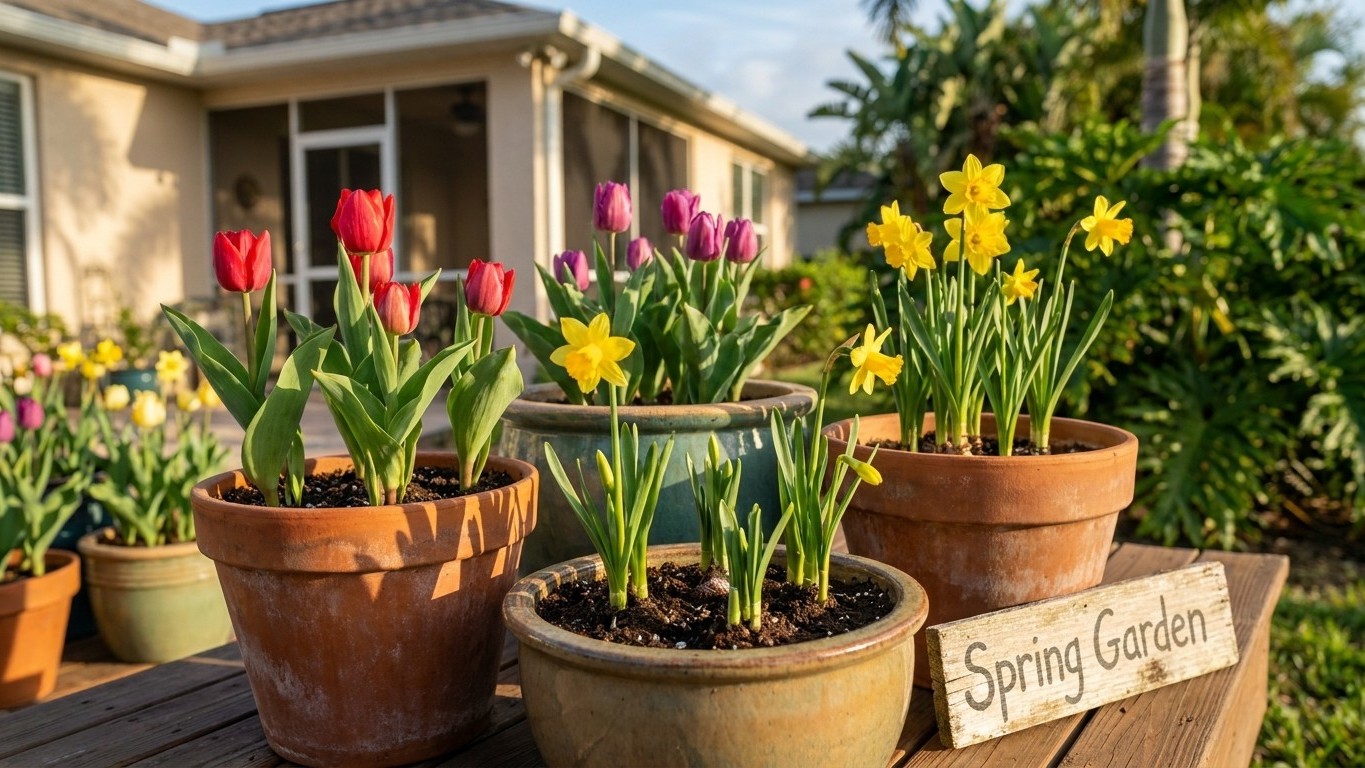

Spring bulbs like tulips and daffodils need weeks of real cold to bloom, and Florida winters rarely deliver enough of it. Forcing supplies that missing chill artificially, but Containers add a second wrinkle: a pot can freeze solid where the ground beneath it never would. Here’s how that plays out in this territory, and what actually works.
Why this matters in Florida

The mean daily minimum during the coldest month, measured at the Jacksonville reference station, sits at 42.9°F (NOAA NCEI Climate Normals, 1991-2020). That single number decides almost everything for spring bulbs here. Tulips, daffodils, and hyacinths need roughly twelve to fourteen consecutive weeks with temperatures staying below 45°F to complete the internal process that turns a dormant bulb into a flower stalk. A mean minimum of 42.9°F sounds close, but it’s an average, not a sustained stretch, and it includes plenty of warm days pulling the number up. In practice, the ground here almost never holds a long enough cold spell for these bulbs to bloom without help. That puts this territory squarely in forcing territory: the gardener has to manufacture the winter that the climate won’t provide.
Containers complicate the picture in a different way, and it depends on where in the state you are. The USDA Plant Hardiness Zone Map (2023, built on 1991-2020 normals) places this territory across a wide 8b-11b range, a scale based on the average annual extreme minimum temperature, not the coldest-month average used above. That’s a different variable measuring a different risk. In the northern part of the range, near the Jacksonville reference point in zone 8b, an occasional hard freeze can still drop overnight temperatures well below what the potted soil can buffer. A pot has no surrounding earth to insulate it, so a freeze that only chills the top few inches of a garden bed can chill a container clean through, roots included. Further south, into zones 10 and 11, that freeze risk mostly disappears, but so does any chance of natural chill for forcing.
So the honest summary is this: across most of the territory, the primary problem is a lack of cold, which is why forcing is the standard answer for spring bulbs here. But if you’re gardening in the northern edge of the range, near zone 8b, don’t ignore the second risk. A stretch of freezing nights can still damage a container that a garden bed would have shrugged off. The two problems call for different responses, and mixing them up (chilling a bulb that then sits outside during a hard freeze) is how gardeners lose plants they thought they’d protected.
How to do it here
Forcing in containers is a sequence, and skipping a step or doing it out of order is the most common way it fails. None of these steps require guesswork. Each one has a check you can perform yourself.
- Buy dormant, unsprouted bulbs. Firm bulbs with no green growth showing are the ones that still have their full chill requirement ahead of them.
- Set aside a chilling space that holds steady between 35°F and 45°F for twelve to fourteen weeks. A refrigerator crisper drawer works, but keep it away from ripening fruit; apples, bananas, and other ripening produce release ethylene gas, and ethylene kills the flower bud developing inside the bulb before it ever gets planted.
- An unheated garage is a workable alternative if it never drops below freezing and never climbs above roughly 50°F. Check it with a simple min-max thermometer for a few days before trusting bulbs to it; garages in this territory can swing more than gardeners expect on sunny afternoons.
- Choose a container that’s at least two USDA zones hardier than the bulb needs, or plan to move the pot during cold snaps. A terracotta pot left outside in zone 8b during a freeze offers almost no insulation; a thick-walled or double-potted container buys some margin, and mulching the surface and sides helps more.
- Pot the chilled bulbs in a container with real drainage holes and a fast-draining mix. Standing water in a pot does more damage here than cold ever will, since Florida’s humidity keeps soil wet longer than gardeners in drier climates expect.
- After the full chilling period, move the pot to a bright, cool spot, not straight into heat or direct sun. Gradual warming over a week or two lets the stem elongate normally before the flower opens.
Follow that order and the bulb does the rest. Reverse steps two and three, or shortcut the chilling time, and you’ll get foliage with no flower, which is covered further down.
Which bulbs are worth it
Not every spring bulb rewards the effort of forcing, and the difference usually comes down to two things: how long the chill requirement runs, and how tall and top-heavy the finished stem gets. A bulb with a short chill requirement finishes faster and with less to go wrong. A short, sturdy stem holds up in a container; a tall one tends to flop, especially once it’s indoors away from wind that would otherwise strengthen it outdoors.
Species that force reliably in containers here
- Paperwhite narcissus, which need no cold treatment at all and bloom directly from a container of water and pebbles or light soil.
- Hyacinths, with a relatively short chill window and a thick, self-supporting stem.
- Crocus, low-growing enough that toppling is rarely an issue even in a shallow pot.
- Muscari (grape hyacinth), another short-stem, short-chill option that handles container life well.
Species that sulk in containers here
- Tulips, which need the longest chill of the common spring bulbs and grow tall stems that lean or snap in a pot without staking.
- Trumpet daffodils, whose taller varieties can outgrow the stability of a container once in bloom.
- Alliums, top-heavy by design, with a flower head that’s often wider than the pot can balance.
One more point worth knowing: none of these bulbs are likely to rebloom reliably in Florida ground the following year regardless of how they’re grown, since the climate that failed to chill them naturally the first time will fail again. That means forcing costs nothing in the long run. A tulip bulb forced in a container and discarded after bloom was never a multi-year investment here to begin with.
What goes wrong, and when you can still fix it
Leaves but no flower
This means the chilling period ran short. The bulb had enough stored energy to push up foliage, but the flower structure inside never finished developing during the cold treatment. There’s no fix this season; the bud simply isn’t there to force open. Next time, track the chilling days rather than guessing, and don’t move the bulb out early because the leaves look ready.
A flower on a stem too short to see
This happens when the pot moved from cold storage into warmth and light too fast. The flower bud was ready, but the stem didn’t get the gradual warm-up it needed to elongate before opening. This one can’t be rescued once it’s happened; the stem has already set its final height. For the next batch, stretch the transition from cold to warm over a week or two instead of moving the pot straight from the refrigerator to a sunny windowsill.
Rot at the base of the bulb
Soft, discolored tissue at the base almost always traces back to standing water, either from a container with poor drainage holes or a potting mix that stays too wet in Florida’s humidity. Once rot has set in, the bulb is done for the season and shouldn’t be replanted. The pot and mix can be reused, but only after drying out completely and, ideally, switching to a coarser, faster-draining mix for the next round.