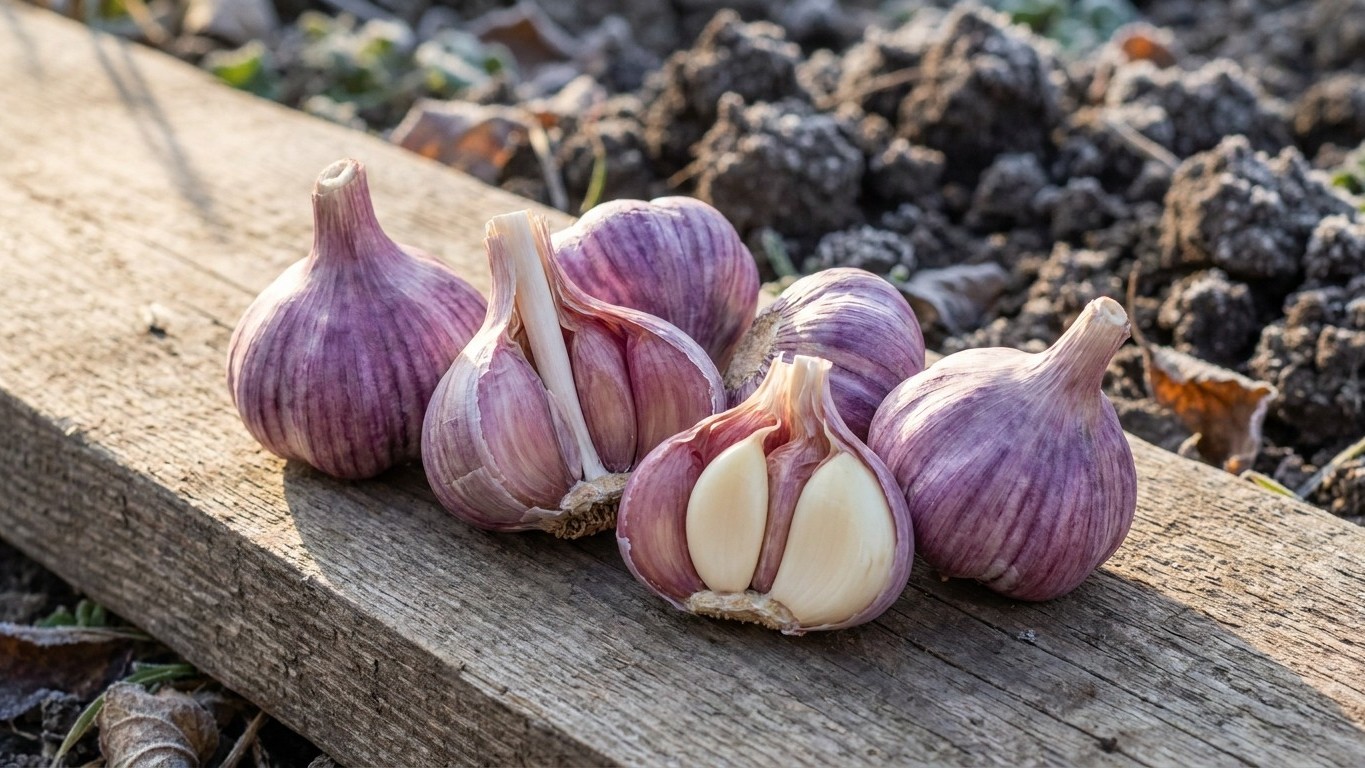

Garlic in north Florida comes out of the ground when the lower leaves turn yellow and brown, usually leaving four or five green leaves standing above ground. It’s planted in autumn and lifted the following summer, not the other way around. Curing then takes three to four weeks in a dry, airy, shaded spot before storage. In central and south Florida, the whole calendar flips.
When garlic is ready to lift in Florida
The signal to pull garlic has nothing to do with a date on a calendar and everything to do with what the leaves are doing. Once roughly half the foliage has died back and turned brown, and the remaining green leaves have gone a bit floppy, the bulb underneath has usually finished sizing up. Pull one test bulb, brush off the dirt, and check the cloves. If they’ve filled out and separated cleanly under their wrapper, the rest of the row is ready too.
For north Florida growers, this whole cycle starts with fall planting and ends with a summer harvest. Cloves go into the ground in autumn, spend the mild months growing a root system and leaves, then bulb up as day length shifts. That autumn planting window sits close to when the region’s first fall frost typically arrives. NOAA’s 1991-2020 Climate Normals for station USW00013889 put that date, on average, somewhere between November 26 and December 13. That’s a midpoint, not a guarantee. In roughly half of the thirty years behind that record, the first freeze landed later than the range suggests, and in three of those thirty falls, no freeze showed up at all. Garlic doesn’t need protection from that first frost the way a tomato does, but the timing matters for scheduling when cloves go in the ground relative to cooler weather setting in.
Central and south Florida run the opposite way
South and central Florida are functionally frost-free, and that changes everything about when garlic gets grown at all. There, the growing season for garlic runs through the cooler winter months, and summer heat becomes the limiting factor instead of any frost risk. A grower near Orlando or Miami planning around a north Florida frost date would be planning for a threat that essentially doesn’t exist locally, while missing the heat stress that actually shapes the calendar in those regions.
| Region | Planting window | Harvest window | Main scheduling factor |
|---|---|---|---|
| North Florida | Autumn, ahead of first frost | Following summer | First frost timing (per NOAA normals) |
| Central & South Florida | Winter growing season | Before summer heat builds | Summer heat, not frost |
Local Extension offices track these regional differences closely, and checking with the UF/IFAS Extension office for a specific county is the most reliable way to nail down timing for a particular spot on the map.
Curing it, and where to hang it here
Curing is the step that turns a freshly pulled bulb with wet, papery skin into something that will actually keep. The bulbs need to dry down slowly, out of direct sun, with air moving around them, for roughly three to four weeks. Skip this step, or rush it, and the wrapper stays soft, moisture stays trapped near the neck, and the bulb starts breaking down within weeks instead of lasting months.
Florida’s climate makes this trickier than it is in a drier state. Humidity here doesn’t drop off the way it does out West, and that means airflow matters more than usual. A garage with the door cracked, a covered carport, or a shaded porch with a fan running all work better than a closed shed where damp air just sits. Bundling garlic into tight bunches and hanging them from rafters looks appealing, but in a humid space, tight bundles trap moisture between bulbs and invite rot right where growers can’t see it happening. Spreading bulbs out in a single layer on screens, or hanging them loosely with real gaps between each plant, gives the air a path through.
Signs the cure is finished
The wrapper around each bulb should feel dry and papery, not soft or damp. The neck, where the leaves meet the bulb, should feel tight and stiff rather than rubbery. Roots should be dry and brittle. At that point, tops and roots can be trimmed, leaving about an inch of neck, and the bulbs are ready for whatever storage comes next.
Rain during the curing window is the other complication that shows up more in Florida than in drier garlic-growing regions. A sudden afternoon storm rolling through while bulbs are drying on an open table can undo weeks of progress in an afternoon. Curing under cover, rather than counting on open air and hoping the forecast holds, avoids that setback entirely. A screened porch, an open-sided pole barn, or a garage with good cross-ventilation all serve the purpose without exposing bulbs to a downpour.
Storing it through a Florida winter
Once garlic is cured, the goal shifts from drying it out to keeping conditions steady. Garlic stores best somewhere cool, dark, and dry, with some airflow, tucked into mesh bags, paper sacks, or open baskets rather than sealed plastic containers that trap condensation.
Florida winters complicate this because “cool and dry” isn’t the default indoor climate for most of the state. Central heating isn’t running as often as it would be further north, so indoor humidity tends to stay higher for longer stretches, and a pantry that would work fine in a drier climate can turn muggy here. A closet on an exterior wall, a spare room with a dehumidifier, or a climate-controlled space away from the kitchen’s steam and the bathroom’s humidity all tend to outperform a typical kitchen cupboard.
The refrigerator seems like an obvious fix, but it works against garlic rather than for it. Cold, moist refrigerator air can trigger sprouting, and once a clove starts putting out a green shoot, that bulb’s storage life is essentially over. Garlic wants cool, not cold, and dry air, not the humid environment most refrigerators maintain to keep produce from wilting.
How long it actually lasts
Properly cured garlic stored in the right conditions typically holds for several months, though exactly how long depends heavily on the variety and how consistent the storage environment stays. Bulbs kept somewhere that swings between humid and dry, or warm and cool, break down faster than bulbs kept in a stable spot. Checking stored garlic periodically and pulling out any bulb that’s gone soft keeps one bad bulb from affecting the rest of the batch, since rot can spread between bulbs stored in close contact.
For growers in central or south Florida working around a winter growing season instead of a summer one, the storage challenge shifts timing but not substance. Bulbs harvested before summer heat sets in still need the same cool, dry, dark conditions to make it through the hottest months of the year, which for that part of the state functions the way a Florida winter does for stored garlic further north.
What goes wrong here
Most garlic problems in Florida trace back to moisture, either too much of it during curing or too much of it during storage, and to a handful of pests that show up in the region’s warm, humid growing conditions.
On the pest side, the UF/IFAS Extension documents a specific set of insects and related pests for this territory, and garlic growers dealing with foliage damage or stunted plants are generally looking at one of these:
- Aphids
- Chilli thrips (Scirtothrips dorsalis)
- Root-knot nematodes
- Whiteflies
Root-knot nematodes deserve particular attention because they attack underground rather than on the leaves, which means the damage often isn’t obvious until a bulb comes out of the ground undersized or misshapen with no clear aboveground symptom pointing to the cause. Aphids and whiteflies, by contrast, show up on the leaves themselves and are easier to spot early, while chilli thrips tend to show up as distorted or scarred new growth.
Beyond pests, the other recurring failure point is simply humidity outpacing the drying process. Bulbs that go into storage even slightly underdried, or that get packed too tightly during curing, tend to soften and break down well before a bulb that was fully dry going in. That’s less a pest problem than a process problem, and it’s the one most within a grower’s control. Slowing down the cure, spacing bulbs out, and checking that necks are genuinely stiff before storage solves more storage failures in Florida than any pest treatment does.
Fire ants and Eastern lubber grasshoppers, both documented pests for this territory, are less specific to garlic itself but can disturb beds and damage nearby plantings, so growers dealing with either around a garlic patch are dealing with a documented regional pest rather than something unusual.
Common questions
Can garlic survive a light frost in north Florida while it’s still growing?
Garlic foliage tolerates cool weather well during its growing months, and the first fall frost typically arriving between November 26 and December 13, per NOAA’s Climate Normals, doesn’t threaten cloves that are planted and settling into the ground around that window.
Does garlic grown in south Florida need the same curing time as garlic from the north of the state?
The curing process itself, drying bulbs for roughly three to four weeks in a shaded, airy spot, works the same regardless of region. What changes between north and south Florida is when that harvest and cure happens relative to the growing season, not how the curing itself is done.
Is it safe to store garlic in a Florida garage year-round?
A garage can work well for curing, since airflow matters more than temperature at that stage. For longer-term storage afterward, a garage that gets hot during Florida summers can push temperatures too high for good keeping, so a cooler indoor spot tends to serve better once curing is finished.
Where can a Florida grower get planting dates specific to their county?
County-level Extension offices track local conditions than any statewide range can. The UF/IFAS Extension directory connects growers to their local office for planting and harvest guidance suited to their exact location.