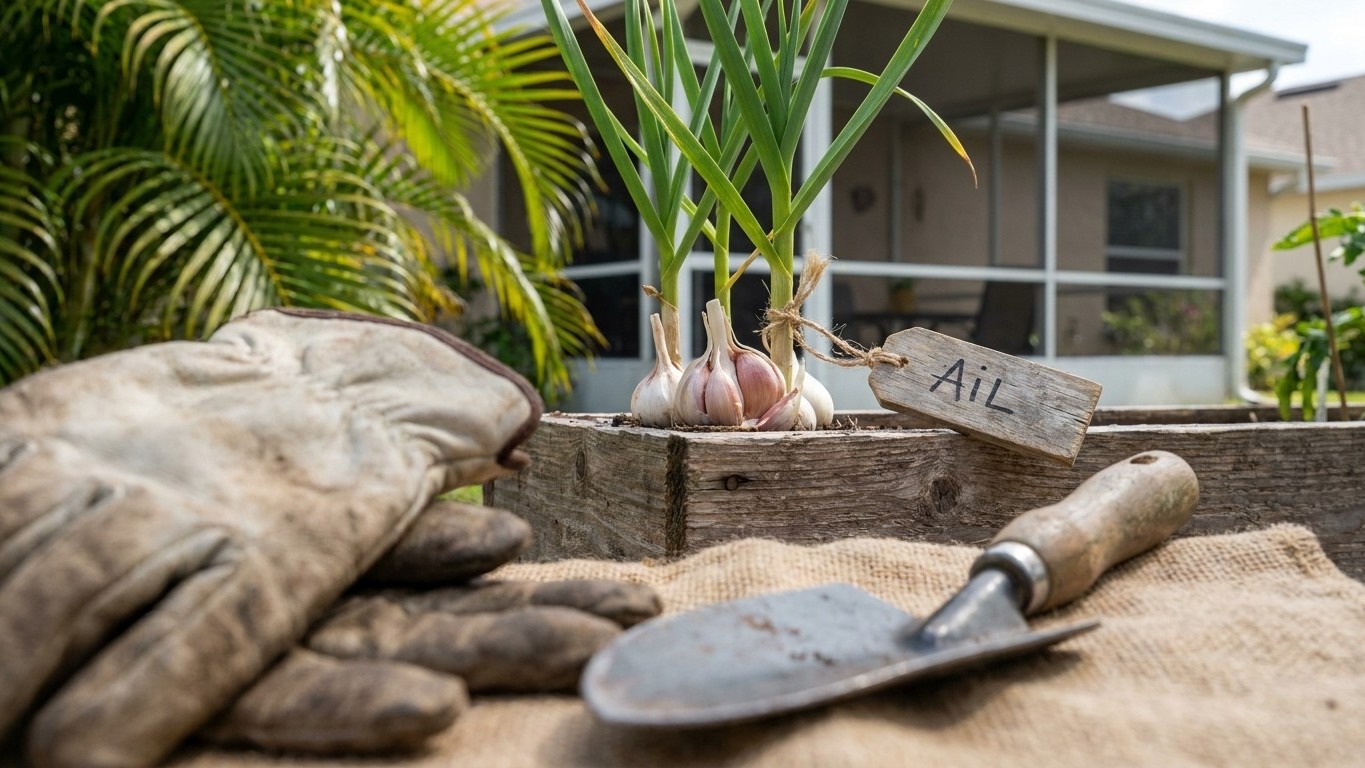

If you’re standing in a Jacksonville-area yard wondering when to get garlic into the ground, the answer is early to late November — before the cold arrives, not after it. That gives the cloves three to five weeks of root growth while the soil is still cooling instead of frozen solid, which is what they need to make it through winter. So walk your yard now, pick your bed, and plan to have cloves tucked in by the third week of the month rather than waiting for a cold morning to remind you.
The short answer for Florida

For gardens around Jacksonville, plant garlic cloves from early November to late November. That window comes from NOAA’s 1991-2020 climate normals for station USW00013889 at Jacksonville International Airport, which put the average first fall freeze between November 26 and December 13. Garlic set out in early to late November gets three to five weeks of root growth in soil that is cooling but not yet frozen, which is what the crop needs before winter slows it down.
That freeze date is a midpoint, not a guarantee. NOAA’s normals describe a 30 to 70 percent probability band across three decades of Jacksonville records, and three of the thirty falls in that record saw no freeze at all. In roughly half of all years, the first freeze at this station falls later than December 13, and in a smaller share it can arrive earlier than November 26. Planting on the early side of the window costs you nothing. Planting on the late side and hoping the freeze holds off is a bet you lose about half the time.
This window applies to north Florida, anchored on Jacksonville. It does not apply to the rest of the state. South and central Florida, from around Orlando down through Miami, are effectively frost-free, and the whole garlic calendar there runs the opposite direction: the growing season is winter, and the difficult stretch is the return of summer heat, not an autumn freeze. If you garden south of the panhandle and north Florida border country, the “count back from frost” method does not apply to you at all, because there usually isn’t a frost to count back from.
Working it out for your own garden
The logic behind the November planting window is simple arithmetic, even though the frost date itself is a range rather than a single day. Garlic needs several weeks of root establishment before the coldest part of winter arrives, and the catalog recommendations for the varieties suited to this region converge on the same set-out range regardless of whether the bulb is a hardneck or a softneck type. Count back roughly three to four weeks from NOAA’s Jacksonville freeze window of November 26 to December 13, and you land in early to late November, which is exactly the planting range given for every variety below.
Fourteen varieties, one planting window
Every cultivar suited to Florida’s garlic-growing counties shares the same set-out range near Jacksonville, but they differ in neck type, which matters more at harvest than at planting. Softnecks generally store longer and tolerate the milder winters of this region more reliably. Hardnecks need a longer, colder chill to divide their cloves properly, which is the more demanding choice here, as covered further in Garlic Varieties That Suit Florida Winters.
| Variety | Neck type | Set-out window (Jacksonville area) |
|---|---|---|
| Early Red Italian | Softneck | Early Nov to late Nov |
| Inchelium Red | Softneck | Early Nov to late Nov |
| Italian Late | Softneck | Early Nov to late Nov |
| Lorz Italian | Softneck | Early Nov to late Nov |
| Bavarian Purple | Hardneck | Early Nov to late Nov |
| Blue Music | Hardneck | Early Nov to late Nov |
| Chesnok Red | Hardneck | Early Nov to late Nov |
| Duganski | Hardneck | Early Nov to late Nov |
| Fall Festival | Hardneck | Early Nov to late Nov |
| Georgian Crystal | Hardneck | Early Nov to late Nov |
| Georgian Fire | Hardneck | Early Nov to late Nov |
| German Red | Hardneck | Early Nov to late Nov |
| German White | Hardneck | Early Nov to late Nov |
| Ivan | Hardneck | Early Nov to late Nov |
Elevation, a large lake, and the coast all shift the actual freeze date without changing the catalog planting window. A garden sitting in low ground where cold air pools will reach freezing before the regional average, while a spot on a slope or near a large body of water that holds heat overnight can run a week or two behind it. None of this changes when you plant. The catalog window already assumes you’re getting cloves in early enough to beat whichever end of the freeze range your specific yard tends toward.
What changes across Florida
The Jacksonville figures anchor this article because that’s the nearest NOAA station with a published 1991-2020 normal, but north Florida is not one climate. Inland counties away from the coast and away from the moderating effect of the St. Johns River tend to run a few degrees colder on a clear winter night than the airport site itself, which sits close to open water and urban pavement that both hold heat. Low-lying fields where cold air settles overnight, sometimes called frost pockets, can freeze even when a garden a half mile away on higher ground does not.
Where north Florida runs colder
The Panhandle counties west of the Jacksonville reference point are generally the colder end of north Florida’s garlic-growing range, sitting further from the coast for a comparable distance inland. Gardeners there should treat the November planting window as a maximum, not a target, and lean toward the earlier half of it rather than the later end.
Where the calendar inverts entirely
South of roughly the northern third of the state, the entire calendar changes. Central Florida around Orlando and south Florida around Miami are effectively frost-free, and NOAA’s fall-freeze normals used in this article don’t describe those areas at all. Garlic grown there is planted for a winter growing season and lifted before the heat of early summer becomes the limiting factor, which is the opposite problem from the one this article is solving. A gardener in those regions counting back from a frost date that essentially doesn’t exist would end up planting far too late for their own climate.
The mistakes this climate punishes
Planting a hardneck and expecting a hardneck’s bulb
Hardneck garlic needs a real stretch of cold to divide its cloves properly, and north Florida’s winters sit at the mild edge of what several hardneck types tolerate. Choosing a hardneck such as German Red, Duganski, or Chesnok Red without accounting for a short, mild chill season is the single most common reason gardeners here end up with a single round bulb instead of a head of separated cloves. Softneck types such as Inchelium Red, Lorz Italian, and Italian Late ask for less cold and are the more forgiving choice for a first attempt.
Planting too early into warm, wet soil
The opposite mistake shows up when a gardener plants in September to get a jump on the season. UC IPM’s Pest Management Guidelines for onion and garlic (UC ANR Publication 3453) list soil temperature ranges tied to the fungal diseases that attack garlic, and Jacksonville’s mean air temperatures fall inside the published range for Fusarium basal rot (59 to 90°F) across eight months of the growing season, including September and October. White rot‘s published range of 50 to 75°F is met across eight months too, from October through May. These are air temperature figures standing in for soil temperature thresholds, and soil lags air by weeks, so treat the overlap as a signal that the risk window is long, not as proof that infection happens on a specific date. Pink root‘s published optimum of 75 to 85°F is met in September, June, and July, at the edges of the planting-to-harvest calendar rather than in the depths of winter, and southern blight‘s optimum of 86 to 95°F isn’t reached by any month’s mean in this growing season, though that only means the disease is less active here, not absent. Planting stock that’s already carrying any of these pathogens is the real risk factor at any planting date, not the calendar alone.
Planting shallow because the ground still feels warm
In a year where the freeze arrives on the early side of NOAA’s range, cloves planted late and shallow don’t have time to root before the cold sets in. Push cloves at least a couple of inches deep and mulch right after planting, regardless of how mild the ground still feels in mid-November. A clove that hasn’t rooted before a hard freeze is far more likely to heave out of the ground than one that went in three weeks earlier.
Checking this against your county
Everything above is built on one NOAA station at Jacksonville International Airport, and that is a specific point on the map, not a description of every county in north Florida. Before you commit to a planting date, check your county’s UF/IFAS Extension office, part of the USDA NIFA land-grant network, through the University of Florida’s Solutions for Your Life directory. County agents can tell you how your specific location compares to the Jacksonville reference and whether local growers push earlier or later than the regional catalog window. If you haven’t settled on bed prep or clove sourcing, work through Growing Garlic in Florida first, since both steps need to happen before this planting window opens.
Common questions
Can I Plant Garlic in the spring in Florida instead of fall?
Spring planting doesn’t give a bulb time to size up before summer heat cuts root growth short in north Florida. The fall window described here, anchored on NOAA’s Jacksonville normals, is what lets garlic form a proper head before harvest the following summer.
What happens if I miss the November window?
Cloves can still go in during early December in a mild year, but you’re racing an approaching freeze and every week you wait shrinks the rooting time before it arrives. Expect smaller bulbs at harvest rather than a total loss, but don’t push much later than that without expecting a real yield hit.
Does a thick layer of mulch let me plant later?
Mulch buffers soil temperature swings, but it doesn’t replace the weeks of root growth a clove needs before a hard freeze. Heavy mulch piled on an unrooted clove during a cool, wet spell can also hold moisture against it longer than is good for the clove.
Is Jacksonville’s frost date close enough for my area if I’m further inland or further north?
It’s a reasonable starting point if you’re at a similar latitude and distance from the coast, but inland cold pockets, higher ground, or a spot well north or south of Jacksonville can shift the real freeze date by a couple of weeks either way. Confirm with your county’s UF/IFAS Extension office rather than treating the Jacksonville figure as exact for your yard.
The Moon calendar is a separate, older custom: see when to plant garlic by the moon, written as tradition rather than fact.