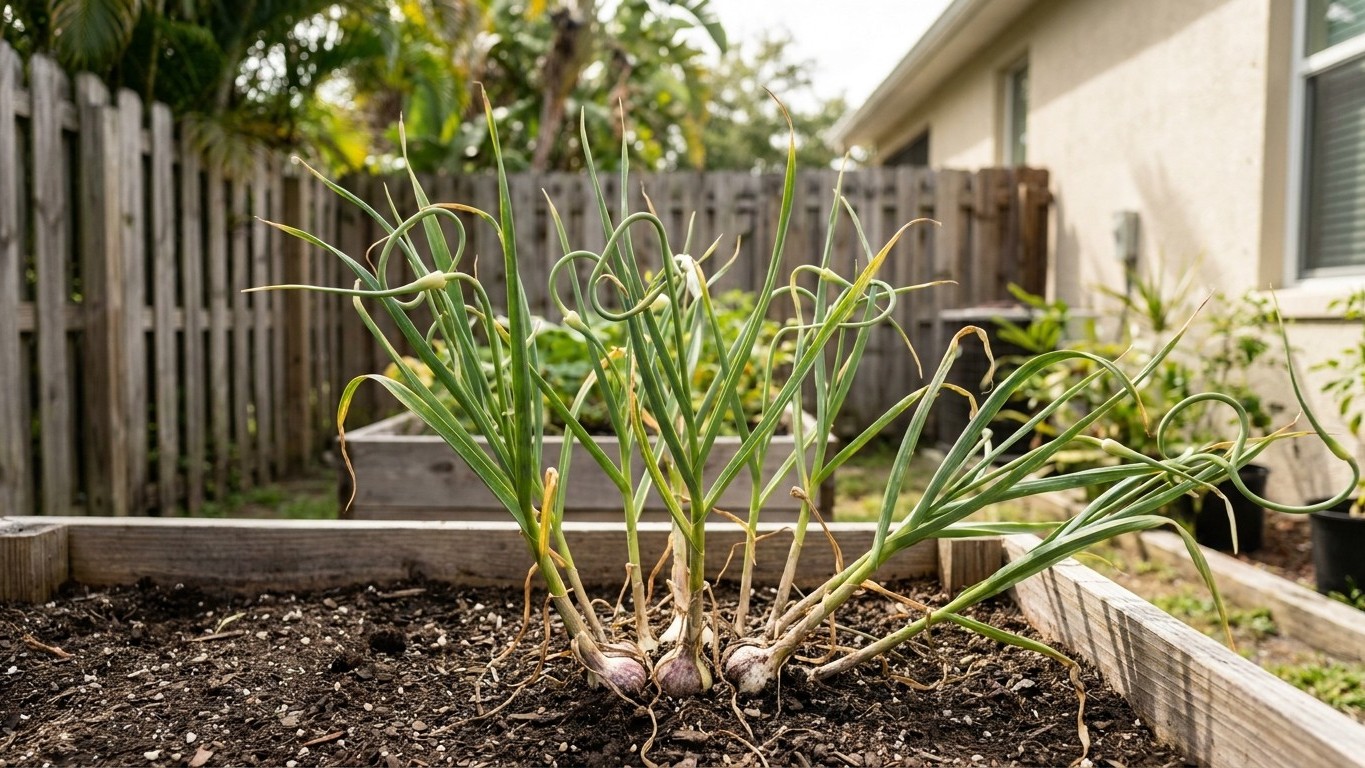

Jacksonville’s first freeze rarely arrives before late November, and three winters out of thirty don’t freeze at all — which matters, because hardneck garlic needs six to eight straight weeks below 40°F to split into a proper head of cloves. Skip that chill and you pull up a single rounded bulb instead, what growers call “rounding.” Jacksonville sits at the ragged edge of enough cold; central and south Florida sit well outside it, and the cloves show the difference at harvest.
Will garlic get the cold it needs in Florida

Garlic cloves stay single until a season of cold tricks the plant into building a bulb with a full ring of cloves around a central stem. Skip that cold, and the plant lifts one round, undivided bulb instead of a head you can peel apart, a problem gardeners call “rounding.” University of Georgia Extension publication C854 sets the requirement at six to eight weeks with temperatures below 40°F for a hardneck variety to divide properly.
What the freeze window tells you
At the Jacksonville station, NOAA’s NCEI 1991-2020 climate normals put the first fall freeze (32°F) between November 26 and December 13, and three of the thirty years measured saw no freeze at all that fall. That single freeze date only marks the start of cold weather, not six to eight cumulative weeks below 40°F, and a winter that doesn’t start freezing until early December rarely holds a hard, sustained chill through the weeks that follow. Jacksonville’s own winter is marginal for hardneck garlic, and central and south Florida, where NOAA’s freeze data effectively disappears, do not clear that bar at all. Growers one state north work from a colder baseline entirely. Georgia’s growing guide, covered in Growing Garlic in Georgia: Planting Dates, Varieties and Winter Cold, describes the kind of sustained cold that Florida gardeners have to manufacture instead of wait for.
Two ways around a short winter
Two workable paths remain for a Florida grower who wants a hardneck bulb anyway. Refrigerate the seed cloves at standard refrigerator temperature for several weeks before planting, kept away from any fruit that gives off ethylene, to substitute for the field cold the state’s winter won’t provide. Or plant a softneck type, bred from stock that never depended on a hard winter in the first place, and one that divides reliably even where the freeze arrives late or skips a year entirely, as it does at Jacksonville roughly once a decade — a full rundown of the garlic varieties growers rely on in Florida covers both types in more detail, and the garlic planting dates guide for Florida lays out when to get either type in the ground. Compare that to the opposite extreme: a place like Nunavut, covered in Growing Garlic in Nunavut: Planting Dates, Varieties and Winter Cold, has more cold than garlic can use in a season and an entirely different set of problems.
Neither path is a guarantee against rounding in an especially mild year, and neither should be a reason to skip growing garlic altogether. Plant hardneck without pretreatment in Florida and the risk of an undivided bulb is real. Plant softneck, or pretreat a hardneck clove, and the odds swing back in the grower’s favor.
When to put the cloves in
Every variety on Florida’s usable list goes into the ground early November to late November, and that window is built around the same freeze data used above. NOAA’s 1991-2020 normals put Jacksonville’s first fall freeze between November 26 and December 13. A clove set out in early November gets roughly three to six weeks of rooting and cool soil before that freeze window opens, and one set out in late November gets as little as a few days to two weeks before it. Lean toward the earlier half of that range if the goal is strong roots ahead of any freeze, and toward the later half only if the fall has run unusually warm.
That November 26 to December 13 figure is a midpoint band, not a safe date. NOAA’s own data records three falls out of thirty with no freeze at all at the Jacksonville station, and a freeze arriving after mid-December is entirely possible in a warm year. Local terrain moves the date further still. A low-lying inland field frosts earlier than the NOAA station shows, a site near a large lake or the coast lags behind it, and the modest elevation changes across north Florida rarely shift the date by more than a few days either way.
South of the frost line
Central and south Florida do not have a frost anchor at all. NOAA’s freeze data effectively disappears south of the panhandle and north Florida, and growers there are working a different calendar, one where summer heat, not winter cold, is the limiting season. Without a frost date to plant against, the practical anchor becomes the drop in soil temperature through fall, and whatever planting window local growers in that county have already worked out by trial. That is not a gap this page can paper over with an invented date. It is a real difference in climate that puts a central or south Florida grower outside the pattern these frost figures describe.
Which types suit Florida
Softneck garlic is the reliable choice for most of Florida, because it does not depend on the sustained cold that hardneck needs to divide, and because it stores for months longer after curing, an advantage in a state where a fall replanting is still a long way off.
Softneck varieties for Florida
- Early Red Italian, a fast, adaptable softneck.
- Inchelium Red, a mild, large-bulbed softneck that keeps well past midwinter.
- Italian Late, bred for a longer stretch in the ground.
- Lorz Italian, a heavier-yielding softneck with a stronger flavor once cured.
Hardneck varieties, with a caveat
Hardneck garlic is not off the table, but it is the harder path in a state where the winter itself will not finish the job on its own. A grower willing to refrigerate cloves before planting, as described above, can still get a properly divided bulb from any of the ten hardneck varieties suited to this list: Bavarian Purple, Blue Music, Chesnok Red, Duganski, Fall Festival, Georgian Crystal, Georgian Fire, German Red, German White, and Ivan. All ten go in during the same early-to-late-November window.
The tradeoff runs the other direction after harvest. Hardneck bulbs, even a correctly divided one, store for a matter of months. Softneck bulbs, properly cured, hold for the better part of a year, which matters more in Florida’s climate than the extra clove size hardneck sometimes offers.
Soil and bed preparation
Garlic sits in the same bed for the better part of eight months here, from a November planting to a harvest the following summer, and it spends much of that stretch through Florida’s wet season. Drainage matters more than fertility. A clove sitting in saturated soil for even a few days can rot before any disease organism gets involved, and Florida’s flat terrain and heavy summer rain make standing water a routine risk rather than a rare one.
Raised beds or ridged rows solve most of that problem outright, lifting the root zone above whatever water sits in the surrounding path after a storm. Where the native soil is deep, well-drained sand, as it is across much of the state, a raised bed matters less for drainage and more for holding the moisture and organic matter that pure sand drains away too fast to be useful.
What to work into the bed
Turn several inches of compost or well-rotted manure into the bed a few weeks before the November planting window, giving it time to settle and start feeding the soil biology before the cloves go in. Garlic is a heavy feeder over a long season, and Florida’s sandy soils hold nutrients poorly compared to the heavier soils further north, so organic matter worked in ahead of planting does double duty: it improves structure and it supplies some of what a sandy soil would otherwise leach away with the first hard rain.
Check the bed’s drainage before committing to it. Dig a hole a foot deep, fill it with water, and watch how long it takes to disappear. A bed that still holds water after several hours is not ready for a crop that will sit in it through the wettest months of the year, and it needs raising, amending with coarser material, or replacing with a different spot entirely.
What the climate here favours, and what it does not
UC IPM’s Pest Management Guidelines for Onion and Garlic (UC ANR Publication 3453) publish the temperature ranges that let four major garlic diseases build up in soil. Measured against average air temperature at the Jacksonville reference station across the growing season, from a fall planting through harvest the following summer, Florida’s climate crosses into the published range for two of these diseases for most of the season, and edges into a third for a shorter stretch.
| Disease | Published range | Months in range (Sept-July) | Note |
|---|---|---|---|
| White rot (Sclerotium cepivorum) | 50-75°F | 8 months: Oct, Nov, Dec, Jan, Feb, Mar, Apr, May | 2 of those months sit at the published optimum |
| Fusarium basal rot (Fusarium oxysporum f. sp. cepae) | 59-90°F | 8 months: Sept, Oct, Nov, Mar, Apr, May, Jun, Jul | 2 of those months at the published optimum |
| Pink root (Setophoma terrestris) | 75-85°F (optimum) | 3 months: Sept, Jun, Jul | all three sit at the optimum |
| Southern blight (Sclerotium rolfsii) | 86-95°F (optimum) | 0 months at the optimum | less active outside its optimum, not absent |
Reading the numbers safely
Read the soil-versus-air gap before drawing conclusions from that table. UC IPM’s thresholds are published as soil temperatures, and the counts above are built from average air temperature instead, because that is the only figure a weather station records. Soil lags air by weeks and swings far less day to day, so a month with a mean air temperature of 65°F does not mean the soil sat at 65°F all month, or that garlic in it spent the whole month at any single temperature. Treat the counts as a tendency toward disease pressure, never as a forecast of infection.
Two things follow for a Florida grower. White rot and Fusarium basal rot have wide windows here across most of the planting-to-harvest season, and both survive for years in soil as resting structures regardless of any single season’s weather, so the real defense is planting clean, certified seed garlic rather than trying to time around a temperature window. Southern blight‘s optimum, by contrast, never arrives during the growing season by this measure, which is real information worth having, not a guarantee the pathogen is absent if it is introduced on infected stock.
Getting it through the winter
Laying mulch
Mulch does two different jobs depending on how cold the winter actually gets, and Florida’s mild, uneven winters ask more of it than a steady northern cold does. Lay mulch, pine straw, hay, or shredded leaves, over the bed once the cloves are in and before the first hard cold snap, covering the soil surface completely so it holds moisture and buffers the swings between a warm afternoon and a freezing night that are common here in a way they are not further north.
Planting depth matters more than mulch depth for preventing heaving. A clove set shallow, an inch or less, is far more likely to be pushed partway out of the soil when a hard freeze followed by a quick thaw expands and contracts the top layer of soil, a pattern Jacksonville’s winters produce more than a sustained deep freeze does. A clove planted at a proper depth and topped with a solid mulch layer resists that movement far better, and a heaved clove exposed to open air dries out and loses vigor even if it survives the cold itself.
Pulling it back in spring
Pull the mulch back gradually in late winter as new growth pushes up, rather than stripping it all at once. Florida’s spring warms quickly once it starts, and a bed still smothered in a thick mulch layer when the soil beneath it is already warm invites the kind of constant dampness that rots a bulb before it finishes sizing up. Leave a lighter layer through spring to suppress weeds and hold moisture, since Florida’s dry spells in a normal spring can be as hard on a shallow-rooted garlic bed as a wet one.
Harvest and curing here
When to pull the bulbs
Lift garlic by what the leaves are doing, not by a date on the calendar. When the lower third to half of the leaves have died back and turned brown while the upper leaves are still green, the bulb is done sizing and ready to come out. Pulling too early means small, unfilled cloves. Waiting too long past that point, especially in Florida’s humid summer soil, invites the bulb to split open or start rotting in the ground before it is dug.
Curing in Florida’s humidity
Curing is where a Florida crop is most often lost after the hard part is already done. The goal is to dry the outer wrapper and neck down until they seal the bulb, and that takes moving air and low humidity working on it for an extended stretch. A humid Florida summer works against both. Cure in a shaded, open-sided space with a fan running rather than in a closed shed or garage, and spread the bulbs in a single layer instead of piling them, since a pile traps the same damp air a closed room does and rot spreads bulb to bulb once it starts.
Check bulbs partway through curing for any that have gone soft or show mold at the neck, and pull those out before they spread it to the rest of the batch. In a drier summer, curing outdoors under a simple cover to keep off rain and direct sun works well and finishes faster. In a wet, humid one, indoor curing with forced air is close to essential, and a batch left to cure passively in Florida’s summer humidity can mold before it ever dries down.
Local help
Frost dates, soil types, and disease pressure all vary within Florida enough that a single statewide answer only gets a grower partway there. The UF/IFAS Extension office for the county runs the planting calendar and soil testing, working county by county rather than from a single reference station near Jacksonville. A county-level soil test before planting is worth the small cost, particularly in a state where soil type changes as often as it does between a coastal county and one further inland.
Common questions
Can I plant garlic from the grocery store in Florida?
You can, but it usually performs worse than certified seed garlic, and it carries a real risk of introducing white rot or Fusarium basal rot into a bed where, per UC IPM’s published thresholds, Florida’s air temperatures already sit in the range those diseases favor for much of the growing season. Grocery garlic is also frequently treated with a sprout inhibitor, and it is often a variety not chosen for any particular climate at all.
Do I have to refrigerate garlic cloves before planting in Florida?
Only if you are planting a hardneck variety and want it to divide reliably. Softneck varieties like Early Red Italian or Inchelium Red do not need the pretreatment, which is the main reason they are the more forgiving choice across most of the state.
What happens if I plant garlic too early in Florida?
The cloves push top growth while the weather is still warm, and that soft growth is more exposed when a freeze eventually arrives in the November 26 to December 13 window NOAA’s Jacksonville normals describe. A clove planted at the front of the recommended window still roots and puts on some top growth before winter, but planting weeks ahead of that window, while it is still hot, adds stress without adding any benefit.
Can I grow garlic in south Florida?
You can, but the calendar does not apply south of the panhandle and north Florida. NOAA’s freeze data effectively disappears there, the growing season shifts toward the cooler months instead of aligning with a fall freeze, and the county extension office is the only reliable source for a workable planting date in that climate.
Why did my garlic come up as one big round clove instead of a bulb with several cloves?
That is rounding, and it means the crop did not get the sustained cold it needed after planting to divide. It happens most often with hardneck varieties grown without pretreatment in a mild winter, a real risk anywhere in Florida given how short and unreliable the state’s freeze window is against the six to eight weeks below 40°F that hardneck garlic needs.