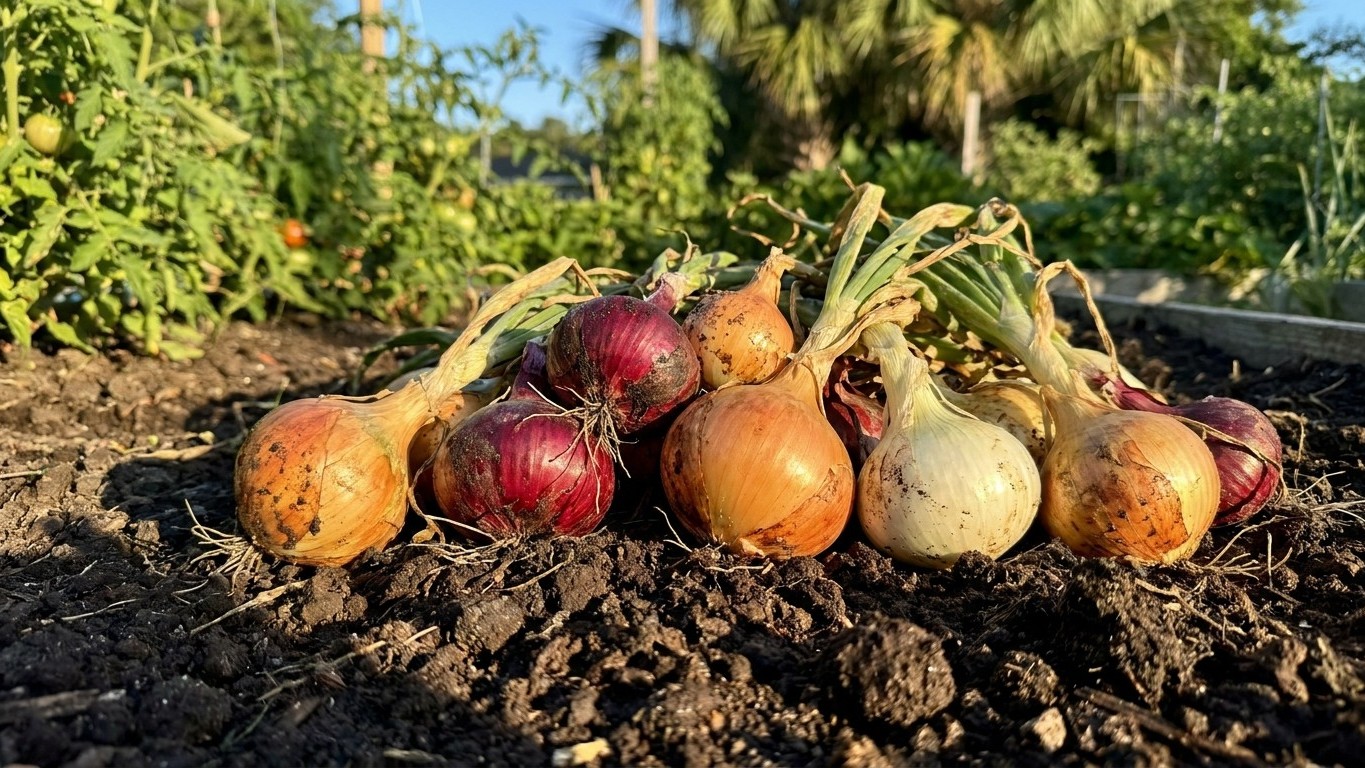

Florida gardeners need short-day onions, full stop. At 30.48°N, the reference station used for these figures sees just 13 hours and 58 minutes of daylight on the longest day of the year, June solstice. That number never climbs into long-day or even most intermediate-day territory. Only short-day varieties, the ones that start bulbing around 12 hours of daylight, will reliably form a bulb anywhere in the state. Seven varieties documented on this site have a published range that covers this latitude.
The short answer for Florida

Onions don’t respond to heat, frost dates, or how long you’ve had the plant in the ground. They respond to day length. A short-day onion starts converting its energy from leaf growth to bulb growth once daylight hits roughly 12 hours, which is why it can bulb almost anywhere, including far south where summer days stay relatively short year-round. At 30.48°N, the longest day tops out at 13 hours and 58 minutes, well short of the 14-to-16-hour window that long-day types demand before they’ll even attempt a bulb.
That single fact settles the variety question for most of the state. Seven varieties in the documented catalogue have a published latitude range that includes 30.48°N: Gabriella (20-35N), Madalyn (20-35N), Red Rock (30-36N), Red Sensation (25-35N), Texas Grano 1015Y (25-35N), Vidora (25-35N), and White Castle (30-38N). All seven are short-day types. None of them needs anywhere close to 14 hours of daylight to trigger bulbing, which is exactly why they work here and long-day onions do not.
Why the group matters more than the name
It’s tempting to shop by flavor or by a name you recognize from a grocery store bin. Skip that instinct. The day-length group listed on the seed packet or tag, short-day, intermediate-day, or long-day, is the only spec that determines whether the plant makes a bulb at all in a given location. Everything else, sweetness, storage life, color, is a secondary trait you choose once the group is settled.
What will not work here
This is the part most planting guides skip, and it’s the reason a lot of home gardens in Florida end up with a bed full of green tops and no onions underneath. Long-day and intermediate-day varieties need daylight lengths that this latitude never reaches, not even at the summer solstice. Plant one anyway and the result isn’t a smaller onion. It’s leaves all season, followed by rot when the plant eventually gives up and the bulb never forms.
Twenty-four varieties documented on this site carry a published range that starts north of 24°N, meaning every one of them is out of reach for a Florida garden at this latitude:
- Ailsa Craig (long-day, 38-60N) — needs far more daylight than Florida summers provide
- Barolo (long-day, 38-55N) — same daylight gap, no bulb forms
- Blush (long-day, 38-55N) — range starts nearly eight degrees north of the reference city
- Bridger (long-day, 35-50N) — still five degrees short of what Florida offers
- Cabernet (intermediate-day, 35-45N) — requires more daylight hours than 30.48N ever sees
- Calibra (intermediate-day, 35-45N) — same story, plant stays vegetative
- Candy (intermediate-day, 33-40N) — range floor sits above the reference latitude
- Elsye (intermediate-day, 32-45N) — still north of what triggers bulbing here
- Expression (intermediate-day, 32-45N) — day length never reaches its threshold
- Frontier (long-day, 40-50N) — a ten-degree gap from the reference city
- Monastrell (intermediate-day, 35-46N) — needs longer days than Florida produces
- New York Early (long-day, 38-50N) — built for a much higher latitude
- Patterson (long-day, 38-55N) — same daylight shortfall
- Powell (long-day, 43-47N) — among the most northern ranges on the list
- Red Carpet (long-day, 40-45N) — no path to bulbing this far south
- Red Long of Florence (intermediate-day, 38-50N) — range floor is nearly eight degrees away
- Red Long of Tropea (intermediate-day, 35-48N) — same problem, no bulb
- Redwing (long-day, 43-65N) — the most northern range on this list
- Rossa di Milano (long-day, 38-50N) — needs far more summer daylight
- Safrane (long-day, 42-50N) — range starts well north of Georgia
- Scout (intermediate-day, 32-46N) — still outside Florida’s daylight ceiling
- Sierra Blanca (intermediate-day, 32-45N) — same shortfall
- Talon (long-day, 42-50N) — requires a much longer summer day
- Walla Walla Sweet (long-day, 35-55N) — a Pacific Northwest onion, not a Florida one
The day here simply never gets long enough to flip the switch on any of these. The plant doesn’t stall or underperform. It makes leaves indefinitely, then rots in the ground once its natural life cycle runs out. There’s no partial credit for planting a long-day onion in Florida.
What changes across Florida
Florida isn’t one latitude, and the 30.48°N figure describes a specific reference station in north-central Florida, not the whole peninsula. The state runs roughly seven degrees of latitude from the Georgia border down to Key West, and that spread changes the picture at the edges even though the core recommendation, short-day onions, holds everywhere.
| Location | Approx. latitude | What it changes |
|---|---|---|
| North Florida (near the reference station) | 30.48°N | 13h58 on the longest day; all seven listed short-day varieties fit; Red Rock and White Castle fit best here since their ranges start at 30N |
| Central Florida | about 28°N | Shorter longest-day daylight than the reference point; still solidly short-day territory, all seven varieties remain viable |
| South Florida (Miami area) | about 25.8°N | Red Rock (30-36N) and White Castle (30-38N) fall outside their published range this far south; Gabriella, Madalyn, Red Sensation, Texas Grano 1015Y, and Vidora still fit |
| Key West | about 24.5°N | Falls just below the 25N floor published for Red Sensation, Texas Grano 1015Y, and Vidora; Gabriella and Madalyn (20-35N) still cover this far south |
A gardener near the Georgia border and one near Key West are gardening under noticeably different daylight totals on the same calendar day, even though both fall inside the short-day group. The practical takeaway: if you’re near either edge of the state, don’t assume the reference figures apply exactly to your yard. Cross-check your own latitude before picking a variety whose published range only just reaches your area.
Sweet now, or onions that last
Florida’s short-day climate pushes gardeners toward sweet onions, and that’s not a matter of taste or tradition. It’s chemistry. The compounds that make an onion sharp, volatile sulfur compounds, are the same ones that protect the bulb from decay in storage. University of Missouri Extension puts it plainly: sweet varieties don’t store as well as pungent types, because they simply contain less of the sulfur chemistry that fights off spoilage.
Short-day varieties, the ones that thrive at 30.48°N, tend to run milder and sweeter than their long-day northern counterparts. That’s good news at the dinner table in April and May, when a fresh-pulled short-day onion is at its best raw in a salad or on a burger. It’s less good news for the pantry. Long-day onions grown in northern states pack more of those protective sulfur compounds and can sit in a cool, dark space for months. Short-day onions grown in Florida generally don’t offer that same shelf life.
What that means in practice: a Florida garden gives you onions to eat over the following weeks, not onions to stretch through winter. If your pantry in March is looking for onions, they’re more likely coming from a store shelf sourced from a longer-day growing region than from your own spring harvest. Some gardeners split the difference by growing a batch specifically for fresh eating and treating any surplus with dehydrating or freezing rather than counting on long-term raw storage, since the chemistry that makes these bulbs sweet is the same chemistry working against them in the pantry.
Checking this against your own garden
The 30.48°N and 13h58 figures describe one reference station, not your specific plot. Before you commit a season’s bed space to a variety, run a few checks that take less than an afternoon:
- Look up your own latitude if you’re more than a county or two away from north-central Florida, since a few degrees can shift which varieties on the list above are the safest fit
- Call your county extension office for local frost dates and planting windows specific to your soil and microclimate
- Confirm the day-length group printed on any seed packet or transplant tag before buying, rather than relying on the name or the picture
- If you’re near Key West or the far south tip of the state, double-check whether a variety’s published range actually reaches your latitude, since a couple of the seven listed here stop just short
- Ask your extension office whether local growers in your area favor particular short-day varieties, since soil and rainfall patterns can tip the balance between otherwise similar options
A state-wide figure is a starting point, not a guarantee for every backyard in it. The daylight math holds statewide, but the fine print, exactly which variety’s range reaches your exact spot, is worth five minutes of checking before seed goes in the ground.