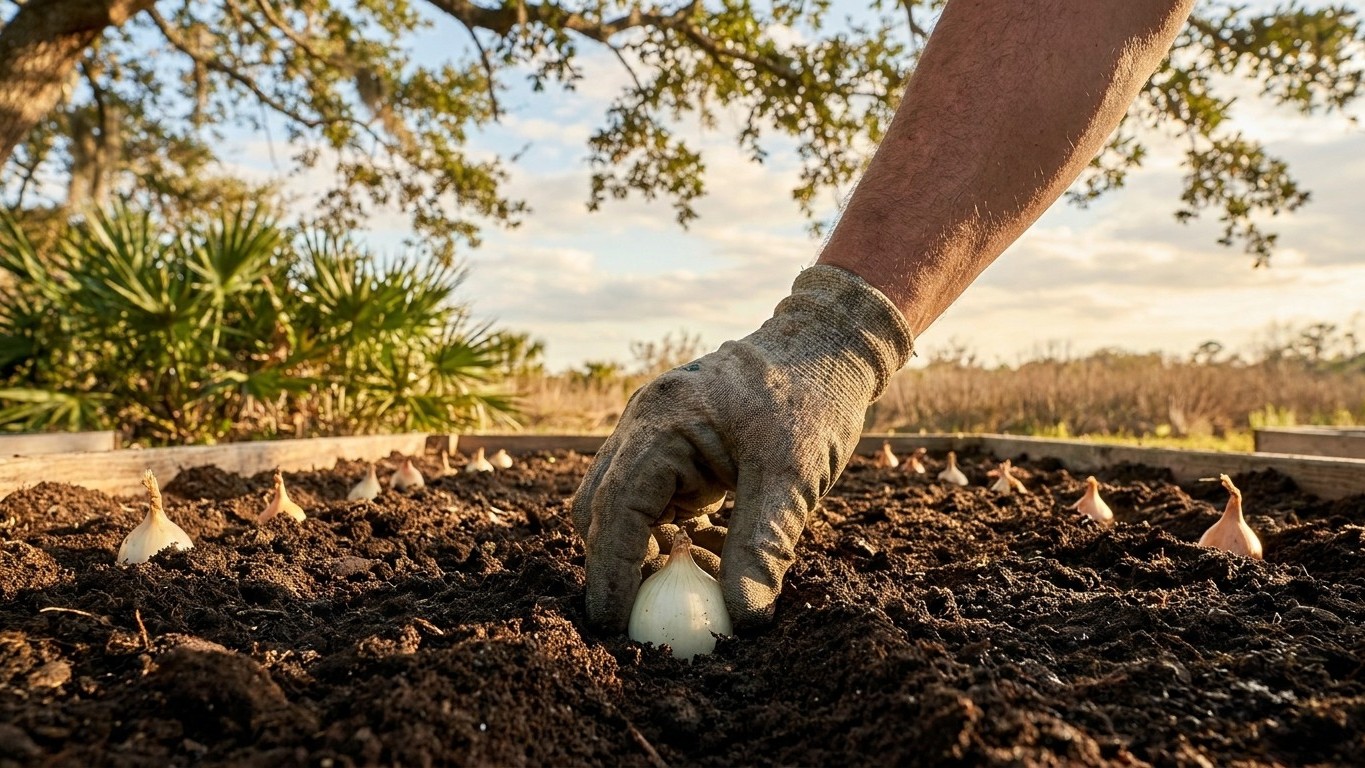

Plant short-day onions in North Florida between mid-October and early December, not in spring. At 30.48 degrees north, the reference latitude for this state, the longest day of the year brings only 13 hours and 58 minutes of daylight, well above the roughly 12-hour trigger that tells a short-day bulb to stop growing leaves and start forming a bulb. That timing window exists because of day length, not soil temperature.
The short answer for Florida

Florida’s onion calendar runs backward compared to most of the country. Gardeners in Minnesota or Ohio plant in early spring and harvest in late summer, chasing long summer days. Florida gardeners plant in fall and harvest in late spring, because the state’s latitude, 30.48 degrees north at the reference station, never produces the long summer daylight that northern varieties need. The longest day of the year here delivers 13 hours and 58 minutes of light. That number matters more than any frost date on a calendar.
Short-day onions begin bulbing once daylight reaches about 12 hours, a threshold published by Clemson Cooperative Extension. In Florida, that 12-hour mark arrives in late winter, around February, well before the summer solstice. So the planting window has to sit months earlier, in fall, giving the young plant enough time to grow a decent root system and a handful of leaves before the shortening trigger flips the switch to bulb formation. Plant too late in fall, and the onion hasn’t built enough leaf mass by the time day length says “bulb now”, the plant simply makes the best of a small frame.
Why fall, specifically
Mild winters make this possible. Florida rarely sees the hard freezes that would kill young onion transplants or sets over winter, so a fall-planted onion just keeps growing slowly through the cool months, then accelerates into bulbing as days lengthen toward that 12-hour mark. States further north can’t use this trick, their winters would wipe out a fall-planted crop, so they wait for late winter or early spring instead, working with a much shorter runway before their own local bulbing trigger arrives. The gap between Florida’s fall planting and a Midwestern gardener’s spring planting isn’t a matter of preference. It’s dictated by which day-length group can even survive and bulb at each latitude.
What will not work here
Planting an onion variety at the wrong time doesn’t delay the harvest. It shrinks it. Whatever size the plant has reached the moment day length crosses the bulbing threshold is the size the bulb will be, permanently. There’s no catching up once bulbing starts. A late-planted short-day onion in Florida doesn’t ripen a few weeks behind schedule with a full-size bulb waiting at the end. It locks in a smaller bulb the day the trigger fires, because the plant redirects its energy from leaf growth into bulb formation right then, whether or not it’s ready.
The bigger failure, though, isn’t timing within the right group. It’s planting the wrong day-length group altogether. Long-day and intermediate-day onions need 14 to 16 hours of daylight to start bulbing. Florida’s longest day tops out at 13 hours and 58 minutes. That threshold simply never arrives here, not in June, not ever. A long-day onion planted in a Florida garden doesn’t bulb late or bulb small. It doesn’t bulb at all. It spends the whole season making leaves, then rots in the ground once the plant exhausts itself.
These varieties, all published for latitudes north of Florida’s growing range, will not bulb at 30.48 degrees north:
- Ailsa Craig — long-day, needs 38-60N, daylight here never reaches its threshold
- Barolo — long-day, 38-55N range, same failure
- Blush — long-day, 38-55N
- Bridger — long-day, 35-50N
- Cabernet — intermediate-day, 35-45N
- Calibra — intermediate-day, 35-45N
- Candy — intermediate-day, 33-40N
- Elsye — intermediate-day, 32-45N
- Expression — intermediate-day, 32-45N
- Frontier — long-day, 40-50N
- Monastrell — intermediate-day, 35-46N
- New York Early — long-day, 38-50N
- Patterson — long-day, 38-55N
- Powell — long-day, 43-47N
- Red Carpet — long-day, 40-45N
- Red Long of Florence — intermediate-day, 38-50N
- Red Long of Tropea — intermediate-day, 35-48N
- Redwing — long-day, 43-65N
- Rossa di Milano — long-day, 38-50N
- Safrane — long-day, 42-50N
- Scout — intermediate-day, 32-46N
- Sierra Blanca — intermediate-day, 32-45N
- Talon — long-day, 42-50N
- Walla Walla Sweet — long-day, 35-55N
Any of these planted in a Florida garden gives leaves all season and nothing underground worth harvesting.
What changes across Florida
Florida stretches roughly from 24.5 degrees north at the southern tip to just over 31 degrees north at the Georgia line, a span of nearly seven degrees of latitude in a single state. The reference figures in this article, 30.48 degrees north and 13 hours 58 minutes of longest-day light, come from a station near Jacksonville, close to the state’s northern edge. A gardener in Homestead or Key West, near 25 degrees north, works with a noticeably shorter summer day and a warmer winter, which shifts the fall planting window later and compresses it into a narrower stretch of cool weather.
| Location type | Approx. latitude | What it changes |
|---|---|---|
| North Florida (Jacksonville area, reference) | 30.48N | 13h58 longest day; earliest safe fall planting, coolest winters in the state |
| Central Florida | ~28N | Slightly shorter longest day; bulbing trigger arrives a bit sooner relative to planting |
| South Florida (Miami-Homestead area) | ~25.5N | Mildest winters, shortest summer daylight in the state; fall planting window shifts later |
A gardener near the state line with Georgia sits closer to the northern short-day/intermediate-day boundary than someone in Tampa or Fort Myers, and should treat the fall planting date as roughly two weeks earlier than a South Florida garden, since cooler weather arrives sooner up there. The short-day varieties named earlier still apply across the whole state, but the exact week to put transplants or sets in the ground shifts depending on where in Florida the garden actually sits.
Sweet now, or onions that last
Florida gardens are built for sweet onions, not storage onions, and that’s chemistry, not chance. The compounds responsible for an onion’s sharp bite are volatile sulfur compounds, and those same compounds double as the bulb’s natural defense against rot in storage. Fewer sulfur compounds means a milder, sweeter onion at harvest, but also one that breaks down faster on a shelf. More sulfur compounds means a sharper onion in the kitchen, and one that can sit in a mesh bag through the winter without going soft.
Short-day varieties, the only group that bulbs reliably in Florida, run consistently toward the sweet, low-sulfur end of that spectrum. According to University of Missouri Extension, “as a rule, ‘sweet’ onions do not store as well as the more pungent types.” That’s not a marketing distinction. It’s the direct trade-off Florida gardeners accept in exchange for being able to grow onions at all at this latitude.
The practical result shows up in March. A Florida pantry stocked from a spring harvest of short-day onions is usually empty of home-grown onions by late winter, because the bulbs that made it through the fall-to-spring growing season don’t hold in storage the way a northern long-day onion would. Gardeners further north, growing pungent long-day varieties through a long summer, are the ones still pulling onions out of storage in March. Florida’s reward is a sweeter onion at harvest. The trade is a shorter shelf life afterward.
Checking this against your own garden
Every figure in this article comes from a single reference station near 30.48 degrees north. A garden hundreds of miles south, or close to the Georgia border, won’t match that number exactly, and neither will the local frost pattern that determines exactly when fall planting should start. Before committing to a planting date, it’s worth confirming a few things locally rather than trusting a single statewide number.
- Look up your own garden’s latitude, especially if you’re near the state’s northern or southern edge, since a few degrees shifts both daylight length and the safe planting window
- Check your average first and last frost dates through your county’s Cooperative Extension office rather than a generic state-wide estimate
- Confirm which day-length group any transplants or sets you’re buying belong to before planting, since a mislabeled long-day onion will not bulb here regardless of when it goes in the ground
- Ask your county extension agent about local variety trial results, since some short-day varieties perform better in sandy coastal soils than in the state’s central ridge areas
A statewide planting calendar is a starting point, not a guarantee. The county extension office nearest your zip code will have observed data specific to your soil and microclimate, and that beats a single reference latitude every time.
The Moon calendar is a separate, older custom: see when to plant onions by the moon, written as tradition rather than fact.