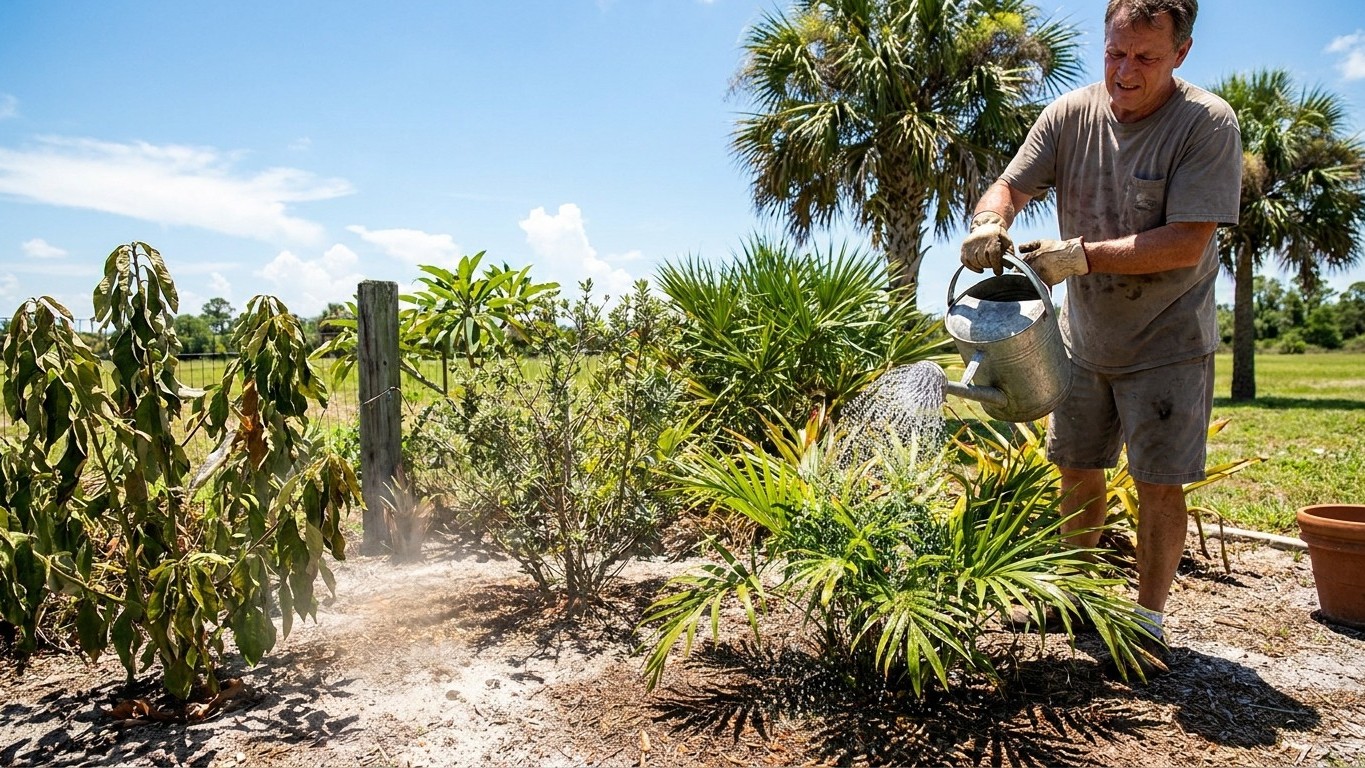

Florida’s answer depends on where you stand: Jacksonville sees a real winter with frost, while central and south Florida stay frost-free and flip the whole calendar upside down. Add USDA zones 8b to 11b, an average of 73.2 days a year above 90°F, and you get a state where the garden’s biggest enemy isn’t cold, it’s heat and evaporation, most of the year.
What the climate asks of you

Start with the number that rules everything east of the Panhandle and south of the Georgia line: 73.2 days a year hit 90°F or higher, measured at the Jacksonville reference station over the 1991-2020 period. That’s not a summer spike, it’s a stretch of the calendar wide enough to swallow late spring, all of summer, and a slice of early fall. Every one of those days pulls moisture out of the soil faster than a mild afternoon would, and it does that whether or not the sky delivered rain the night before.
Florida runs on a wet-season, dry-season rhythm rather than a four-season one, and that split matters more than any single monthly rainfall figure. The wet months bring frequent, often heavy, short-duration storms; the cooler months turn dry and require the gardener to take over almost entirely. A bed that looks well-watered after a July thunderstorm can be crusted and cracking two weeks later if that storm doesn’t repeat, because the state’s sandy soils don’t hold what falls on them.
That soil is the second half of the equation. Much of Florida, especially the peninsula, sits on sandy or sandy-loam ground that drains fast. An inch of rain that would soak a clay bed for a week can pass through Florida sand in a day or two. Pair that drainage with 73.2 days of 90-plus heat and you get a garden that can be sitting in a wet season and still be thirsty by Thursday, which is why many growers turn to Watering Pots and Containers in Florida as a more controlled alternative to in-ground beds.
The frost picture only applies cleanly to the north. At the Jacksonville station, the last spring freeze falls between February 16 and March 7, and the first fall freeze lands between November 26 and December 13, based on the 30 to 70 percent freeze-probability band in NOAA’s 1991-2020 normals. Three of the thirty years in that record saw no freeze at all, even at an inland airport site. Move south to Orlando or Miami and frost becomes rare to nonexistent, which means the growing season effectively runs through winter, and Summer Heat, not cold, becomes the limiting factor for tender crops.
What this means for a watering schedule
A calendar built for the Panhandle won’t serve Miami, and a schedule built for the wet season won’t survive December. The safest planning move is checking your own zone against the USDA range of 8b to 11b, and treating the Jacksonville frost dates as a north-Florida reference only.
How much, how often
Garden beds want roughly an inch of water a week, delivered all at once or in two sessions rather than sipped daily, a rhythm covered in detail in Watering Through a Dry Spell in Florida. Deep, infrequent watering pushes roots down into the soil where moisture lingers longer and heat swings are smaller; shallow daily watering trains roots to stay near the surface, exactly where Florida’s 90-degree afternoons bake them hardest. The fix isn’t a bigger hose, it’s fewer, deeper sessions.
Knowing when to water beats guessing on a fixed schedule. Push a finger, or the tip of a trowel, two inches into the soil near the root zone. If it’s dry at that depth, water. If it’s still damp, wait. This single check does more for a Florida garden than any timer, because rainfall here is patchy and can hit one yard and skip the next.
Soil texture changes the plan more than most gardeners expect. On the sandy ground common across much of the state, water drains through quickly and holds little reserve, so shorter, more frequent soakings usually beat one big weekly dose that just runs past the roots. On the heavier clay pockets found in parts of north and central Florida, the ground can hold a week’s worth of water, but soaking or working that soil while it’s already wet compacts it and can drown roots outright. Clay needs patience; sand needs frequency.
Because the wet season delivers rain unevenly and the dry months deliver almost none, irrigation in Florida isn’t a backup plan, it’s the plan. A garden that gets no meaningful rain for weeks at a time during the cooler months is not “occasionally topped up,” it’s on irrigation full stop, and the schedule should be built that way from the start rather than adjusted after plants show stress.
A simple watering sequence
- Check the soil two inches down at the root zone before watering, using a finger or trowel tip.
- Water early morning, before the heat of the day, to cut evaporation loss.
- Apply water at the base of the plant, at the soil line, never over the leaves.
- Deliver roughly one inch per week on sandy soil, split into two sessions if the ground drains fast.
- On clay soil, water less often but let it soak deeply, and never work or re-water clay that’s still damp.
Restrictions and rules
Watering restrictions are common across Florida and change from one water management district to another, sometimes season to season. Rules typically govern which days of the week irrigation is allowed and which hours are off-limits, and they tend to tighten during dry stretches and after storms strain the water supply. None of that is fixed statewide, and a rule that applies in one county can be different a few miles away.
Given how uneven Florida’s rainfall is between the wet and dry parts of the year, and how fast sandy soil pushes gardeners toward supplemental watering, checking local restrictions before setting up any regular schedule or automatic timer is worth the ten minutes it takes. A schedule that ignores a designated watering day is the fastest way to end up with a warning notice instead of a healthy garden.
Local rules are set by water management districts and municipal utilities, not by any single statewide office, so the right source is always the one covering your address. The University of Florida IFAS Extension can point you to the current district rules for your county, along with guidance suited to your specific zone within that 8b to 11b range.
Using less
Cutting water use in a Florida garden isn’t about watering less, it’s about losing less to heat, drainage, and evaporation before it ever reaches a root. A few changes do most of the work.
- Mulch: A two to three inch layer over sandy soil slows evaporation dramatically and buys extra days between waterings, which matters most during stretches with no rain at all.
- Drip irrigation: Delivers water at the root zone instead of across the whole bed, cutting the losses that come from overhead watering hitting leaves and bare soil that don’t need it.
- Grouping plants by need: Placing thirsty plants together and drought-tolerant ones elsewhere means no bed gets more water than it actually needs just to keep its neighbor alive.
- Organic matter worked into sandy soil: Compost improves the water-holding capacity of fast-draining Florida sand, giving roots a longer window before the ground dries out again.
- Rain barrels, where locally permitted: An inch of rain falling on a thousand square feet of roof yields roughly 600 gallons of runoff. Florida’s wet season can fill a barrel repeatedly within a single week, while the dry months can leave that same barrel empty for weeks, so it works best as a supplement during storms, not as the sole source through a dry spell.
None of these steps replace checking the soil before watering. They just reduce how often the check comes back “dry.”
Common questions
Does Florida’s wet season mean I can stop watering in summer?
No. Rain during the wet season is often heavy but uneven, and with 73.2 days a year above 90°F, evaporation keeps pulling moisture out of sandy soil between storms. Keep checking the soil two inches down rather than assuming rain covered it.
eqApplies which Florida frost dates should I use for planning?
Which Florida frost dates should I use for planning?
The February 16 to March 7 and November 26 to December 13 window applies to the Jacksonville area in north Florida. Central and south Florida are largely frost-free, so gardeners there should plan around summer heat as the limiting season instead of frost.
Is sandy soil really that different to water than other soil types?
Yes. Sandy soil common across much of Florida drains fast and holds little water, so it typically needs shorter, more frequent watering than clay, which holds moisture longer but must never be worked or soaked while still wet.
Where do I find the actual watering restrictions for my address?
Restrictions come from your local water management district or municipal utility, not a single statewide rule. The UF IFAS Extension office for your county can point you to the current schedule and any seasonal changes.