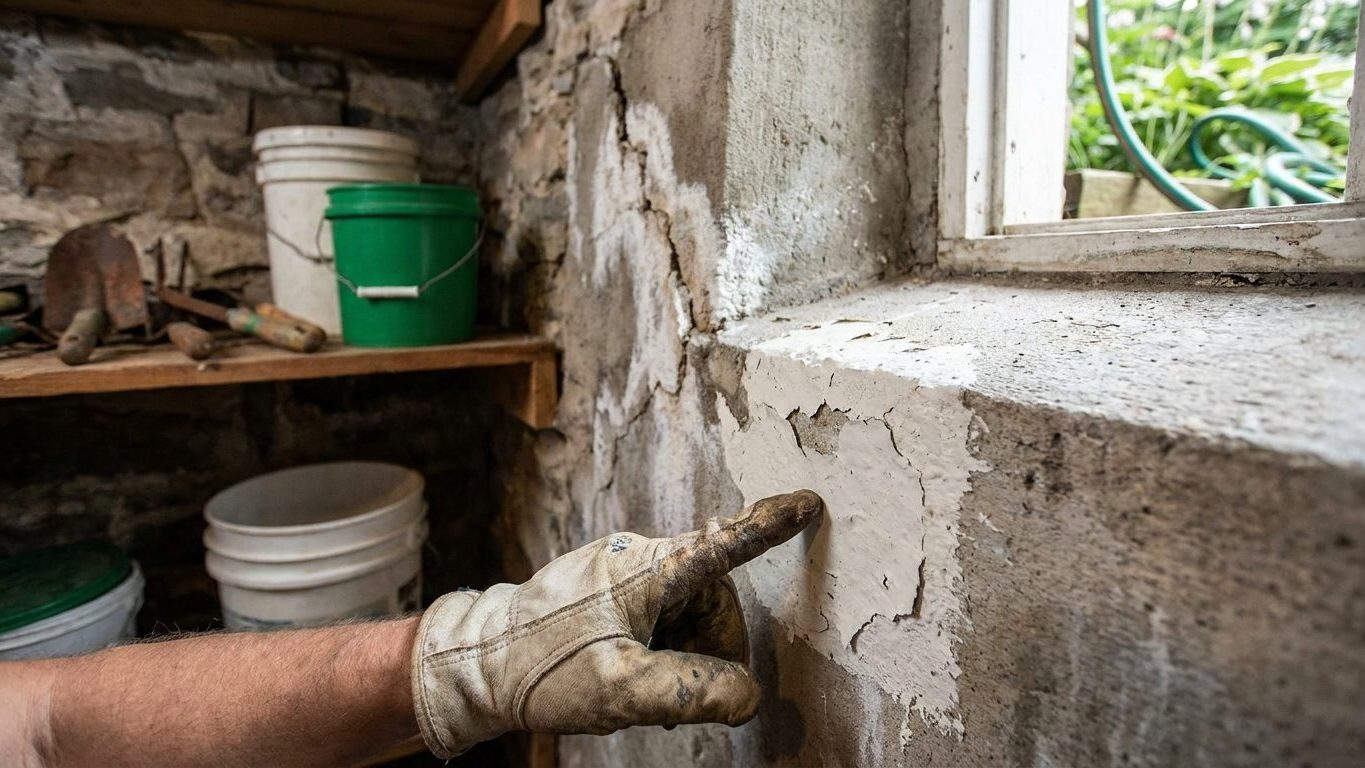

That flaking, bubbling coat of waterproofing paint on your basement wall is doing exactly what it was built to do, and still losing. Interior sealants block water vapor, not liquid water pushed by pressure from the soil outside. Check the wall for a band of bubbling or peeling right along the floor before you buy another can. That pattern means water is coming up through the joint, and paint can’t fix a joint.
What is actually going on

The mechanism at work here is hydrostatic pressure. When the soil around your foundation gets saturated, water doesn’t just sit in the yard. It pushes against the outside face of your basement wall with a force tied to the height of saturated soil sitting above it. That pressure looks for anywhere it can get through: a hairline crack, the mortar joint between block courses, or the seam where the wall meets the floor slab. It doesn’t need a large opening. Water under pressure moves through the porosity of concrete the way water moves through a coffee filter, just slower and less visibly.
What a coating actually blocks
A roll-on waterproof paint or a cementitious coating goes on the inside face of the wall as a membrane. A membrane holds back water that arrives calmly, by capillary wicking or vapor diffusion through the concrete. It does nothing to relieve pressure. Water that used to seep gently through the block, evaporate at the surface, and leave a white mineral crust now has nowhere to go once that surface is sealed. It travels sideways behind the coating until it finds an edge, an old fastener hole, or the wall-floor joint, and comes out there instead. That’s why the classic failure looks like a coating that holds fine for a season and then bubbles or lifts in a band right along the floor line.
Sealing the interior manages symptoms, not the source. It can cut musty odor, hide old staining, and slow surface dampness enough that a room feels usable again. What it cannot do is stop water arriving under pressure from outside. The water still gets into the wall. It has just been redirected, and it usually finds the weakest point in the assembly, which is almost always a joint rather than solid concrete.
Order matters more than the product
Drainage comes first, coating second. If grading, gutters, and subsurface drainage around the house are doing their job, hydrostatic pressure against the wall stays low most of the year, and an interior sealant can genuinely finish the job by handling the residual vapor that concrete always lets through. If drainage isn’t doing its job, the sealant is fighting a pressure it was never designed to resist, and it loses within months or a few seasons depending on how wet the year turns out.
For the wider picture of how water moves around a house and where a basement sits inside that system, see Foundations and Basements: Almost Everything Here Is Water.
What to look at, and in what order
Work from cheapest and least invasive toward more involved. Each check below tells you something the next one can’t, and skipping ahead is how people end up buying a coating that was never going to solve their actual problem.
Cheapest checks come first
| Step | What you’re checking | What a clear result rules out |
|---|---|---|
| Downspouts and grading | Where water actually goes during and right after a hard rain | Rules out surface runoff as the driver if water already carries well clear of the wall |
| Wall deposit pattern | A white, powdery crust versus a wall that’s genuinely wet to the touch | The powdery crust rules out active pressure-driven leakage. A wet wall does not |
| Where water shows up indoors | Along the wall-floor joint versus at one specific crack or window well | A joint-wide pattern rules out a single localized entry point |
| Seasonal tracking | Humidity and staining logged against rainfall over several weeks | Rules out condensation as the sole cause if dampness tracks tightly with rain |
| Interior coating | Applied only once the checks above point at vapor, not pressure | Appropriate once pressure-driven water has already been ruled out |
The second row deserves its own look. That white, crumbly deposit is efflorescence, mineral salt left behind after water evaporates through the concrete. It tells you moisture is moving through the wall slowly, by capillary action, not squirting through under pressure. See “/foundations/efflorescence/”>The White Powder on Basement Walls for how to tell that apart from an actual wet patch before you decide anything about the wall itself.
The tracking step matters more than people expect. A dehumidifier and a simple written log of tank levels against rainfall tell you more over a season than any single inspection can. If humidity and staining rise and fall with storms, you’re dealing with active water intrusion tied to the outside. If it stays fairly constant regardless of weather, you may be looking at condensation from indoor humidity meeting a cold wall, which is the one problem an interior product handles well, because that’s the problem it was actually built for.
Watch it, or get someone in
A homeowner can reasonably track the things that change slowly. Whether a downspout still drains away from the house after autumn leaves clog the gutter. Whether the same patch of efflorescence keeps reappearing after you brush it off. Whether a dehumidifier’s tank fills faster in a wet month than a dry one. Keep a simple log with dates and rainfall next to it. That record is the single most useful thing you can hand a professional later, because it turns a vague feeling of dampness into a pattern someone can actually diagnose.
Signs that need a call now
Some signs need someone in on the next available day, not on your next free weekend. A wall that bulges or leans inward, a crack that’s noticeably wider at one end than the other, or cracks that follow the mortar joints in a stair-step pattern up a block wall are structural signals, not moisture signals, and they call for a structural engineer before anyone talks about sealing anything. That pattern means the wall itself is moving, and a coat of paint on the surface tells you nothing about whether that movement is still active. See Cracks That Follow the Mortar in a Block Wall for what that pattern actually looks like and why it reads differently from an ordinary settlement crack.
Three different calls, three different people
Water that accumulates on the floor rather than just dampening the wall calls for a drainage contractor: someone whose whole job is grading, downspout routing, and subsurface drainage systems. That’s a different specialist from a waterproofing salesman, whose job is to sell a system, usually an interior one, and who has a financial reason to tell you the problem is solvable entirely from inside. That doesn’t make the product dishonest, but the incentive behind the visit is worth knowing before you treat a sales appointment as a diagnosis.
A structural engineer, by contrast, assesses without selling you a repair. They charge for an inspection and a written report, not for a fix, so their read on whether a crack is active, whether a wall is bowing, or whether the foundation needs attention isn’t shaped by what’s sitting in a truck outside. If you’re not sure which call to make first, that’s the one. An engineer’s answer tells you whether what you’re looking at is cosmetic, moisture-related, or structural, and that answer decides who else you need to call after.
What has to happen first
Money gets wasted in basements in a predictable order. Someone buys an interior fix before the outside water problem is under control, then buys a second one when the first fails, then finally calls a drainage contractor after two coatings have already peeled. Reverse that order and most of the expense disappears.
Outside before inside
Water management outside the wall comes first, always. That means gutters that actually carry water away from the foundation instead of overflowing at a clogged joint, and downspouts that discharge well clear of the wall rather than dumping at its base. A gutter emptying at the foundation every time it rains does more to cause a wet basement than most cracks ever will, which is why the roofing guides that cover gutter maintenance are worth reading before the basement gets any attention at all.
Inside, if water is already reaching the floor rather than just the wall, a sump pump paired with a drainage system deals with water that’s already inside faster and more reliably than any wall coating ever will, and it’s worth sorting out before spending on finishes. That’s a plumbing project, not a paint project, and it belongs earlier in the sequence than most people put it.
Only once the water itself is under control does it make sense to think about what goes on the walls and floor. Insulating a basement wall before the moisture problem is solved traps dampness against the wall and against the insulation material itself, which causes its own set of problems later. Any flooring that goes down afterward, tile, vinyl, or something else, sits directly on a slab that needs to be reliably dry first, not just dry-looking on the day it’s installed.
Sealing the inside of a basement wall is the last step in that sequence, not the first, and treating it as the first is the single most common reason it fails.
Common questions
Does hydraulic cement stop a leaking crack for good?
It plugs that specific crack, but hydrostatic pressure doesn’t stop pushing just because one path closed. If drainage outside hasn’t improved, the same water often finds a new joint or a new hairline crack nearby within a season or two, which is why plugging a crack without addressing drainage is a temporary fix rather than a permanent one.
Can a dehumidifier replace fixing the drainage?
No, and it isn’t trying to solve the same problem. A dehumidifier pulls moisture out of the air in the room, which helps with condensation and general dampness, but it does nothing about water already pushing through the wall or pooling at the floor. Run one for comfort and to slow mold growth, not as a substitute for dealing with the water’s source.
Is an interior drain tile system the same as sealing the wall?
No. An interior drain system collects water once it has already entered along the base of the wall and channels it to a sump pump, rather than trying to keep the wall dry with a coating. It’s a legitimate response to water that’s already reaching the floor, but it manages water after the fact. It doesn’t reduce the pressure pushing water through the wall in the first place, which is why exterior drainage improvements still matter even after an interior drain is installed.
How long does it usually take for a coating to fail?
That depends entirely on how much hydrostatic pressure the wall is under, which is why there’s no single answer worth stating here. A wall behind good drainage might hold a coating well for many years because the pressure it faces stays low. A wall behind a downspout that dumps at the foundation can show bubbling or peeling within a single wet season, because the coating is being asked to resist a force it was never built to fight.