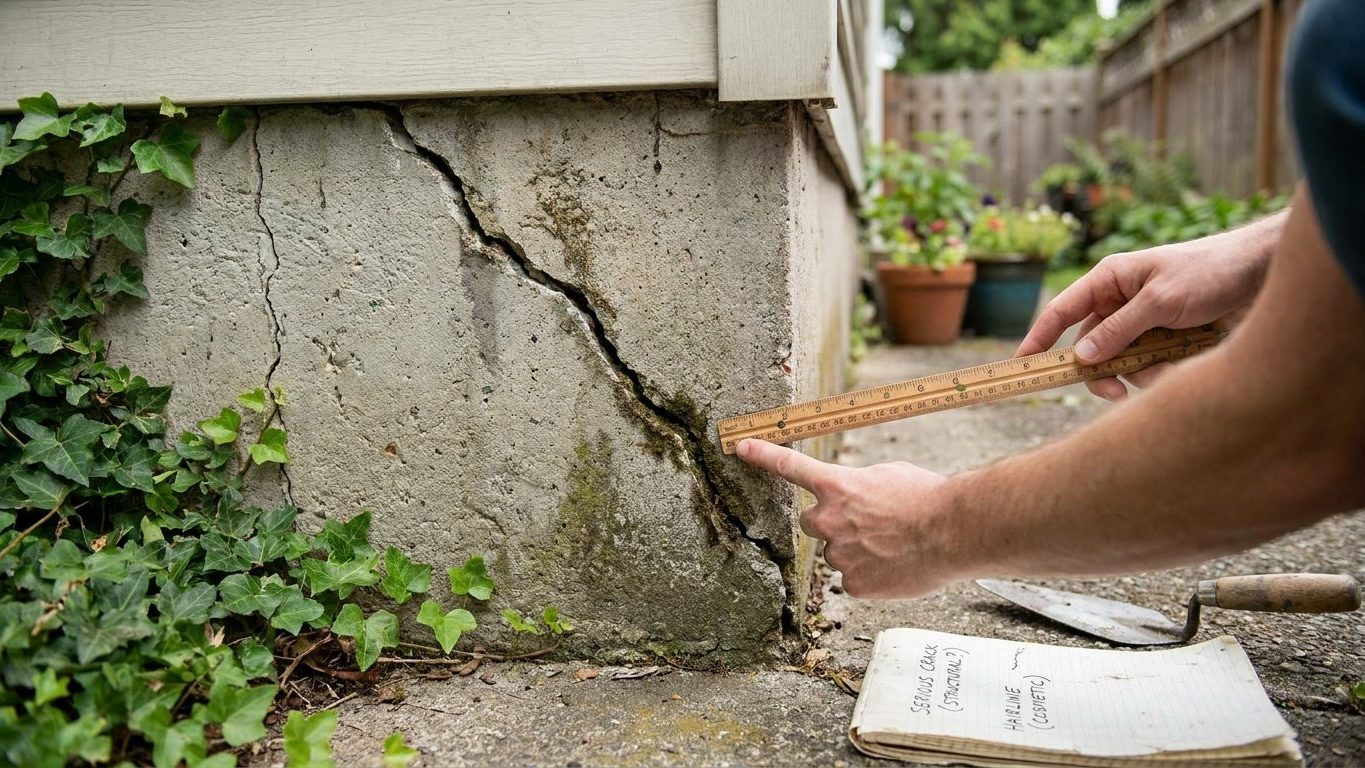

A crack that runs straight up and down through a poured concrete wall, the same hairline width from top to bottom, is almost always just shrinkage from curing. A crack that steps diagonally across the mortar joints of a block wall, wider at one end than the other, is telling you something different: the ground under one part of the house has moved relative to another. Photograph it today with a ruler in the frame, mark both ends in pencil, and check it again in a few weeks before you do anything else.
Reading a crack correctly is the first step in every foundation question that follows, because it decides whether the rest is urgent or not.
What is actually going on

Concrete shrinks as it cures, and it keeps shrinking slightly for years afterward as it dries out. That shrinkage has to go somewhere, and it goes into cracks. Because the shrinkage happens evenly across a poured wall, the cracks it produces are predictable: vertical, roughly the same width along their whole length, and usually located mid-wall or running down from the corner of a window or door opening where the wall is thinnest and most stressed. None of that involves the soil outside. It is the concrete settling into its own final size.
Movement in the ground is a separate mechanism, and it leaves a different signature. Soil under one section of footing can compress, wash out, or swell more than the soil under another section, and when that happens the foundation above it moves unevenly. A wall reacting to differential movement in the soil cracks on a diagonal, or steps across the mortar joints of block or brick in a staircase pattern, and the crack is typically wider at one end than the other because one side of the wall has physically dropped or risen relative to the rest.
Horizontal cracks are their own category
A crack running horizontally across a basement wall is not a shrinkage crack and not ordinary settlement either. It usually means the wall is being pushed inward, either by saturated soil pressing against it or by hydrostatic pressure building up behind it after heavy rain. That kind of loading can bow a wall before it ever cracks visibly, so a straight horizontal line with no other symptoms deserves closer attention than a diagonal one. A horizontal crack in a basement wall is covered on its own because the mechanism, and what it demands from you, is genuinely different.
Here is the honest limit of reading a crack from a photograph or a homeowner’s eye. Direction and pattern give you a strong hint about which mechanism produced a crack, but they do not tell you whether the movement behind it is finished or still happening, and they cannot rule out a structural problem on their own. Only a structural engineer, using a level, a straightedge, and observation over time, can determine whether a crack reflects a completed, harmless settling or an active, worsening one. Nothing in this article is a substitute for that assessment when the pattern points toward movement.
What to look at, and in what order
Work through these checks from cheapest and least invasive to most involved. Each one narrows down what you are dealing with, and just as importantly, each one tells you what it does not settle.
| Check | What to look for | What it suggests | What it does not tell you |
|---|---|---|---|
| Photograph and mark the crack | Pencil lines at both tips, dated, revisited every few weeks | Whether the crack is currently active or dormant | Whether past movement has already caused structural loss |
| Read the direction | Vertical and even, versus diagonal or stair-stepped, versus horizontal | Shrinkage versus differential settlement versus lateral pressure | The severity of the underlying movement |
| Check grading and downspouts | Soil sloping toward or away from the wall, downspouts dumping close to the foundation | Whether surface water is a likely driver near that section of wall | Whether the crack itself is structural |
| Check window wells nearby | Standing water, clogged drains, wells filling after rain | A localized water source feeding pressure on that stretch of wall | Damage already done to the footing or wall |
| Check doors, windows, and trim | Sticking doors, gaps opening at ceiling or baseboard, diagonal drywall cracks over doorways | Whether the movement is isolated to one crack or part of a broader shift in the house | The cause of that broader shift |
| Bring in a structural engineer | Instrumented monitoring, level readings across the wall, review of the whole foundation | An actual determination of active versus historical movement | Nothing withheld: this is the step that answers the question |
Notice that grading and window wells sit in the middle of that list, not at the top. A wet window well next to a cracked wall is a tempting explanation, and it is often part of the story, but correlation with water is not the same as a diagnosis. A crack can worsen for reasons that have nothing to do with the water you can see, and a dry crack can still be actively moving from soil conditions well below the surface. Window wells that fill with water are worth checking and worth fixing regardless, but fixing one doesn’t close the file on a crack that is stair-stepping or widening.
Watch it, or get someone in
A homeowner can reasonably monitor a crack that is vertical, consistent in appearance along its length, dry, free of any powdery white mineral deposit, and unchanged across a full season of photographs and pencil marks. That pattern matches ordinary shrinkage, and the job at that point is patience: keep the photo log going, note the date each time you check it, and treat any change in width or length as the trigger to stop monitoring and start calling.
What moves it out of your hands
- The crack widens, lengthens, or steps further across mortar joints between checks
- It runs horizontally across a basement wall, with or without a visible bow
- Doors and windows nearby start sticking or show new gaps at the frame
- Drywall cracks appear diagonally over a doorway on the floor above the foundation crack
- Water is actively coming through the crack itself, not just present nearby
Any one of those is reason to stop guessing and get an assessment. The professional for that call is a structural engineer, not a repair company. An engineer’s job is to inspect and report on what is happening, without a financial interest in what fix you choose afterward. That independence is the whole point of hiring one before you hire anyone else.
A drainage contractor is a different call entirely, and the right one when the issue is water at the surface: poor grading, downspouts discharging too close to the house, a window well that never drains. A waterproofing salesman is different again. That visit typically comes with a proposed system and a price attached before anyone has confirmed what is actually driving the crack. None of that is inherently dishonest, but a sales visit is not an assessment, and treating it as one is how homeowners end up paying for an interior fix that never addresses the movement that caused the problem. If a crack’s pattern raises any doubt, get the engineer’s opinion before anyone else’s estimate.
What has to happen first
Water is the thread running through nearly every foundation problem, and the order you address things in matters more than the amount you spend. “/foundations/”>Foundations and basements are, almost without exception, a water problem before they are anything else, and treating the symptom in the wrong order wastes money and can mask the very movement you need to be watching.
Outside before inside
Deal with water at the surface before anything gets treated on the inside. That means clean gutters, downspouts that carry water well away from the foundation, and grading that slopes away from the house rather than toward it. A roofing guide on gutter maintenance covers the upstream half of that job, since a gutter dumping water at the base of the wall undoes anything done further down. Fixing the outside first also serves the diagnosis: if a crack keeps changing after the water source is corrected, that is meaningful information for the engineer, not just for you.
Water before finishes
Do not insulate, frame, or finish a basement wall before the water and the crack question are both settled. An insulation guide for basement walls will tell you how to do that work well once the wall is dry and the movement has been assessed, but doing it first buries the evidence you or an engineer would need later, and traps moisture behind the new material in the meantime. The same logic applies to a slab: a flooring guide for what goes over a concrete slab assumes the moisture and cracking have already been dealt with, not that flooring is being laid to hide them.
Diagnosis before repair
A sump pump, covered in the plumbing guides, belongs in this sequence too, since managing water that has already entered the basement is a maintenance step, not a substitute for stopping it from getting in. And no crack, once it has been flagged as more than simple shrinkage, should be filled or sealed before an engineer has looked at it. Filling a crack that is still moving hides the one signal that told you something was wrong in the first place.
Common questions
Can I fill a hairline crack myself if I’ve been watching it for months and nothing’s changed?
If a vertical, even-width crack in poured concrete has stayed unchanged across a full season of photographed monitoring, it is generally being treated as dormant shrinkage rather than active movement. Even then, a structural engineer is the one qualified to confirm that before any sealing, since filling it removes your ability to keep watching it afterward.
Why did a crack that was fine for years suddenly start growing?
Something changed in the moisture or loading around the foundation, most often a shift in drainage, a very wet or very dry stretch of weather, or new load added to the structure above. A crack that was stable and starts moving again is exactly the situation that calls for an engineer’s assessment rather than continued monitoring.
Does a crack on the inside always match one on the outside in the same spot?
Not necessarily. Interior drywall or plaster can crack in a different location and orientation than the concrete or block crack that’s actually causing it, especially where the movement travels through framing before it reaches a finished surface. That mismatch is one more reason a homeowner’s read on a crack is a starting point, not a verdict.
Is a crack more serious if it’s letting water in than if it’s dry?
Water coming through a crack tells you it has become a path for moisture, which is worth fixing regardless, but it is not a reliable measure of structural seriousness on its own. A dry crack that is stair-stepping or widening can matter more than a wet one that is otherwise stable, which is why direction and change over time carry more weight than whether water is present.