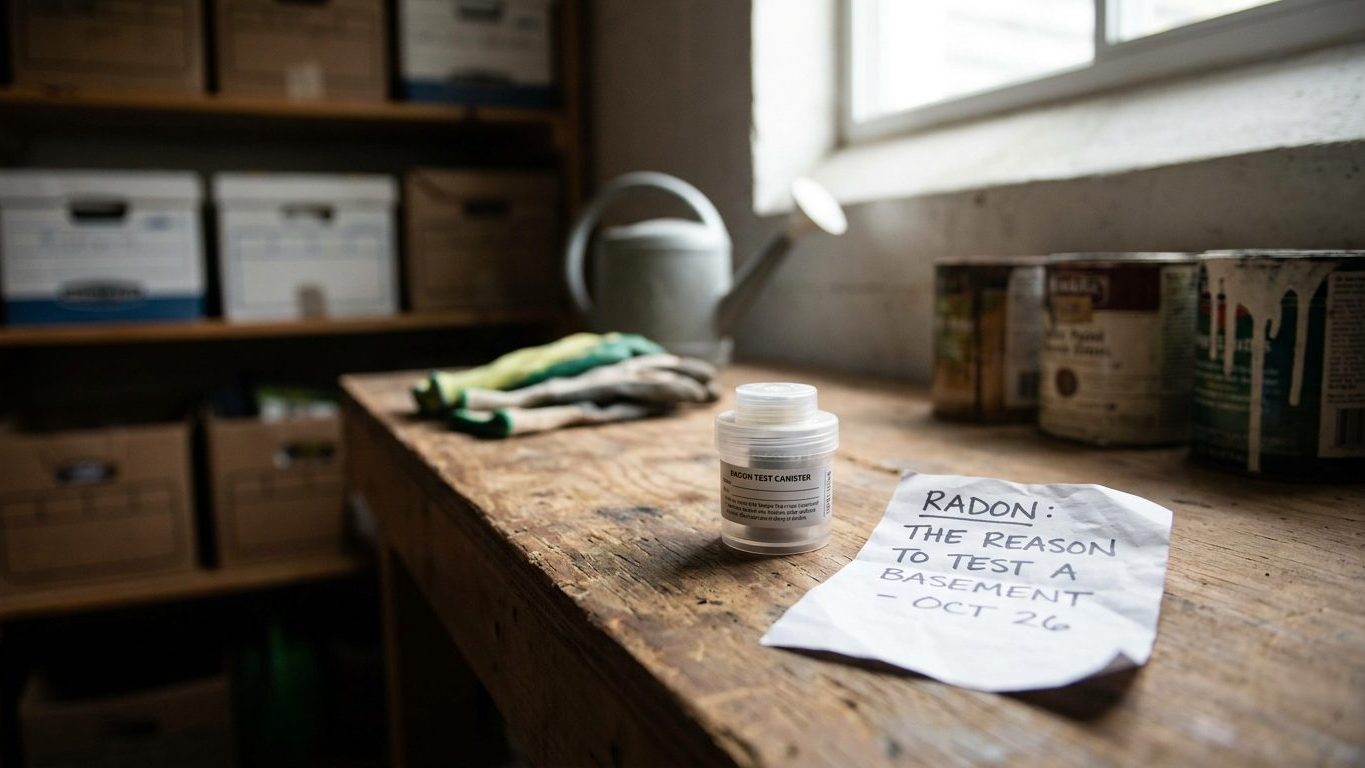

Radon doesn’t care how new your basement is, how dry it looks, or what the house next door tested. It’s a gas rising straight out of the soil under the slab, and the only way to know your number is to test for it. Get a test kit or a certified radon tester into the lowest lived-in level of the house before you worry about anything else down there.
What is actually going on

Radon is a soil gas. It comes from the ordinary breakdown of uranium that’s present, in small amounts, in almost all rock and soil, and it moves upward through the ground until it finds a path into whatever sits on top of it. In a house, that path is usually the lowest part of the structure: a crack in a slab, the seam where a foundation wall meets the floor, an open sump pit, a hollow-block wall, or the bare dirt of a crawl space. Once it’s inside, it accumulates, and it accumulates most in the basement, because that’s the level closest to the source and often the one with the least air movement.
You cannot see it, smell it, or taste it. There’s no stain, no odor, no visual tell that separates a house with a radon problem from one without. A house built last year can test high. A house with a brand-new, bone-dry, finished basement can test high. A house standing right next to one that tested clean can test high anyway, because radon entry depends on that specific foundation’s cracks and gaps, not on the block or the county it sits in.
This is the one part of basement work that is dangerous rather than expensive. A cracked footing or a damp crawl space costs money to fix and rarely threatens anyone directly. Radon is different. The EPA and the U.S. Surgeon General recommend testing every home for radon, in every state and at every age of construction, because long-term exposure is linked to lung cancer and there is no way to know a specific home’s level without measuring it.
Radon potential maps exist by region, and they describe broad tendencies across a wide area. They don’t describe your address. The EPA doesn’t treat a map as a substitute for an actual test in the actual house, and neither should you.
The action level is 4 pCi/L, and no level of radon exposure is considered completely safe. At or above 4 picocuries per liter, the EPA recommends fixing the house. Between 2 and 4 pCi/L, the EPA still says it’s reasonable to consider fixing it, precisely because that safety floor doesn’t exist. Levels are almost always highest in the lowest occupied level of the building, which is why a basement used only for storage still deserves its own test rather than a number borrowed from upstairs. If the house also has a crawl space that’s never been finished, the moisture problems down there are worth a separate look, and moisture in a crawl space often shares an entry path with radon even though the two are caused by different things.
What to look at, and in what order
Testing is the only step in this whole subject that isn’t a judgment call. A hairline crack in a slab might reasonably wait a season while you watch it. Radon shouldn’t, because the EPA recommends testing every home regardless of age, location, or how the basement looks, and there’s no substitute for a measurement.
Start with the least involved option and move up only if the first result asks for it. The order below runs cheapest and simplest first.
| Test type | Duration | What a result rules out | What it doesn’t tell you |
|---|---|---|---|
| Short-term kit (charcoal canister or alpha-track, placed by the homeowner) | A few days up to about 90 days | Whether the home is clearly far below, or clearly above, the action level right now | Seasonal swings. Radon often runs higher when the house is closed up, so a result near the line needs a second look |
| Long-term kit | More than 90 days | Seasonal variation, giving a full-year average exposure figure | Which specific crack or gap the gas is entering through |
| Professional test with a continuous radon monitor | Typically 48 hours under closed-house conditions | Tampering or interference, which matters for a real estate transaction | Year-round average, since it’s a short snapshot |
Reading the result
A single short-term result at or above 4 pCi/L is enough to act on, but the EPA’s own guidance is to follow a first short-term test with a second short-term test or a long-term test before deciding on mitigation. Radon readings shift with weather, ventilation, and even which way the wind was blowing on the day of the test, so one reading close to the line is a reason to retest, not a reason to relax.
A result between 2 and 4 pCi/L doesn’t clear the house. The EPA still lists that band as worth considering action on. Because no level of radon is known to be safe, a homeowner in that range isn’t wrong to fix it even though it sits under the formal action level.
None of this replaces the other checks that matter for basement moisture and settling, and it doesn’t happen instead of them. It happens alongside them. A house can have a bowing wall, a wet crawl space, and a radon reading that needs attention, all at once, all unrelated to each other in cause.
Watch it, or get someone in
Some things around a foundation are fine to keep an eye on for a season before calling anyone. A radon test is not one of them. It’s cheap and simple enough that “wait and watch” isn’t a defensible answer here the way it can be for a hairline crack.
What you can reasonably track yourself
- Whether a crack you’ve already had assessed is staying the same width or opening further
- Whether a floor drain or sump pit backs up during heavy rain
- Whether damp staining on a foundation wall is growing, shrinking, or staying put across seasons
- Whether a retest, done a year or so after the last one, still lands in the same range
What needs a call now
A radon result at or above the action level needs a certified radon mitigation contractor, not a general handyman and not the same company that’s trying to sell you a basement waterproofing package. Radon mitigation is its own trade. A qualified contractor designs a sub-slab depressurization system specific to that foundation, and afterward the house gets retested to confirm the system actually brought the number down.
A crack that’s widening, a wall that’s bowing, or a floor that’s noticeably out of level is a different call entirely, and it goes to a structural engineer. An engineer assesses the movement and tells you what’s actually happening without a financial stake in what repair gets sold afterward. That’s a different conversation from whether the cause is ordinary settling or something that needs immediate attention, which is covered in more depth in foundation settlement, old or still happening.
A waterproofing salesman is a third, separate role, and it’s worth naming the difference plainly. That person is there to sell a specific product or system for water intrusion. Their assessment isn’t neutral the way an engineer’s is, and it has nothing to do with radon at all, since sealing a wall against water doesn’t reliably seal it against soil gas.
What has to happen first
Radon testing doesn’t wait on anything else. It’s independent of whatever else is going on with the foundation, and it costs almost nothing to start, so it belongs at the front of the list regardless of what else the house needs.
Water management comes before any finish work, and diagnosis comes before repair. If a basement has a wet floor, a musty smell, or a sump pump that runs constantly, sort that out before drywall, flooring, or insulation go in, because finishing over an active moisture problem just hides it. Gutters and grading outside the house affect how much water reaches the foundation in the first place, which is a roofing and drainage question more than a foundation one. A sump pump that’s undersized or failing is a plumbing question. What goes on the walls afterward, and what goes down on a slab once it’s dry, are insulation and flooring decisions that only make sense once the water problem is actually solved rather than covered up.
If a radon mitigation system is going in around the same time as drainage work, tell both contractors about each other. A sub-slab depressurization system and a sump pit can share the same footprint, and coordinating the two avoids one crew undoing the other’s work. For the wider picture of how water, cracks, and gas all move through the same handful of entry points in a foundation, foundations and basements is the place to start before tackling any one symptom on its own.
Common questions
Does a sump pump or a french drain lower radon too?
Not on its own. A sump pit is actually a common radon entry point, since it’s an open gap straight down to the soil, and a plain drainage system doesn’t seal or vent that gas. A sealed sump lid can help a little, but bringing radon down to a safe range takes a dedicated mitigation system, and the only way to confirm it worked is a retest.
If the house already has a radon mitigation system from a previous owner, do I still need to test?
Yes. Fans fail, pipes get disconnected, and conditions in the house change over the years, so an existing system is not proof of a current safe reading. Test the house as if the system weren’t there, and if the number comes back elevated, have the existing system checked before assuming it’s doing its job.
Is radon worse in a crawl space or in a basement?
Levels are usually highest in whichever level sits lowest and closest to the soil, which is the basement in most houses with one. A house built over a crawl space instead still needs its own test, because the same soil gas is entering through the crawl space floor and can move up into living space above it.
Will sealing visible foundation cracks fix a radon problem by itself?
Sealing the obvious gaps can reduce entry somewhat, but it’s not a substitute for a proper mitigation system if the test result calls for one. Radon moves through gaps too small to see as easily as through the ones you can, so the only way to know whether sealing was enough is to retest afterward.