
Expansive clay is the reason a house can rise and fall with the seasons instead of staying put. The clay itself changes volume as it wets and dries, and whatever sits on top of it moves along with it, not because of the weight above but because of the ground below. Watch how a specific crack or door behaves across one full dry season and one full wet one before deciding whether you have a problem worth calling someone about.
What is actually going on

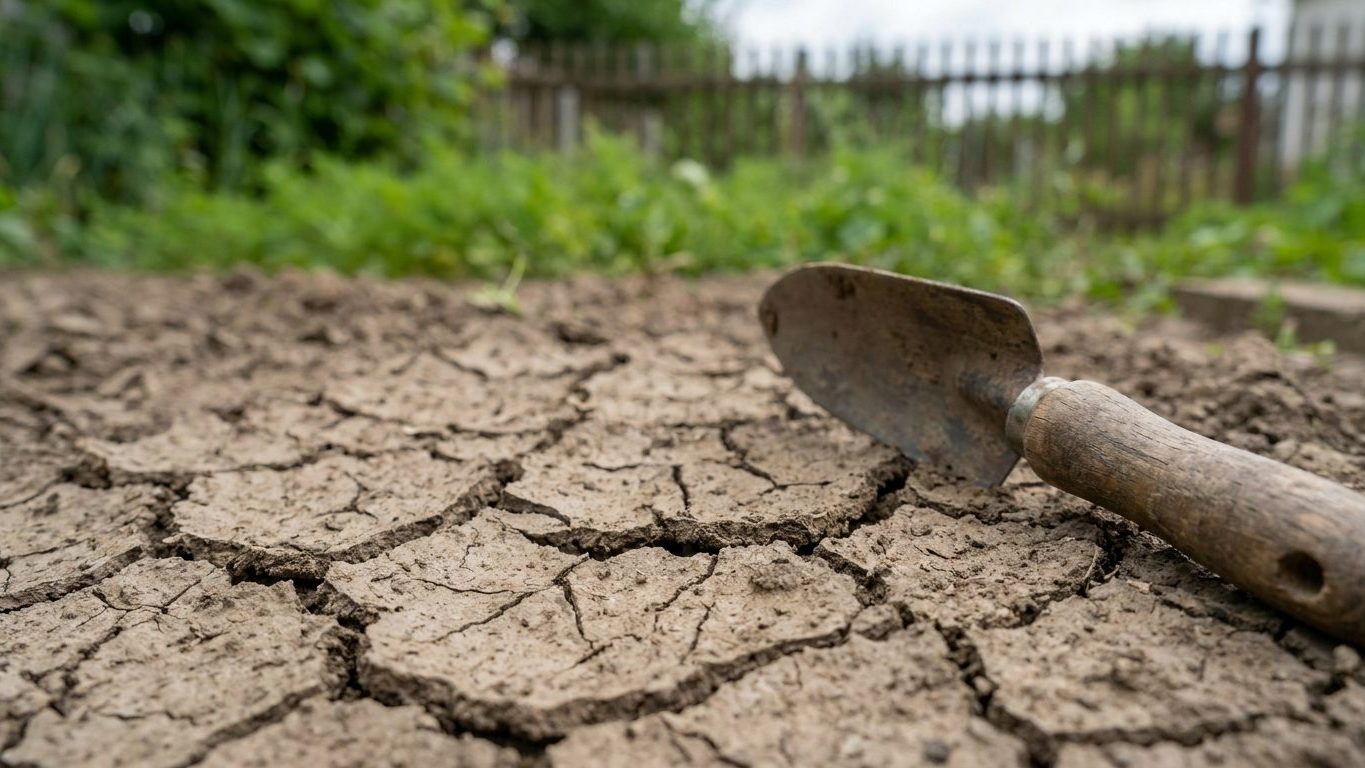
Expansive clay is the reason the ground itself changes size instead of staying still. Certain clay minerals hold water inside their own structure, not just between particles, so when the soil gets wet the clay swells and pushes upward. When that same soil dries out, the water leaves the clay minerals and the ground shrinks back down, sometimes cracking at the surface in the process. A house sitting on top of that clay moves with it, and because the ground rarely dries or wets evenly across the whole footprint, one corner of a foundation can lift or drop more than another.
Why it’s the difference in movement that matters
That uneven movement, not the movement itself, is what causes damage. A foundation that rose and fell evenly across its whole area would cause almost no visible cracking anywhere in the house. It is the difference in movement from one point to another, called differential movement, that racks door frames out of square, opens gaps at the top of walls, and puts stair-step cracks through masonry. The pattern of cracking usually tells you more than the size of any single crack does.
The clay near a foundation dries out faster where a tree draws water from the soil, where a downspout dumps water in one spot every time it rains, or where a plumbing leak keeps one patch of ground wetter than the rest. That is why movement often shows up first at one corner or along one wall rather than everywhere at once, and why it tends to track the seasons, worse after a dry stretch and easing back after a wet one, then repeating the following year.
Some of that seasonal movement is normal for a house built on expansive clay and will never be eliminated entirely. What is not normal is movement that keeps getting worse year over year instead of cycling back, or cracking that runs through structural elements rather than finishes. Only a structural engineer can tell you which one you are looking at, since a crack’s width or direction does not set a threshold. What it can do is help you watch the right things, in the right order, so that when you do call someone, you can describe a pattern instead of a single alarming photo.
What to look at, and in what order
Before spending money on anyone, work through the cheap and the reversible first. Each step below either rules something out or narrows down what is actually driving the movement, and the order matters because later steps only make sense once the earlier ones are answered.
Five checks, in order
- Walk the perimeter and record the crack pattern, not just its presence. Diagonal, stair-step cracks running from window and door corners point toward differential movement of the kind expansive clay causes. Vertical hairline cracks straight up a wall are far more often ordinary shrinkage in the material itself and rule out a foundation problem on their own.
- Check where your gutters and downspouts actually discharge. Water dumped against one corner of the house season after season keeps that patch of clay wetter than the rest, and a downspout emptying close to the wall can explain movement concentrated at a single point rather than across the whole foundation.
- Look at what is growing within reach of the foundation. Large trees and thirsty shrubs pull moisture out of clay on their side of the house even in a wet season, and our guide to Trees Near a Foundation: The Real Mechanism goes into how far a given species can reach and dry the soil out unevenly.
- Track how doors and windows operate across a full season, not a single week. A door that sticks in late summer and swings free again after fall rain is behaving the way a house on expansive clay is expected to behave. A door that keeps getting tighter through both a wet season and a dry one suggests movement that is not reversing, which is a different and more serious pattern.
- Get a level survey of the slab or foundation top from a professional if the pattern above looks uneven rather than uniform. This is the first step that costs real money, and it earns its keep only after the free observations above have already suggested there is a real difference in elevation from one point to another, not just cosmetic cracking in finishes.
Watch it, or get someone in
Cosmetic movement you can watch yourself. Hairline cracks in drywall or paint, a door that sticks in late summer and frees up by winter, small gaps at baseboards that open and close with the seasons: these are worth a photo and a date each time you notice them, but they do not need a phone call yet. What matters is whether the same crack looks the same after a full year has passed, through one dry season and one wet one. If it does, you are watching normal cyclical movement in expansive clay, not a developing problem.
Call a professional when the pattern stops cycling and starts progressing. A crack that is visibly wider or longer than it was a year ago, a horizontal crack running along a foundation wall rather than diagonally through a corner, a door or window that has stopped working altogether rather than just sticking seasonally, or a wall that looks like it is bowing or rotating out of plane are all reasons to stop monitoring and get an assessment. So is any crack where you can feel air movement or see daylight through it.
The professional to call
The professional to call for an assessment is a structural engineer, not a foundation repair company. An engineer’s job is to look at the pattern, sometimes with instruments to measure movement over time, and tell you what is happening and whether it is serious. A repair contractor’s job is to sell you a repair, and a waterproofing salesman’s job is to sell you waterproofing. None of those three are wrong to eventually involve, but only the first one has no financial interest in finding a problem, which is exactly why it should come first.
If new cracking shows up in a basement floor or wall alongside older, already-explained cracks, that is also a reasonable moment to test for soil gas, since a new opening changes how gas enters the house even if the crack itself turns out to be cosmetic. Our guide to Radon: The Reason to Test a Basement covers what a test involves and how to read the result.
What has to happen first
Outside drainage comes before anything you do inside the house, and the broader mechanics in Foundations and Basements: Almost Everything Here Is Water come first, since expansive clay only causes trouble when it has water to react to unevenly. Grading that slopes away from the house and gutters that discharge well clear of the foundation reduce how much of that swelling and shrinking is caused by the site rather than the clay itself.
The order that saves money
Inside the house, water management comes next, and a working sump pump matters more than any finish you put over a slab or a wall. Get the plumbing side of that right before you insulate a basement wall or lay flooring, because insulation and flooring both hide water problems instead of solving them, and a slab that keeps taking on moisture will keep moving the clay beneath it regardless of what sits on top of it.
Diagnosis has to come before repair, every time. Filling or patching a crack before an engineer has looked at it does not fix anything, it just hides the one piece of evidence that would have told you how serious the movement actually is. Once a professional has looked at the pattern and told you, the order for everything after that, drainage work, structural repair if it is needed, and finish work last, follows in a straightforward line. Doing it out of that order is how homeowners end up paying twice, once for a finish that gets damaged again and once for the repair that should have come first.
Common questions
Does expansive clay affect the whole state or just some areas?
It varies block by block as much as region by region, since it depends on the specific clay minerals in the soil at your address rather than a state boundary. Check with your county or state geological survey, or a local soils map, rather than assuming your neighborhood matches a general reputation for the state.
Will watering my yard evenly stop the movement?
Consistent watering can reduce the swing between wet and dry, but it will not stop expansive clay from being expansive. The goal with watering around a foundation is keeping moisture roughly even year round rather than eliminating moisture entirely, since a suddenly parched clay bed shrinks just as hard as a suddenly soaked one swells.
Is it safe to fill a crack myself once I’ve watched it for a while?
Not before a structural engineer has assessed it, even if the crack looks stable. Filling it removes the one piece of physical evidence that shows how the crack has behaved, and if movement starts again later you lose the ability to compare it to what it looked like before.
Can removing a tree near the house stop the movement?
Sometimes it helps and sometimes it makes things temporarily worse, because a large tree that is suddenly gone stops pulling water out of the clay on its side of the house, and that soil can swell back toward a wetter state unevenly. This is a case for professional advice rather than a guess, since the wrong removal can shift the problem instead of solving it.