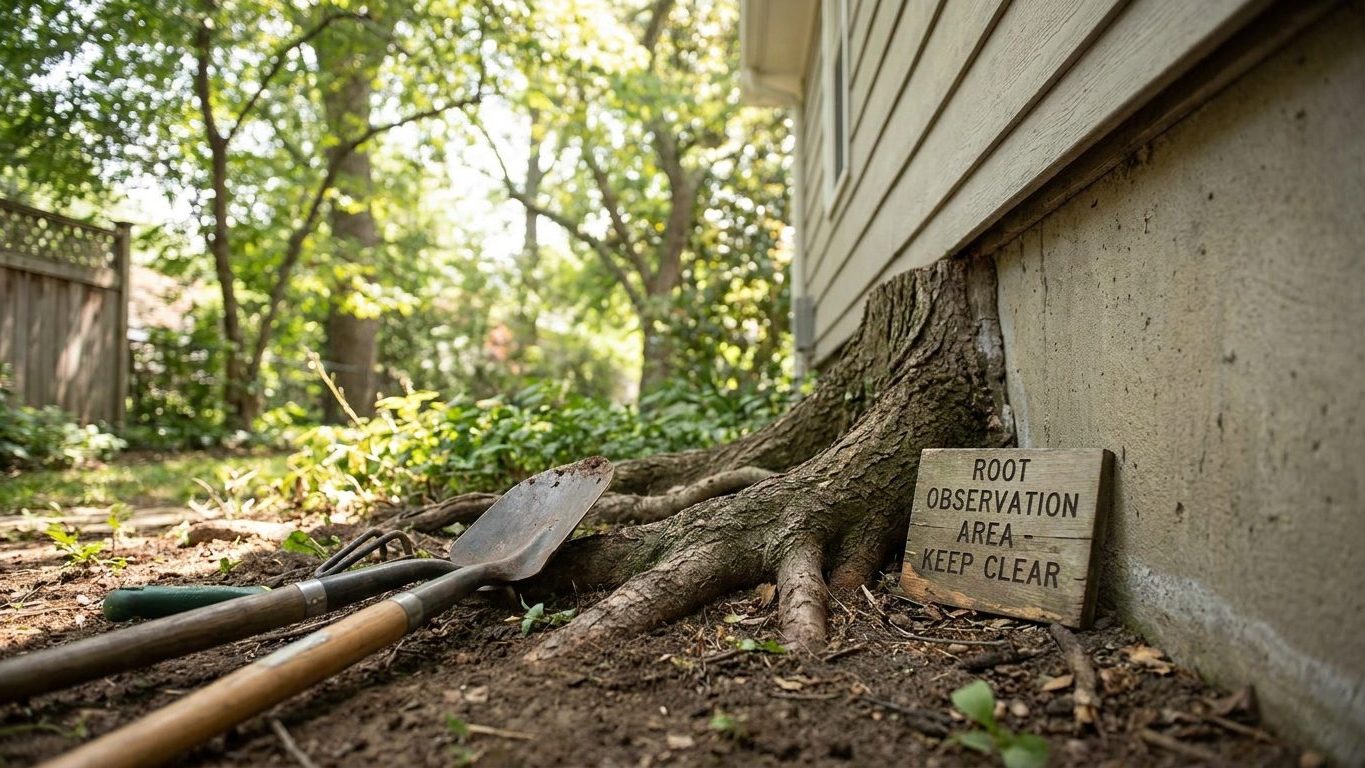

Oak roots don’t punch through a foundation wall. What actually shows up years after a tree goes in traces back to water, not force: a big tree pulls enormous amounts of moisture from the soil, and in clay that loss shrinks the ground unevenly under the footing. The slab or wall then follows the ground down on one side. Check the soil type under your foundation and the distance to the nearest large tree before assuming a crack is ordinary settling.
What is actually going on

Roots get blamed for foundation cracks constantly, and in the vast majority of cases they are not the cause. A root growing against a footing usually loses that fight. Concrete is far harder than a root tip, and roots tend to grow around an obstruction rather than through it. The exception, an unusual one, is a root that finds an existing gap or a weak joint and follows it, but that is opportunism, not force.
What a large tree actually does to a foundation is remove water from the soil around it, sometimes from a radius well beyond the reach of its branches. A mature tree draws a significant amount of water out of the ground on a hot day, and it pulls that water from wherever roots have spread, not only from directly beneath the canopy. In sandy or gravelly soil this barely matters, because that soil doesn’t change volume much. In clay, it matters enormously, because clay shrinks as it dries and swells again when it wets.
That shrink-swell cycle is the actual mechanism behind most tree-related foundation problems. A tree growing close to a house pulls moisture out of the clay under one section of the footing more than it pulls from clay elsewhere, because roots are denser on that side. The soil there shrinks, the footing loses some of its support, and that corner or wall segment settles slightly. Everywhere else, the soil hasn’t moved, so the house is now sitting unevenly. That uneven settling is what shows up as a crack, a door that sticks, or a gap opening at a window frame.
This is also why removing a mature tree can cause its own version of the same problem. Once the tree is gone, the soil that had been kept relatively dry starts absorbing water again and swells back up. If it swells unevenly, or faster on one side than another, the foundation moves a second time, in the opposite direction. Neither the drying phase nor the rewetting phase is something a homeowner can stop. Only a professional assessment can say if that movement is minor or serious enough to matter structurally, and that distinction takes a trained eye, not a tape measure.
A crack that only ever looks cosmetic, hairline, and doesn’t come with doors sticking, floors sloping, or gaps opening at the roofline, is something to watch. A crack that widens, that runs diagonally through a wall, that comes with a door or window suddenly out of square, or that shows up alongside a wall shifting horizontally, is not something to diagnose from a driveway. Only a structural engineer can tell you which one you’re looking at. For a broader look at how water moves through a foundation generally, the Foundations and Basements: Almost Everything Here Is Water guide covers the mechanisms that apply with or without a tree nearby.
What to look at, and in what order
Before assuming a tree is responsible for movement at all, work through a short sequence of checks, cheapest and least invasive first. Each one either points toward the tree or points away from it, and running them in order keeps you from acting before you know what you’re actually dealing with.
Start with what’s free to check
- Measure the distance and note the species. A large, thirsty tree close to the house is a stronger suspect than a small ornamental tree well away from it. This step rules nothing in or out by itself, it just tells you how much weight to give the tree before you look at anything else.
- Look up the soil type under the foundation. The USDA’s Web Soil Survey, a free tool run through the Natural Resources Conservation Service, shows whether a site sits on clay, loam, or sand. If the soil isn’t a clay or a clay-heavy loam, the shrink-swell mechanism described above mostly doesn’t apply, and the tree becomes a much weaker suspect.
- Watch how the crack behaves across a season, not just once. A crack that opens in the driest part of the year and tightens back up after a wet stretch is behaving exactly like a clay-shrinkage crack. A crack that stays constant regardless of rainfall, or one that appeared suddenly rather than gradually, points away from a tree and toward something else, possibly something structural.
- Check the grading and drainage around the foundation, including where gutters and downspouts discharge. Water pooling against a foundation on one side can produce the same uneven-settlement pattern as a tree pulling water out on the other, and the two can also be happening at once.
Notice that none of these four checks involves digging near the foundation. Test pits and trenches along a footing are how foundations get undermined and how people get hurt when soil collapses back into a hole. That kind of work, if it’s ever warranted, belongs to a professional with the equipment and training to do it safely, not to a homeowner with a shovel on a Saturday.
If the crack pattern looks seasonal and the soil survey confirms clay, the tree is a genuine candidate. If the pattern doesn’t track with rainfall at all, look at drainage first, and also rule out frost-related movement, since a foundation that heaves in winter and settles back in spring is showing frost heave, a completely different mechanism driven by freezing groundwater rather than a tree pulling moisture out of clay.
Watch it, or get someone in
Most of what a homeowner can reasonably do here is monitoring, and monitoring only works if it’s consistent. Photograph the crack next to a coin or a ruler for scale, note the date, and repeat every few weeks through at least one dry stretch and one wet stretch. Note whether doors and windows near the crack still open and close normally. A crack that isn’t changing, that stays the same width and length over several months across different weather, is one you keep watching, not one you act on.
What moves the decision from watching to calling someone
- The crack is widening measurably between checks, not just appearing different in changing light.
- A door or window that used to close normally now binds or won’t latch.
- A crack runs diagonally through a wall rather than following a mortar joint, or shows any offset where one side sits higher than the other.
- Floors are visibly sloping, or a new gap has opened between a wall and the ceiling or floor.
Any one of those is a reason to call a structural engineer, not a contractor. This distinction matters more than most homeowners realize. An engineer’s job is to assess the problem and say whether it is structural, and if it is, how serious. An engineer does not sell foundation repair, has no financial stake in finding a problem, and will tell you plainly if what you’re looking at is cosmetic and not worth further action. That independence is worth paying for on its own.
A drainage contractor is a different call entirely, and the right one if your checks pointed at grading, gutters, or standing water rather than at the tree itself. Their job is managing water around the foundation, not assessing the foundation’s condition, and a good one will say so if they see something that looks structural rather than diagnosing it themselves.
Be careful with anyone who inspects a crack and immediately quotes a fix, especially injected sealants or wall anchors, before anyone has determined whether the movement is even ongoing. That’s the pattern of a waterproofing or foundation-repair salesperson working on commission, whose incentive is to find a problem their product solves, not to tell you the crack is stable. Get the engineer’s assessment first, ideally in writing, and only then bring in a contractor to act on it.
What has to happen first
Once you know whether a tree, drainage, or something structural is behind the movement, the order of fixes matters as much as the fixes themselves. Outside water management comes before anything done on the inside, every time, because treating the inside of a basement or crawl space while water is still getting in from outside just moves the moisture problem behind a new finish, where it’s harder to see and worse when it’s finally found.
That means gutters, downspout extensions, and grading around the foundation get addressed first, covered in the roofing guides on gutter systems, before anyone talks about interior sealants, drains, or a sump pump, which belong to the plumbing side of things. A sump pump handles water that’s already inside; it does nothing about the water still arriving from outside, and installing one without fixing exterior drainage just means the pump runs constantly instead of solving anything.
If the crawl space is damp, the same order applies before you insulate or seal it. The crawl space needs its own diagnosis first, covered in Moisture in a Crawl Space, and Where It Goes, because sealing a crawl space that still has an active water source just traps the moisture against the wood and the insulation instead of keeping it out.
Insulating basement walls, covered in the insulation guides for basement walls, is a finishing step, not a repair, and it should happen only after any water and any structural questions are settled. The same goes for flooring on a slab. The flooring guides on what goes over a slab all assume the slab itself is dry and stable, and none of those materials hold up over a slab that’s still moving or still taking on moisture from below.
The tree itself is usually the last decision, not the first. Removing a mature tree solves nothing if drainage is also poor, and it can introduce its own round of soil movement as the ground rewets, discussed above. Fix drainage, get a structural opinion if the cracking warrants one, and only then decide whether the tree needs to come down, be root-pruned by a certified arborist, or simply be left alone and watched.
Common questions
Can I just cut the roots instead of removing the whole tree?
Cutting large structural roots near a foundation is a job for a certified arborist, not a DIY fix, because removing the wrong roots can destabilize the tree itself and create a new hazard. It also doesn’t undo the soil moisture pattern that’s already built up over years of the tree drawing water from that side of the house.
How close is too close for a tree near my foundation?
There isn’t one safe distance that applies everywhere, because it depends on the species, the mature root spread, and the soil type at your specific site. An arborist or your county extension office can give species-specific guidance for your area, and that’s the right place to get an actual number rather than a rule of thumb.
Will replacing a tree with shrubs or grass stop the movement?
Smaller plants pull far less water out of the soil than a mature tree, so turf and shrubs rarely create the same shrink-swell pattern on their own. Soil moisture near a foundation still depends on irrigation habits and drainage nearby, so removing the tree doesn’t guarantee the soil stays stable.
What if it’s my neighbor’s tree causing the problem?
The water-demand mechanism doesn’t stop at a property line, and a neighbor’s tree can absolutely be pulling moisture from soil under your foundation. Property disputes over tree-related damage are a legal matter that varies by jurisdiction, so that side of it needs a local attorney or your county’s office.