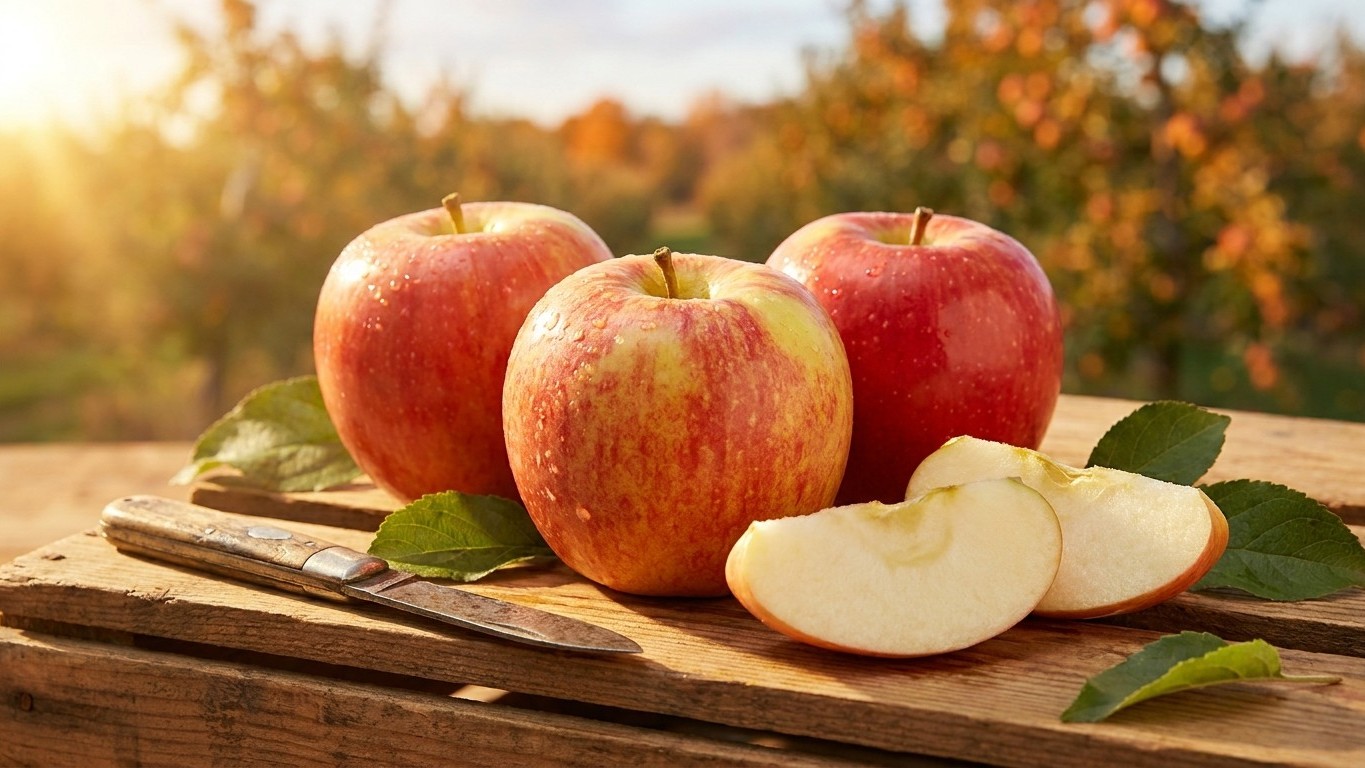

Honeycrisp ripens mid-September to early October, carries a moderate resistance to fire blight, and needs a genuine winter to set fruit well. It’s sold under its own name almost everywhere, but shoppers sometimes confuse it with other crisp, sweet apples marketed under a second name, like Mutsu (sold as Crispin) or Pink Lady (sold as Cripps Pink). Honeycrisp itself keeps one name across the country.
What Honeycrisp actually is

A grower planting this tree is really buying four things, and it helps to see them before anything else:
- When it ripens: mid-September to early October
- What it tastes like: sweet, balanced, and crisp
- What it’s good for: fresh eating and cooking, salads and fruit trays
- How long it keeps: about three and a half months in an ordinary cool store
The eating quality is the reason this variety became a supermarket fixture in the first place. According to NDSU Extension (FN1847, Table 1), the flesh is described as sweet, balanced, and crisp, which is a different profile from the sharp, acid-forward apples bred mainly for pie filling. That balance is also why it lands on the “fresh eating and cooking” line rather than the “baking only” one. A dessert apple and a pie apple aren’t interchangeable, and the reason is physical, not just a matter of taste. Pie apples need flesh dense enough to hold its shape through heat and acidity strong enough to survive baking without turning flat and sweet. Honeycrisp’s cell structure is looser and juicier, which is exactly what makes it satisfying to bite into raw, but it also means it softens faster in the oven than a variety bred specifically for pies.
Bloom season is listed as early by USU Extension, which matters more than most gardeners realize, since it narrows down which other trees can even be flowering at the same time to share pollen. Harvest runs mid-September into early October, a few weeks later than early-season apples but ahead of the late storage varieties still hanging on in November. Fire blight resistance is rated moderately resistant, a middle-of-the-road score worth understanding in practical terms further down.
Will it grow where you are
Hardiness zones
USU Extension lists Honeycrisp as suited to hardiness zones 3 through 6. That’s a wide band, running from the harsh winters of northern Minnesota and the Dakotas down through the mid-Atlantic and inland Pacific Northwest. It is not a single-zone plant; treat that 3-6 range as the working window, and check your specific zip code’s zone before ordering a tree, since microclimates (a south-facing slope, a wind-sheltered yard) can shift things by half a zone in either direction.
Winter chill
Hardiness zone answers “can the tree survive the cold.” Winter chill answers a different question: “will the tree actually flower and fruit.” Chill hours are the accumulated cold time, usually counted below about 45°F, that a deciduous fruit tree needs during dormancy before it can break bud normally in spring. Skip that requirement and the tree may leaf out unevenly, bloom sparsely, or drop buds outright.
What can be said with confidence is where this variety belongs geographically: a hardiness range of 3-6 puts it squarely in cold-winter and cold-temperate territory, not the mild-winter South or coastal California, where low-chill apple varieties bred specifically for short winters are the better fit. If you garden in zone 7 or warmer, Honeycrisp is a riskier bet regardless of how well it tolerates summer heat, simply because the winter dormancy period may run too short and too mild for the tree to reset properly.
What to plant beside it
This is usually the reason someone lands on a Honeycrisp page in the first place, and it’s worth being direct about the limits of what’s documented. Nearly all apple varieties crop better with a compatible partner nearby, since very few set a full, reliable harvest on their own pollen alone. Some are partly self-fertile and will produce a light crop solo, but yields improve substantially once a second variety is flowering at the same time within bee range, roughly 50 to 100 feet for most home gardens.
Rather than guess at a name and risk sending a reader to the nursery with bad information, the honest answer is that the specific partner varieties aren’t published here. The early bloom season narrows the search: any candidate partner needs to flower at the same early window, not a mid- or late-season variety that opens its blossoms weeks apart.
A few practical rules still apply while you’re shopping for a partner, even without a named list for this variety:
- Two trees blooming at the same time is necessary but not sufficient, since a parent variety generally cannot pollinate its own seedling
- A variety with sterile pollen can receive pollen and set fruit, but it cannot pollinate anything else, so it never counts as the “second” tree in a two-tree planting
- Crabapples with overlapping bloom time are a reliable fallback pollen source when you’re unsure of a compatible full-size variety
Given the missing partner data here, the safest move is to buy from a local nursery that can confirm bloom overlap and known compatibility for the specific varieties sold in your region, or to check a dedicated apple pollination guide before finalizing an order.
Growing it well
Fire blight
USU Extension rates Honeycrisp moderately resistant to fire blight, a bacterial disease that can blacken and wilt blossoms and young shoots almost overnight in warm, wet spring weather. A moderate rating doesn’t mean immune. In practice it means this tree is less likely than a highly susceptible variety to suffer a severe outbreak, but a grower should still watch new growth each spring for the telltale shepherd’s-crook wilt and blackened leaves, and prune out any infected wood well below the visible damage, disinfecting shears between cuts.
Growth habit and thinning
Honeycrisp trees tend toward vigorous upright growth when young, which means early training matters. Spreading the main branches to wider angles, either with spreaders or by weighting them slightly, encourages earlier fruiting and a stronger branch structure that can hold a heavy crop without splitting.
Fruit thinning is worth doing every year on this variety, not just when a heavy crop demands it. Removing extra fruitlets down to one per cluster, spaced several inches apart along the branch, reduces the strain on limbs and helps the remaining apples size up properly by harvest.
Biennial bearing
Left unthinned, apple trees in general are prone to alternating a heavy crop one year with a light or nonexistent one the next, a pattern called biennial bearing. Consistent annual thinning is the main tool a home grower has to smooth that cycle out and keep production steadier year over year, rather than swinging between a glut and a gap.
Picking it and keeping it
The harvest window for Honeycrisp runs mid-September to early October, but a calendar date is only a starting point. The real test happens at the tree, and it’s best done as a short sequence rather than a single glance:
- Lift and twist: cup the apple in your palm, tilt it upward, and give a gentle twist. A ripe apple separates from the spur easily; one that resists and has to be yanked isn’t ready yet.
- Seed color: cut one sample apple open. Seeds should have turned dark brown; pale or greenish seeds mean more time is needed on the tree.
- Ground color: check the background skin color, the shade underneath any red blush, on a couple of apples. It should shift from green toward a creamy yellow as the fruit matures.
Storage
Once picked, Honeycrisp keeps for about three and a half months in an ordinary cool store, which is the realistic figure for a home grower using a cellar, unheated garage, or root cellar kept cold and reasonably humid. A longer figure of around six months is sometimes quoted, but that number assumes controlled atmosphere storage, meaning a commercial packhouse regulating oxygen levels and temperature precisely, not a setup available to a backyard grower. Plan around the three-and-a-half-month figure, store apples separately from vegetables that give off ethylene, and check periodically for any fruit starting to soften, since one spoiling apple can speed up decay in the whole batch.
Common questions
When does Honeycrisp ripen?
Mid-September to early October, according to USU Extension, though exact timing shifts a bit with local weather and elevation each year.
Is Honeycrisp resistant to fire blight?
It’s rated moderately resistant, which lowers the odds of a severe outbreak compared to highly susceptible varieties but doesn’t eliminate the risk, so spring monitoring is still worthwhile.
Can Honeycrisp pollinate itself?
No specific self-fertility or partner data is published in the sources behind this page. As with most apples, planting a compatible variety with overlapping early bloom nearby will generally improve fruit set.
How long does Honeycrisp keep after picking?
About three and a half months in an ordinary cool store. A six-month figure exists but applies only to controlled atmosphere storage used commercially, not typical home conditions.
Is Honeycrisp the same as Crispin or Pink Lady?
No. Crispin is a market name for the Mutsu variety, and Pink Lady is a market name for Cripps Pink. Honeycrisp is sold under its own name and is a distinct variety from both.