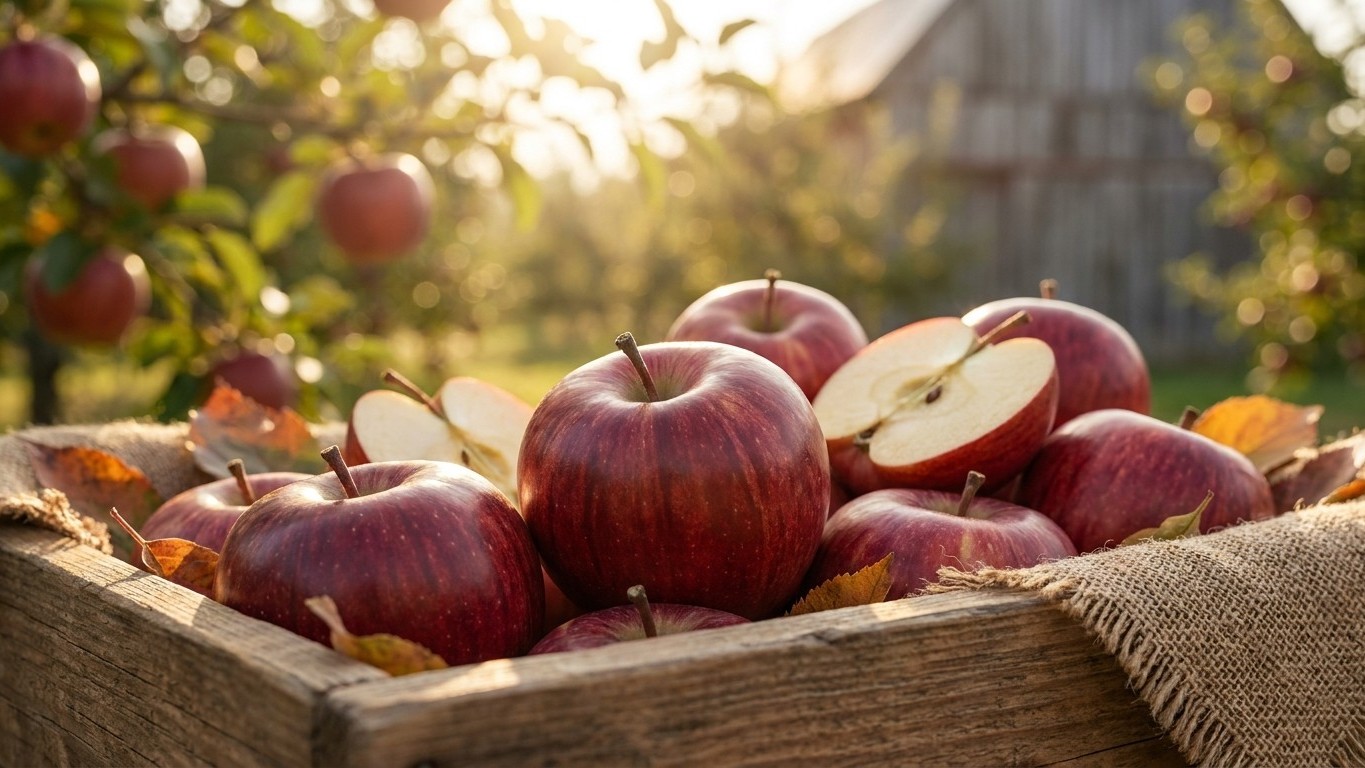

Jonamac is a McIntosh-type apple bred for the same soft, aromatic bite as its parent but ready to pick two to three weeks earlier. If you’re deciding whether it fits your yard, the answer hinges on three things: your climate zone, what you’ll plant next to it for pollination, and whether you’re after a sauce apple or a keeper. Here’s what the record actually says.
What Jonamac actually is

According to Utah State University Extension’s guide to apple production for home gardens, Jonamac carries a specific set of traits worth knowing before you order a tree. Four things matter most to a grower:
- Ripens: Late September to October
- Taste: Aromatic and sweet-tart, with the soft flesh of its McIntosh parent
- Best for: Sauce and fresh eating, not pie
- Keeps: Storage duration isn’t published in this source
That harvest window puts Jonamac ahead of standard McIntosh, which is part of why the variety exists at all. Breeders wanted the McIntosh flavor profile without waiting into late fall for it. The result is an apple that tastes like a familiar favorite but shows up on the tree earlier in the season, which matters if your growing window is short or if an early frost tends to threaten your orchard.
The eating quality leans aromatic and sweet-tart rather than sharply acidic, and the flesh is soft, a trait inherited directly from its McIntosh lineage. That softness is the reason the source flags it as a sauce apple rather than a pie apple. Pie fruit needs flesh that holds its shape under heat and acidity that doesn’t fade in the oven. Jonamac’s flesh breaks down readily when cooked, which is exactly what you want in applesauce (no mashing required, minimal added liquid) but exactly what you don’t want in a pie, where you’d end up with mush instead of distinct slices. If you’re planning a pie orchard, this isn’t your tree. If you want a fall sauce apple with good flavor and minimal fuss at the stove, it is.
Will it grow where you are
Hardiness zone
USU Extension lists Jonamac as hardy in zones 4 through 8. That’s a wide band, running from the cold winters of northern Minnesota and Maine down through the milder mid-Atlantic and into parts of the Southeast’s upper edge. If your winter lows regularly dip into the negative twenties (zone 4) or you’re gardening somewhere that rarely sees a hard freeze at all (zone 8), Jonamac is rated to handle either end. That range alone rules out the coldest pockets of zone 3 and the hottest reaches of zone 9 and above.
Winter chill
Hardiness zone is only half the equation. Apples also need a minimum number of hours below about 45°F each winter to break dormancy properly and flower on schedule the following spring, a requirement called chill hours. Without enough of it, bloom is delayed, uneven, or sparse, even in a climate where the tree survives the winter just fine. The source used for this page doesn’t publish a chill-hour figure for Jonamac, so rather than guess at a number, it’s worth saying plainly: that data isn’t documented here. What the hardiness range does tell you is that Jonamac belongs to the northern and mid-latitude side of apple growing, not the warm-winter South. Gardeners in zones 7 and 8 who’ve had good luck with other McIntosh-family apples locally are the best judge of whether their winters deliver enough cold for this one too.
What to plant beside it
This is usually the question that brings people to a variety page in the first place, and here it has an honest, if unsatisfying, answer: pollination partners for Jonamac are not published in the sources used for this page. No list of compatible companion varieties is given, so nothing gets named at a guess here.
What can be said with confidence is the general rule that applies to nearly every apple tree. Nearly all varieties crop better with a compatible partner, since a full crop rarely comes from a tree’s own pollen alone. Some varieties are partly self-fertile and will set a modest crop solo, but yields improve substantially with a second variety blooming nearby, whether that’s a neighbor’s tree over the fence or a crabapple planted for the purpose. Jonamac’s bloom season is listed as mid-season, which is a useful starting point: a compatible partner needs to flower at roughly the same time, since pollen arriving before or after the bloom window does no good.
Two trees flowering together still isn’t automatically enough. A parent variety can’t pollinate its own seedling, so if Jonamac’s parentage traces to McIntosh, planting McIntosh itself as a partner is not a safe assumption without confirmation, and no such confirmation exists in the sourced material here. Until a documented partner list turns up, the practical move is a mid-season bloomer of a different, unrelated lineage, ideally one already known to grow well in your zone. For the mechanics of bloom timing, self-fertility, and how far apart trees can stand and still pollinate each other, see our guide to apple pollination.
Growing it well
Fire blight susceptibility
USU Extension rates Jonamac as moderately susceptible to fire blight, a bacterial disease that can move fast in warm, wet spring weather right around bloom. In the garden, that rating translates into blackened, wilted shoot tips that curl over into a shape often described as a shepherd’s crook, sometimes with a burnt look to the leaves that gives the disease its name. Moderately susceptible means Jonamac isn’t among the most vulnerable varieties, but it isn’t resistant either. Watch new growth closely during and after bloom, especially following a warm rain, and prune out any infected wood well below the visible damage, sanitizing tools between cuts so the bacteria doesn’t spread to healthy branches.
Bloom timing and thinning
Bloom season is listed as mid, which affects more than pollination. A mid-season bloom generally gives some buffer against the earliest spring frosts that can wipe out flowers on the earliest-flowering varieties, though it offers no guarantee in a hard late freeze. Beyond bloom timing and disease rating, this source doesn’t document Jonamac’s growth habit or its tendency toward biennial bearing, so nothing specific is claimed on either point here. As general orchard practice regardless of variety, thinning young fruit down to one apple per cluster in late spring reduces limb stress, improves fruit size, and tends to even out production from year to year, which is worth doing on any apple tree until you’ve observed a few seasons of its particular bearing pattern firsthand.
Picking it and keeping it
Harvest for Jonamac runs late September into October, but a calendar date is only a starting point. Weather shifts the exact week from year to year, so the more reliable approach is to check the fruit itself using a simple three-step sequence:
- Lift and twist: Cup the apple in your hand, tilt it upward, and give a gentle twist. A ripe apple separates cleanly from the spur; if it resists and you have to yank, it needs more time.
- Seed color: Cut one sample apple open. Seeds that are still pale or greenish mean the fruit isn’t finished; brown, fully colored seeds are a sign of maturity.
- Ground color: Look at the background skin color, not the red blush. As the apple ripens, the underlying green tone fades toward yellow or cream, even on fruit that’s mostly red on the surface.
Storage
The source used for this page doesn’t give a specific storage duration for Jonamac. Given its soft McIntosh-type flesh, and the general behavior of that family in storage, it’s a fruit best treated as a near-term eater rather than a long-haul keeper: refrigerate promptly after picking, keep it away from apples that bruise easily, and check the batch periodically for soft spots rather than assuming it will hold indefinitely. If you want a variety bred specifically for months in cold storage, that’s a different tree and a different conversation.
Common questions
Is Jonamac the same as McIntosh?
No. Jonamac is bred from McIntosh and shares its soft flesh and aromatic sweet-tart flavor, but it ripens earlier, in late September to October rather than deeper into fall.
Can I use Jonamac for pie?
It’s not the best choice. Its flesh breaks down readily when cooked, which makes it well suited to sauce but likely to turn to mush in a pie shell.
What pollinates a Jonamac apple tree?
No specific partner list is published in the sources used for this page. A mid-season-blooming variety of different, unrelated parentage is the safer general choice until documented partners are confirmed.
What zones can grow Jonamac?
USDA hardiness zones 4 through 8, according to USU Extension. Winter chill-hour requirements aren’t published for this variety.
Does Jonamac get fire blight easily?
It’s rated moderately susceptible, meaning it’s neither the most resistant nor the most vulnerable variety. Watch new shoots closely after warm, wet spring weather and prune out infected wood promptly.