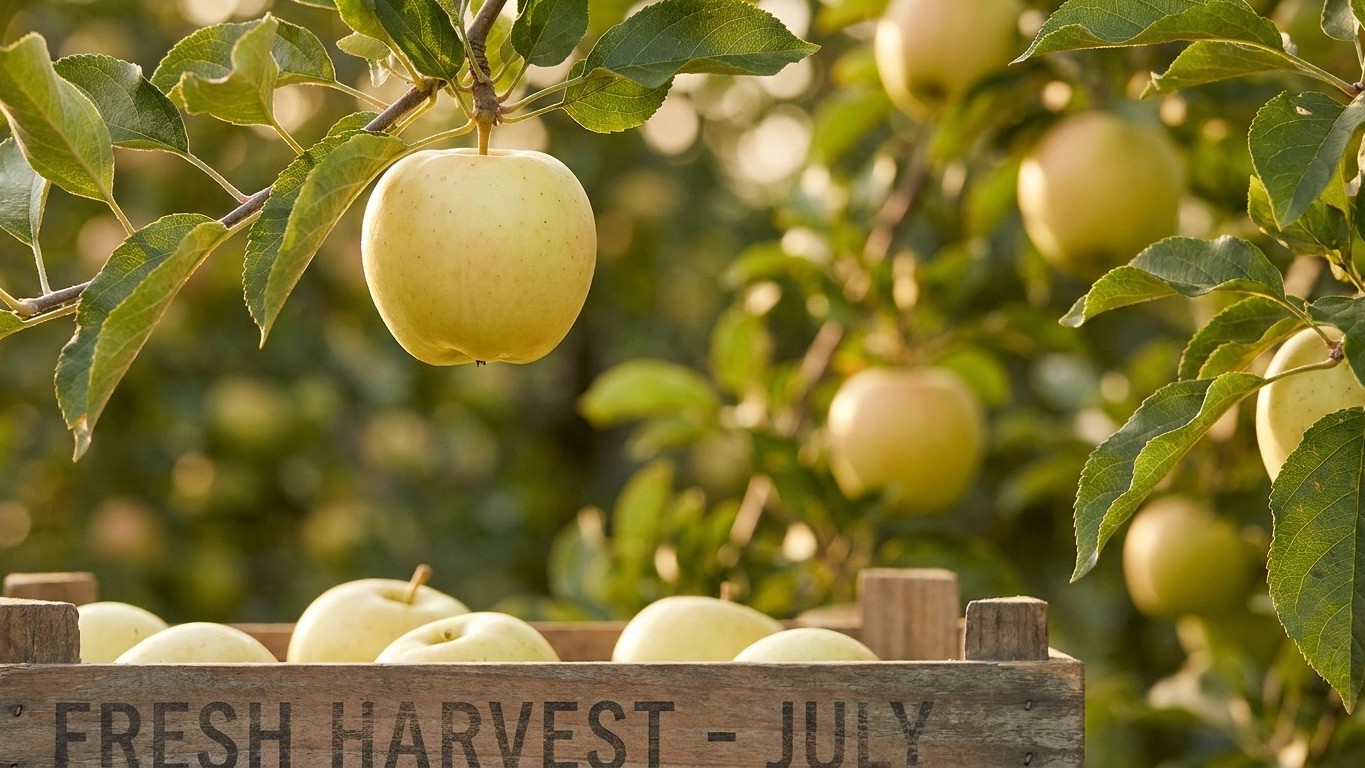

Yellow Transparent is an early-summer apple that ripens from late July to early August, hardy across USDA zones 3 through 8. The flesh is soft and white, the flavor sharply tart, and the fruit is grown almost entirely for cooking rather than eating out of hand. It’s a short-season apple that asks for a pollinator, tolerates cold well, but needs watching for fire blight.
What Yellow Transparent actually is

Before anything else, here’s what a grower is signing up for with this variety:
- When it ripens: Late July to Early August
- What it tastes like: Very tart and sharp, with soft white flesh
- What it’s good for: Sauce and other cooked dishes, since it breaks down fast and needs added sugar
- How long it keeps: Days, not months, according to USU Extension’s summary of the variety
The ripening window puts Yellow Transparent ahead of nearly every other apple in a typical home orchard. According to USU Extension’s Apple Production for the Utah Home Garden, harvest runs late July into early August, which means it’s usually the first tree in the yard to give up its crop, well before the classic fall varieties even color up.
The tartness isn’t a flaw to breed out. It’s the reason the apple exists in kitchens at all. Soft white flesh and sharp acidity are exactly what a good sauce apple needs: the flesh collapses quickly over heat instead of holding a firm slice, and the acid keeps the sauce from tasting flat once sugar is added. Try to eat one raw and most people find it thin and sour. Cook it down with sugar and it turns into something bright and useful within twenty minutes on the stove. That’s the trade a baking apple and a fresh-eating apple are always making, and Yellow Transparent leans hard toward the pot rather than the lunchbox.
Because it doesn’t store well, this isn’t the apple to fill a root cellar with. It’s the one to pick, process, and move on from within a few days, which is part of why so many home orchards keep just one or two trees of it alongside longer-keeping varieties for fall and winter.
Will it grow where you are
Hardiness zone range
USU Extension lists Yellow Transparent as hardy across USDA zones 3 through 8. That’s a wide range, stretching from the cold winters of the Upper Midwest and northern New England down through much of the transitional South. Treat that span as a starting point rather than a guarantee: zone 3 gardeners are working near the cold edge of what any apple tree tolerates, while zone 8 gardeners sit near the warm edge, where a second filter matters more than the zone number itself.
Winter chill requirement
Hardiness zone measures how much cold a tree can survive. Winter chill measures something different: whether the tree gets cold enough, for long enough, to break dormancy properly and flower on schedule. Apples generally need a stretch of hours below about 45°F over the winter, and varieties vary in how much they demand. For Yellow Transparent, that specific chill-hour figure isn’t published in the sources used for this page, so it isn’t listed here as a number.
What can be said with more confidence is where this variety tends to fit. Early bloom and early ripening are both traits associated with apples bred for short, cool growing seasons, the kind found across the northern half of the hardiness range rather than the humid Deep South. A gardener in zone 7 or 8 should ask locally, through a state extension office, whether Yellow Transparent reliably gets the chill it needs before assuming the zone map alone settles the question. Zone number and chill hours are two separate gates, and a tree can clear one while stumbling at the other.
What to plant beside it
This is usually the question that brings a reader to a variety page in the first place, and it’s worth naming clearly: nearly all apple varieties crop better with a compatible partner nearby, whether that’s a second named variety or a crabapple that overlaps in bloom time. A tree left entirely alone will sometimes set a light crop, sometimes none, depending on the year.
For Yellow Transparent specifically, no list of confirmed pollination partners appears in the sources used for this page. That’s a gap worth stating plainly rather than papering over with a guess. What is documented is its bloom season, listed as Early by USU Extension, which narrows the search: a workable partner needs to flower at roughly the same time, since pollen arriving a week early or late from a mid- or late-blooming variety does the tree little good.
Given the missing list, the practical move is to check bloom overlap directly. A local nursery or extension office can usually confirm which early-blooming apples or flowering crabapples are already thriving in your area and flowering alongside an early variety like this one. Crabapples are worth considering here specifically because many bloom early and long, which makes them forgiving partners when an exact-variety match isn’t available locally.
For the general rules on how apple pollination works, including why some varieties can’t pollinate their own parent or offspring, see our guide to apple pollination.
Growing it well
Fire blight susceptibility
USU Extension rates Yellow Transparent as susceptible to fire blight. In the garden, that shows up as blackened, wilted shoot tips that curl over into a shape often described as a shepherd’s crook, sometimes with a dark, wet-looking ooze on the bark during warm, humid weather. It spreads fastest during bloom and right after, carried by rain and by pollinating insects moving from an infected blossom to a healthy one. A grower with this variety should prune out any blighted shoots well below the visible damage, sanitizing the tool between cuts, and avoid heavy nitrogen fertilizer that pushes soft, vulnerable new growth right when blight pressure is highest.
Growth habit
Beyond the disease rating, the sources used here don’t detail a specific canopy shape or vigor rating for this variety. What can be said is that mature size and shape are set mainly by the rootstock, not by the variety itself, so a Yellow Transparent grafted onto a dwarfing rootstock will stay compact and start bearing sooner, while the same variety on a standard rootstock grows larger and takes longer to reach full production.
Biennial bearing and thinning
No specific biennial-bearing tendency for Yellow Transparent is documented in the sources used for this page, so it isn’t stated here as fact. As a general practice across apple varieties, thinning a heavy fruit set down to one apple every four to six inches along the branch helps even out yield from year to year and keeps individual fruit size up, which matters more than usual for a variety already being picked young for sauce.
Picking it and keeping it
USU Extension puts the harvest window for Yellow Transparent at late July to early August, but a calendar date is only a starting point. Since it ripens ahead of nearly everything else in the orchard, relying on the date alone risks picking too early or missing the short window entirely. A grower standing under the tree can confirm readiness with a short sequence of checks:
- Lift and twist a fruit gently upward. A ripe apple separates from the spur with little resistance; one that clings and has to be pulled or torn free usually isn’t ready yet.
- Cut one open and check the seeds. Apples generally aren’t ready while seeds are still pale or white; darker seeds are a better sign of maturity, though this variety’s tartness stays sharp even when ripe.
- Check the ground color, the base color of the skin away from any blush. A shift from deep green toward a lighter, yellowing tone signals the fruit is closer to peak.
Storage conditions
Because Yellow Transparent bruises easily and doesn’t hold up in storage the way fall and winter apples do, the practical approach is to pick it, sort out any bruised fruit right away, and process or use it within a few days. Refrigeration slows things down slightly, but this isn’t a variety to count on for long-term cold storage the way a late-harvest apple would be. Given how fast it breaks down for sauce anyway, that short shelf life lines up with what the fruit is actually grown for.
Common questions
Is Yellow Transparent good for eating fresh?
Not really. The eating quality is described as very tart and sharp with soft flesh, which most people find better suited to cooking than to eating out of hand. It shines once sugar and heat are involved.
Why is Yellow Transparent used mainly for sauce rather than pies?
Its soft flesh collapses quickly when cooked instead of holding a firm slice, which works against it in a pie but works in its favor for sauce, where a fast, smooth breakdown is exactly what’s wanted.
How cold-hardy is Yellow Transparent?
USU Extension lists it as hardy across USDA zones 3 through 8, a wide range that covers cold northern climates through much of the transitional South, though winter chill needs still matter separately from that zone rating.
Does Yellow Transparent need a second apple tree nearby?
Nearly all apple varieties crop more reliably with a compatible pollinator nearby, and Yellow Transparent is no exception. No specific list of confirmed partners is documented for this variety, so checking local bloom overlap with an extension office or nursery is the safest route.
Is Yellow Transparent prone to disease problems?
Yes. USU Extension rates it as susceptible to fire blight, which means pruning out infected shoots promptly and avoiding excess nitrogen are worth building into a regular care routine for this tree.