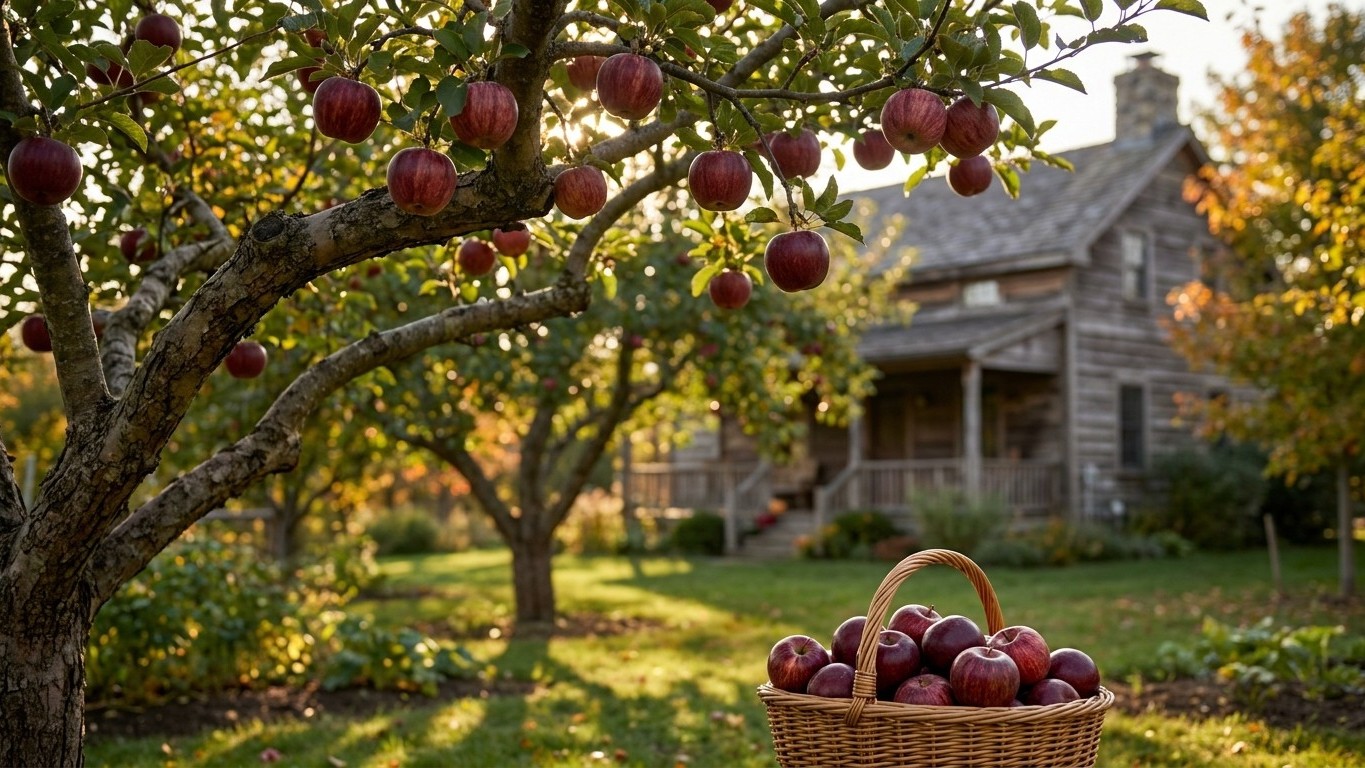

Jonathon apple trees ripen mid September into October, carry a tart bite suited to both the fruit bowl and the pie pan, and grow reliably from USDA zone 4 up through zone 8. Whether this variety belongs in your yard comes down to three things: your climate, a pollinator planted nearby, and what you actually want to do with the fruit once it’s picked.
What Jonathon actually is

Before anything else, here’s what a grower actually gets with this variety:
- When it ripens: mid September through mid October
- What it tastes like: a tart apple, not a sweet one
- What it’s good for: snacking, salads, pies, sauce, baking, and freezing
- How long it keeps: not detailed in the sources behind this page
The harvest window and hardiness data come from Utah State University Extension’s guide to apple production for home gardeners. The eating quality and kitchen use come from University of Maine Cooperative Extension, Bulletin #4262. Both sources agree this is not a dessert apple in the sweet, mild sense. It’s tart, and that tartness is the reason it earns a spot on the “good for baking” list rather than just the fruit bowl. Acid holds up under heat in a way sugar alone doesn’t, which is why a tart apple survives an hour in a 400-degree oven and still tastes like something, while a bland, sugary apple can turn to mush and flatness.
The Maine Extension bulletin lists this variety as excellent for pies and sauce specifically because the flesh has enough structure and enough acid to hold a shape and a flavor through cooking. That’s a real distinction, not marketing language. A pie apple and a dessert apple are chosen on different criteria: one needs to taste good raw, the other needs to survive baking without collapsing.
You may see this variety spelled “Jonathan” on nursery tags and seed catalogs. That’s a spelling variant of the same name, not a different trademarked apple the way Mutsu is sold as Crispin or Cripps Pink is sold as Pink Lady. Worth knowing before you assume you’re comparing two different trees.
Will it grow where you are
Cold hardiness
USU Extension places this variety in hardiness zones 4 through 8, a wide band that stretches from the cold interior of the Mountain West and Upper Midwest down through much of the mid-South. That’s a range, not a single sweet spot, and it means winter minimum temperatures alone aren’t likely to rule this tree out for most of the continental United States outside the coldest pockets of zone 3 or the subtropical extremes below zone 8.
Winter chill hours
Hardiness zone only answers half the question. The other half is winter chill, the number of hours a tree needs at cold-but-not-freezing temperatures to break dormancy properly and bloom on schedule. Skip that requirement and a tree can leaf out unevenly or skip bloom altogether, even in a climate that never gets cold enough to kill it outright. This matters most for growers in the warmer half of the country, coastal California, the Gulf Coast, and similar mild-winter regions, where a tree can survive the winter fine but never accumulate enough chill hours to fruit well.
The sources behind this page don’t publish a chill-hour figure for this variety, so it’s not repeated here as a number. What can be said with confidence: a variety hardy to zone 4 evolved for real winters, and it’s a safer bet in a region that gets a proper cold season than in a mild-winter zone where chill accumulation is already marginal for most apples.
What to plant beside it
This is usually the question that brought a reader here, and it deserves a straight answer. The sources behind this page don’t publish a named list of pollination partners for this specific variety. Rather than guess at a compatible cultivar and risk sending someone to a nursery with the wrong tag, that gap is stated plainly here.
What can be said with confidence, based on how apples pollinate in general: nearly all varieties crop better with a compatible partner nearby, whether that’s a second named cultivar, a neighbor’s tree within bee range, or a crabapple planted specifically for pollen. Bloom season matters as much as the variety name. This tree blooms mid-season, so any partner needs to flower at roughly the same time, since a partner that blooms three weeks early or late is functionally useless no matter how compatible the genetics.
Two things worth remembering before buying a second tree:
- Overlapping bloom time is necessary but not sufficient on its own
- A parent variety generally cannot pollinate its own seedling, so knowing a tree’s parentage matters when picking a partner
For a full breakdown of which apple varieties pollinate which, and how to read a bloom chart before you buy, see our apple pollination guide. That page walks through bloom groups and known partner pairings in more detail than any single variety page can.
Growing it well
Fire blight risk
USU Extension rates this variety as susceptible to fire blight, a bacterial disease that shows up as blackened, wilted shoot tips that curl into a shape often described as a shepherd’s crook, sometimes with a sticky bacterial ooze in humid weather. Susceptible doesn’t mean doomed, but it does mean a grower should prune out infected wood promptly, well below the visible damage, and sanitize pruning tools between cuts. It also means this isn’t the tree to plant right next to a known fire blight hot spot in a warm, wet climate, since the disease spreads fastest in humid, rainy spring weather when blossoms are open.
Growth habit
The sources used for this page don’t detail the tree’s natural growth habit or vigor. General good practice applies here regardless of variety specifics: an open, well-spaced canopy lets air move through the branches, and that airflow is one of the simplest defenses against the humid conditions fire blight favors.
Biennial bearing and thinning
Biennial bearing tendency and thinning needs aren’t specified in these sources for this particular variety. As a general rule that applies broadly across apple varieties, thinning young fruit in a heavy-set year, leaving one apple per cluster rather than three or four, tends to even out production from year to year and improves the size of the fruit that remains. It’s a low-cost habit worth adopting even without variety-specific data to back it.
Picking it and keeping it
USU Extension puts the harvest window for this variety at mid September through mid October, a full month of leeway rather than a single date. Reading a calendar only gets a grower so far, though. The tree itself gives better clues, and they’re worth checking in order:
- Lift and twist an apple gently. If it separates from the spur with a slight twist, it’s ready. If it resists and needs to be yanked, give it more time.
- Cut one open and check the seeds. Ripe apples generally show brown to dark brown seeds; pale or greenish seeds mean the fruit needs more days on the tree.
- Check the ground color, the background color underneath any red blush. As an apple ripens, that background shifts from green toward yellow.
Storage
The sources behind this page don’t publish a specific storage duration for this variety. What is documented is that it’s good for freezing, which gives a grower a reliable second option beyond fresh storage: process a portion into sauce or pie filling for the freezer rather than relying solely on cold storage to keep the harvest usable through winter. Standard apple storage practice still applies in the meantime, cold and slightly humid conditions, away from ethylene-sensitive produce, checked periodically for any fruit that’s started to soften or spot.
Common questions
Is a Jonathon apple sweet or tart?
Tart. University of Maine Cooperative Extension classifies it as a tart apple, which is also why it performs well in pies and sauce, where acidity holds up better under heat than sweetness alone.
What zone does this variety grow in?
USDA hardiness zones 4 through 8, according to USU Extension, covering most of the continental United States outside the coldest and hottest extremes.
Can I plant just one tree and still get fruit?
Possibly a light crop, but nearly all apple varieties, this one included, crop more reliably with a compatible pollinator flowering nearby. A named partner list for this specific variety isn’t published in the sources behind this page.
Does this variety get fire blight easily?
It’s rated susceptible by USU Extension, meaning a grower should watch for blackened, curled shoot tips in spring and prune out infected wood immediately.
Can I freeze this apple instead of storing it fresh?
Yes. It’s specifically noted as good for freezing, which makes it a practical choice for growers who want to preserve a harvest beyond typical fresh storage limits.