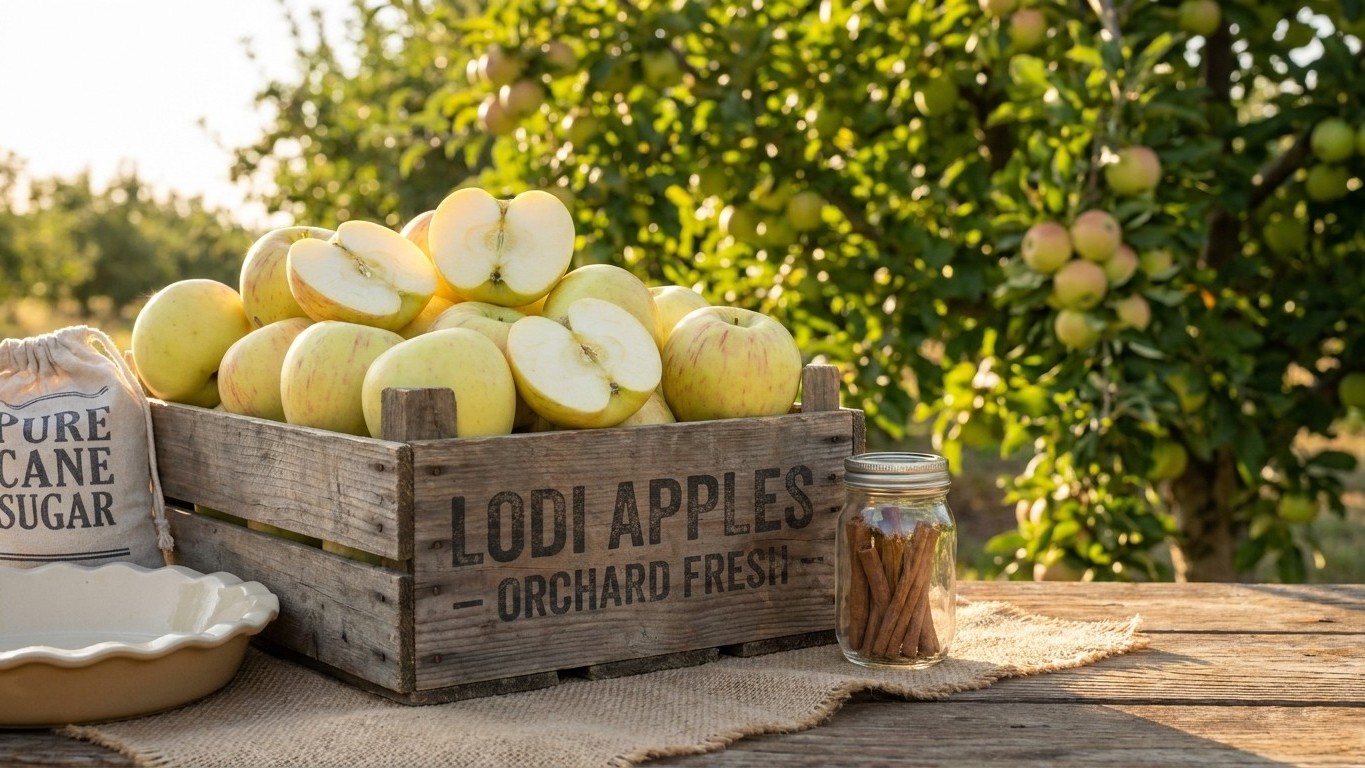

Lodi is one of the earliest apples to ripen in a home orchard, and it comes with a trade-off worth knowing before you plant: outstanding for pies and sauce, and very vulnerable to fire blight. If your region battles that disease, the decision gets harder. Here’s what the variety actually offers, and what it demands in return.
What Lodi actually is

Lodi is a cooking apple built for speed, not storage. Before getting into the details, here’s what a grower can expect, according to USU Extension’s guide on apple production for the Utah home garden:
- Ripens: August to early September, among the first apples off the tree
- Taste: Very tart, with soft, juicy flesh
- Best use: Cooking, not fresh eating
- Keeps: Not documented as a long-term keeper
The flavor profile explains the appeal. That soft, juicy flesh doesn’t hold a knife edge the way a Honeycrisp or a Fuji does, and the tartness that would be unpleasant biting into raw becomes exactly what a pie or a batch of applesauce needs. According to the same USU Extension source, Lodi is the earliest cooking apple of the year: it collapses into sauce in minutes on the stove, needing added sugar to balance the acid. That’s a different job than a dessert apple does, and the two aren’t interchangeable. A pie apple has to hold its shape under heat and keep enough acid to cut through sugar and butter; a dessert apple just has to taste good raw. Lodi is built for the first job, not the second.
Because it ripens so early and softens so fast, Lodi isn’t a variety you tuck away in a root cellar hoping to eat it at Thanksgiving. It’s a use-it-now apple. Growers who plant it are usually after a fast first harvest for sauce and baking, something to fill the gap before the main-season apples come in.
Will it grow where you are
Hardiness zone
According to USU Extension, Lodi is rated for zones (3)4 through 7. That parenthetical 3 matters: it signals the variety can survive in colder pockets than its main range suggests, which is unusual and points to genuine northern hardiness rather than a marginal fit. If you garden in zone 4 or 5, where a lot of dessert apples struggle with late frosts and short seasons, Lodi sits comfortably in range. By zone 7, you’re at the warm edge of what’s documented, and other early apples bred for southern heat may serve you better.
Winter chill
Chill hours, the number of cumulative hours below about 45°F a tree needs to break dormancy properly, aren’t published in the source used for this page. That’s worth stating plainly rather than guessing a number, since an apple planted where winter never delivers enough chill will bloom erratically and set a poor crop no matter how well the hardiness zone matches.
What we can say with confidence: a variety hardy down into zone 3, with an early bloom season, belongs on the northern half of the chill spectrum. Growers in the Upper Midwest, the Mountain West, and northern New England are the ones most likely to get satisfying chill accumulation and a healthy bloom out of Lodi. Gardeners in mild-winter regions, coastal California or the Gulf South, for instance, should treat the lack of a published chill figure as a reason to check with a local extension office before planting, rather than assuming it will perform the same way it does further north.
What to plant beside it
This is usually the deciding question, and here it’s an honest one: no pollination partners for Lodi are published in the sources used for this page. Rather than guess at a compatible variety, the accurate answer is that the pairing isn’t documented here, and a guess would be worse than no answer at all.
What is worth knowing, regardless of variety, is that nearly all apple varieties crop better with a compatible partner nearby. Very few set a full crop on their own pollen; most need cross-pollination from a different variety blooming at the same time, and Lodi’s early bloom season narrows the field to other early bloomers rather than mid- or late-season types. A crabapple with overlapping bloom can also do the job in a pinch.
Two more things matter more than most gardeners expect. First, timing has to overlap closely, not just fall in the same general season; a partner blooming even a week off can miss the window entirely. Second, a seedling variety can’t be pollinated by its own parent, so knowing a tree’s parentage matters before assuming any nearby apple will work. Since Lodi’s documented pairings aren’t listed here, the safest move is to consult a local nursery or extension office about early-blooming varieties known to overlap with it in your specific region, and to check our apple pollination guide for how to plan a compatible orchard layout.
Growing it well
Fire blight susceptibility
Fire blight is Lodi’s defining weakness. USU Extension rates it as Very Susceptible, the most serious rating on their scale. In the garden, that translates into blackened blossom clusters in spring, shoot tips that wilt and curl into a shepherd’s-crook shape, and, in wet or humid seasons, a bacterial ooze at the site of infection. Left unmanaged, fire blight can kill entire limbs in a single season and, in severe cases, the whole tree. Growers in regions where fire blight is already a known problem, warm, humid springs are the classic trigger, should weigh this rating heavily before planting Lodi, and should be ready to prune out infected wood promptly and sanitize tools between cuts.
Habit and bearing pattern
The source used for this page doesn’t document Lodi’s growth habit or whether it tends toward biennial bearing (the pattern where a tree produces a heavy crop one year and almost nothing the next). What is documented is the texture of the fruit itself: soft and juicy. Soft-fleshed apples tend to bruise and split more easily under a heavy crop load, so growers who do get a big set are well served by thinning fruit clusters down to one or two apples each in early summer, regardless of whether the tree runs biennial. Thinning reduces limb stress, improves fruit size, and lowers the odds of storm damage from overloaded branches.
Picking it and keeping it
USU Extension lists Lodi’s harvest window as August to early September, but a calendar date is only a starting point. Apples on the same tree can ripen a week or more apart depending on sun exposure, so the more reliable method is a physical check, done right at the tree:
- Lift and twist: Cup the apple in your hand and twist gently upward. A ripe apple separates from the spur with almost no resistance; if it holds on stubbornly, give it more time.
- Seed color: Cut one test apple open. Seeds that have turned from white to brown or dark brown indicate the fruit has matured.
- Ground color: Check the background color where the apple was shaded from the sun. A shift away from deep green toward a lighter, yellower tone is another sign of readiness.
Storage
No specific storage duration for Lodi is documented in the source used for this page. Given the fruit’s soft, juicy flesh, described directly in the same source, it behaves like a short-keeper rather than a long-term storage apple. The practical approach is to treat a Lodi harvest as a cook-it-now crop: process it into sauce, pie filling, or baked dishes within days of picking, rather than counting on it to hold up in a cool cellar for months the way a firmer, late-season apple would.
Common questions
Can Lodi apples be eaten fresh, off the tree?
They can be, but the source describes the flavor as very tart with soft flesh, which most people find better suited to cooking than to eating out of hand. If you want a sweet snacking apple, Lodi isn’t built for that role.
Why does Lodi cook down so fast compared to other apples?
Its flesh is soft and juicy rather than firm, so it breaks down into sauce in minutes on the stove. That same softness is why it needs added sugar to balance its natural tartness in cooked dishes.
Is Lodi a good choice if fire blight is common in my area?
USU Extension rates it Very Susceptible, the most serious category on their scale, so in regions where fire blight is already a recurring problem, Lodi carries real risk without a solid disease-management plan.
What USDA zones is Lodi hardy in?
According to USU Extension, Lodi is rated for zones (3)4 through 7, which places it comfortably in colder northern regions and at the warmer edge of its range by zone 7.
Do I need another apple tree to get fruit from Lodi?
No specific pollination partners for Lodi are published in the source used here. As a general rule, nearly all apple varieties crop better with a compatible partner blooming at the same time, so planting a second early-blooming apple or crabapple nearby is a reasonable precaution even without a documented pairing.