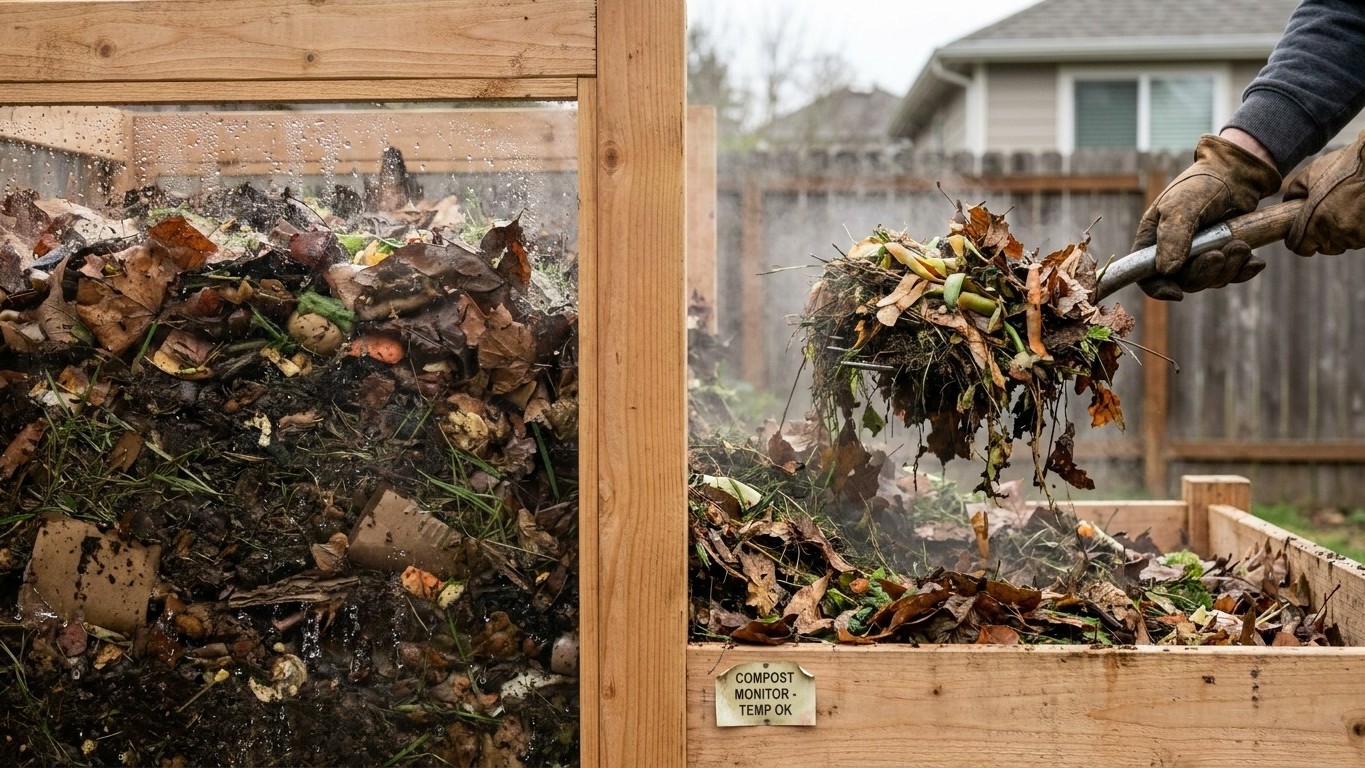

A smelly pile almost always means compaction or excess moisture blocking oxygen inside the heap. A cold pile usually means it’s too small, too dry, or short on nitrogen-rich material to fuel the microbes. Rats and raccoons show up because of meat scraps or fatty food waste sitting exposed in the mix. Utah State University Extension’s Backyard Composting in Utah guide names each cause directly, and the fix for most of them is the same single action: turn the pile.
The short answer
Five of the eight failures listed in Utah State University Extension’s troubleshooting table trace back to one missing action: turning the pile. That single fact reframes almost every complaint a backyard composter has. A pile that stinks isn’t broken, it’s just packed too tight or holding too much water, and both conditions choke off the oxygen that aerobic microbes need. A pile that never heats up isn’t necessarily “dead,” it may simply be too small to hold its own warmth, or too dry, or missing the nitrogen that gets microbial activity going. And a pile drawing pests almost never has a moisture or aeration problem at all, it has a food problem: meat scraps or fatty waste sitting where something with a nose can find them.
The guide treats these as separate, name-able faults rather than one vague “something’s wrong” diagnosis. Malodorous piles get one remedy for compaction and a different one for excess moisture. A pile that’s damp but refuses to heat gets a different remedy than one that’s bone dry and stalled. That distinction matters because reaching for the wrong fix, adding water to a pile that’s already soaked, say, makes the problem worse instead of better.
None of this runs on a calendar. There’s no month when a pile is supposed to start heating or finish curing, only durations tied to what the pile is actually doing. A working pile that’s turned regularly and kept at the right moisture will run hot for a stretch, then taper off as the raw material breaks down. After that, Utah State University Extension recommends an additional curing phase, leaving the finished compost undisturbed for up to one month, before it goes anywhere near a garden bed. Skipping that step is its own kind of fault, one that shows up later as damaged plants rather than an obvious smell today.
What actually decides it
One variable outranks everything else in this troubleshooting table: how often the pile gets turned. Moisture level comes second. Pile size and insulation come third. The ratio of carbon-rich to nitrogen-rich material sits underneath those, shaping how the pile behaves once the first three variables are already in place.
Turning frequency: the variable that dominates
Compaction excludes oxygen, and without oxygen the microbes that break material down cleanly get replaced by anaerobic ones that produce the rotten-egg smell people associate with a “bad” compost pile. Turning breaks up that compaction and lets air back in. It’s also part of the remedy for an ammonia smell (turn after adding carbon material), for a pile running too hot (turn to improve ventilation), for a pile that’s gone cold from poor aeration, and for a pest problem (turning raises the internal Temperature enough to discourage animals). Five distinct faults, one shared fix.
Moisture: the second lever
A pile that’s damp but won’t heat may simply be too wet, in which case the fix is to let it dry out and turn it to dry the center. A pile that’s dry and not composting has the opposite problem: insufficient water. The guide’s remedy there is specific: form the pile so its center is the lowest point, which prevents rainwater from running off instead of soaking in, then apply water directly to moisten it.
Volume and insulation set the temperature ceiling
A working pile runs in the 120-140 F range under normal conditions. Piles that run too hot are usually too large, and the fix is to reduce their size or improve ventilation. Piles that run too cold are often too small, and the fix runs the other direction: make the pile bigger or insulate its sides. In cold weather, that means increasing the pile’s size or adding an insulating layer such as straw. Separately, composting microbes fall into two broad temperature bands: mesophilic organisms work at 50-105 F, and thermophilic organisms take over above 105 F. A pile running in the 110-150 F range does something extra: it destroys more pathogens, weed seeds, and fly larvae than a cooler pile ever will.
The greens-to-browns ratio
An ammonia odor signals too much nitrogen-rich material relative to carbon. A pile that’s damp but cold can signal the opposite: not enough nitrogen to get microbial activity going. Utah State University Extension frames the fix as a volume ratio, not a chemical one: approximately two parts carbon-rich material to one part nitrogen-rich material, or two buckets of browns to one bucket of greens.
How to do it
- Gather carbon-rich material (dry leaves, straw, shredded paper) and nitrogen-rich material (fresh grass clippings, food scraps) separately before building the pile.
- Layer them at roughly two parts carbon-rich material to one part nitrogen-rich material by volume, two buckets of browns to one bucket of greens.
- Shape the pile so its center is the lowest point rather than the highest. This keeps rainwater draining into the pile instead of running off the sides.
- Moisten the material as you build, applying water directly if the mix feels dry rather than waiting until the whole pile has stalled.
- Turn the pile on a regular schedule to keep oxygen moving through the material and to prevent the compaction that causes odor.
- Watch how the pile behaves rather than the calendar. A working pile runs around 120-140 F; if it climbs well above that, reduce its size or turn it more often to improve ventilation; if it stays cold, enlarge it or insulate the sides.
- Keep food scraps buried in the center of the pile, never left exposed on top, to avoid drawing pests.
- Once the material turns dark and crumbly and smells earthy rather than offensive, stop turning it and let it cure undisturbed for up to one month before using it in the garden.
What Goes Wrong
Two opposite faults can produce two very different signals from the same pile. An ammonia smell means too much nitrogen. A pile that simply sits there, cold and inactive, usually means too little nitrogen, or too little size, or too little moisture. Reading which signal you’re getting matters more than reaching for a generic fix.
- Malodorous pile: Compaction cutting off oxygen, remedy is to turn it; or excess moisture, remedy is to turn and add dry porous material such as sawdust.
- Ammonia odor: Too much nitrogen-rich material. Add carbon-rich material and turn the pile to mix it in.
- Damp but won’t heat: Insufficient nitrogen, remedy is fresh grass clippings or fertilizer; or the material is too wet, remedy is to let it dry and turn it to dry the center.
- Dry and not composting: Insufficient water. Form the pile so the center is the lowest point to prevent runoff, then apply water to moisten it.
- Pile too hot: The pile is too large, remedy is to reduce its size; or ventilation is insufficient, remedy is to turn it.
- Pile too cold: Too small (make it bigger or insulate the sides), too dry (water while turning), poorly aerated (turn), short on nitrogen (add greens), or simply cold weather (increase pile size or insulate with an extra layer such as straw).
- Pests (rats, raccoons, insects): Meat scraps or fatty food waste in the mix. Remove them, cover exposed scraps with soil or sawdust, build an animal-proof bin, and turn the pile to raise its internal temperature.
Common questions
How long does finished compost need to cure before use?
Utah State University Extension recommends leaving finished compost undisturbed for up to one month as an additional curing phase. The guide describes this step as extra insurance, since improperly or incompletely composted material can release ammonia and other gases, or continue to heat once applied to soil, damaging plants.
Does turning the pile fix every problem?
No, but it’s part of the remedy for more faults than anything else in the troubleshooting table, including malodorous piles, ammonia smell, overheating, poor aeration, and pest activity. Moisture and nitrogen problems need their own fixes alongside turning.
What does finished compost actually look like?
Dark, crumbly, and carrying an earthy, non-offensive odor. If it still smells sharp or ammonia-like, it isn’t finished yet, no matter how long it’s been sitting.
Why would a pile that was running hot suddenly turn cold?
Usually one of four reasons: it’s lost size (piles shrink as material breaks down), it’s dried out, aeration has dropped off from compaction, or cold weather has pulled heat out faster than the pile can generate it. The remedy in each case is different, from enlarging or insulating the pile to simply turning it again.