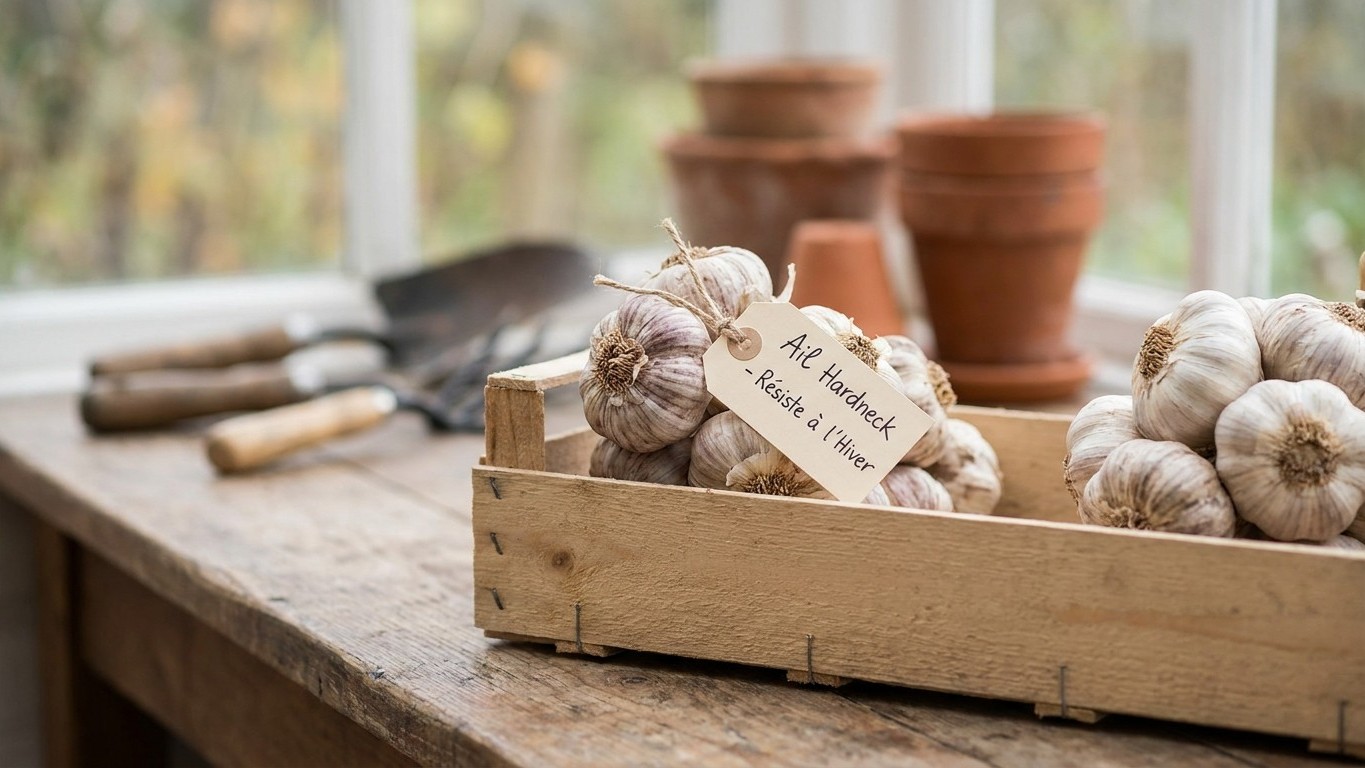

The type that survives your winter is the one whose cold needs actually match what your ground does between now and spring. Hardneck garlic wants a real, sustained freeze to split into the big, easy-peel cloves you picture when you think garlic. Softneck garlic shrugs off a mild winter and stores far longer once it’s cured. Before you order seed garlic, figure out how hard and how long your winter actually freezes, and let that answer, not the prettiest bulb in the catalog, choose the type you plant.
Why this matters for garlic

Garlic is a nine-month crop. A clove planted in fall sits through winter, wakes up in spring, and isn’t lifted until summer. That gap is exactly why a wrong choice at planting time is so easy to miss and so expensive when it finally shows. Plant a hardneck variety somewhere the winter never gets properly cold, and the bulb may never divide into distinct cloves at all. It comes up looking like a single round, undivided lump, and you won’t know until you dig it, long after the mistake could have been fixed.
Run it the other way and plant a softneck variety in a region with brutal, sustained freezes without adequate protection, and the cloves can suffer winterkill below ground before they ever send up a leaf. You won’t see a dead plant in November. You’ll see a gap in the row the following April, and by then the growing season for Replanting has already closed. The fix is not complicated, but it has to happen at planting, not at harvest when the evidence finally arrives. Matching hardneck or softneck to your actual winter, not to what a seed catalog photo makes you want, is the single decision that determines whether the crop even survives to be harvested. Everything else in growing garlic well, from spacing to feeding to curing, only matters once that first choice is right.
When to do it
Garlic goes into the ground in fall, timed off the first hard frost rather than a fixed date on the calendar, because that frost date shifts by weeks depending on where you garden. The general target growers work toward is planting late enough that the clove doesn’t push up green top growth before winter, but early enough that it has time to root into the soil before it freezes solid. Rooting without top growth is the goal either way, but hardneck and softneck differ in how much cold they actually need afterward to do their job underground.
Hardneck garlic has a genuine vernalization requirement: a sustained stretch of cold is what triggers the clove to split into the multiple cloves you expect at harvest, a process covered in more depth in why garlic needs cold. Softneck garlic has a much lower cold threshold and will still divide, if less dramatically, in a winter that never gets properly hard. Sources disagree on how far south hardneck garlic remains worth growing at all. Some extension guidance treats it as workable anywhere with a genuine winter, however short, while other growers in warm-winter regions report undersized, poorly divided bulbs even after a full season. If your winters are short and mild, treat any hardneck result as an experiment rather than an expectation.
How to do it
Break the seed garlic bulb into individual cloves right before planting, not weeks ahead, since a clove separated too early dries out and loses vigor. Keep the papery skin on each clove intact. Plant only the largest, firmest cloves. The small inner cloves from either type will grow, but they mature into small bulbs, which defeats the point of growing your own.
Planting depth and spacing
As a general rule, set each clove pointed end up about 2 inches deep, spaced 4 to 6 inches apart within the row, with rows 12 to 18 inches apart to leave room for the foliage to fill in without crowding. In regions with harsher winters, growers often plant slightly deeper and mulch heavier, since the extra soil and straw buffer the clove against a hard, repeated freeze-thaw cycle that can otherwise heave it right out of the ground.
- Separate cloves from the bulb just before planting, keeping the skin on
- Discard any clove that’s soft, discolored, or visibly small
- Plant pointed end up, roughly 2 inches deep
- Space cloves 4 to 6 inches apart, rows 12 to 18 inches apart
- Cover with 4 to 6 inches of loose straw mulch after the ground begins to cool
Mulch matters more for hardneck varieties in genuinely cold regions, where the goal is insulating the soil enough to prevent frost heaving, not keeping the ground warm. Pull the mulch back gradually in spring once new growth appears, rather than stripping it all at once, so the emerging shoots aren’t shocked by a late cold snap.
Which cultivars to choose
Named hardneck cultivars include ‘Music’, ‘German Extra Hardy’ and ‘Chesnok Red’, all known for producing a stiff central scape and a small ring of large, easy-to-peel cloves. Named softneck cultivars include ‘California Early’, ‘California Late’ and ‘Inchelium Red’, which produce more numerous, smaller cloves and no scape, and are the type typically braided. Catalog descriptions of clove count and maturity are consistent regardless of where you garden, since they’re a property of the cultivar itself, but how well that cultivar performs still comes down to whether your winter matches what the plant needs.
| Trait | Hardneck | Softneck |
|---|---|---|
| Scape | Sends up a stiff central flower stalk, cut off in early summer | No scape produced |
| Cloves per bulb | Fewer, larger cloves, usually 4 to 12 | More, smaller cloves, often 10 to 20 |
| Storage life | Shorter, typically a few months | Longer, often six months or more |
| Cold requirement | Needs a sustained hard chill to divide well | Divides with a much shorter, milder chill |
| Braiding | Stalk too stiff to braid | Pliable neck, traditionally braided |
What goes wrong
The most common failure is planting a hardneck variety somewhere the winter simply doesn’t get cold enough for long enough. The plant looks fine all season. The tell only shows up at harvest, when you crack open a bulb expecting distinct cloves and instead find one solid, undivided round. There’s no fixing that season’s crop at that point. The fix is switching to a softneck variety next fall, or accepting hardneck as a lower-yield experiment in a warm-winter garden.
The opposite failure, softneck or under-mulched hardneck lost to a hard freeze, shows up even later, in spring, as bare gaps where cloves should have sprouted. By the time you notice, the planting window has closed for months. The tell to watch for the following fall is root development before hard frost: if the ground freezes before cloves have had several weeks to root in, winterkill risk climbs regardless of type.
A third failure happens after harvest rather than in the ground. Growers assume all garlic stores the same way, then find their hardneck bulbs sprouting or softening on the shelf months earlier than they expected, because hardneck’s naturally shorter storage life caught them off guard. Softneck bought for its long shelf life defeats the purpose if it’s left in a warm kitchen instead of a cool, dry space, since heat shortens even softneck’s storage window considerably. Leaving hardneck scapes uncut is a smaller but real loss too: an uncut scape diverts energy from the bulb, and the result, a noticeably smaller bulb than the same plant would have produced, only shows up at the very end of the season when it’s too late to do anything about it.
How this changes across the country
Growers in states with long, hard winters, think Minnesota, North Dakota, Vermont and Maine, generally get better, more reliably divided bulbs from hardneck varieties, because those winters supply the sustained cold hardneck needs without any extra effort from the grower. Heavy mulch is still standard practice there, since even a genuinely cold winter can include freeze-thaw swings that heave a shallow-planted clove out of the soil.
Growers in states with short, mild winters, think much of California, the Gulf Coast states and coastal areas of the Southeast, tend to get more consistent results from softneck varieties, which divide reliably without needing a hard, prolonged chill. Softneck is also the type most commercial garlic braiding operations use, and that tradition took hold largely because it grows well where large-scale garlic production actually happens.
States that sit in between, with a real winter that isn’t extreme, are the trickiest to generalize about, and this is exactly where checking your own USDA hardiness zone and your state extension service’s garlic guidance pays off, since the same variety can behave differently just a county or two apart. If your climate doesn’t give you confidence either way, or you’d rather control the winter exposure directly, growing a few cloves of each type in a bed and comparing results over one season tells you more than any regional guideline. Growers without a dedicated garden bed can sidestep some of this uncertainty entirely by growing garlic in containers, where pot placement and insulation give far more control over how much cold the cloves actually experience.
Common questions
Can I plant hardneck and softneck garlic in the same bed?
Yes, there’s no compatibility issue between the two in the same bed. Just label rows clearly at planting, since the cloves and early foliage look similar enough that it’s easy to lose track of which is which by spring.
What happens if I plant hardneck garlic somewhere too warm?
The plant usually still grows and produces a bulb, but the bulb often fails to divide properly into separate cloves, coming up as one solid round instead. It’s not dangerous or diseased, it’s simply a sign the cold requirement wasn’t met.
Is elephant garlic hardneck or softneck?
Neither, technically. Elephant garlic is a different species, more closely related to leeks than to true garlic, though it does send up a flower stalk similar to a hardneck scape. It’s grown and stored more like a leek relative than either true garlic type.
Can I grow garlic from a bulb I bought at the grocery store?
You can, but it’s a gamble. Grocery store garlic is often treated to slow sprouting, may not be labeled hardneck or softneck at all, and can carry soil-borne diseases you don’t want introduced into your garden bed. Certified seed garlic from a known supplier costs more but removes most of that risk.