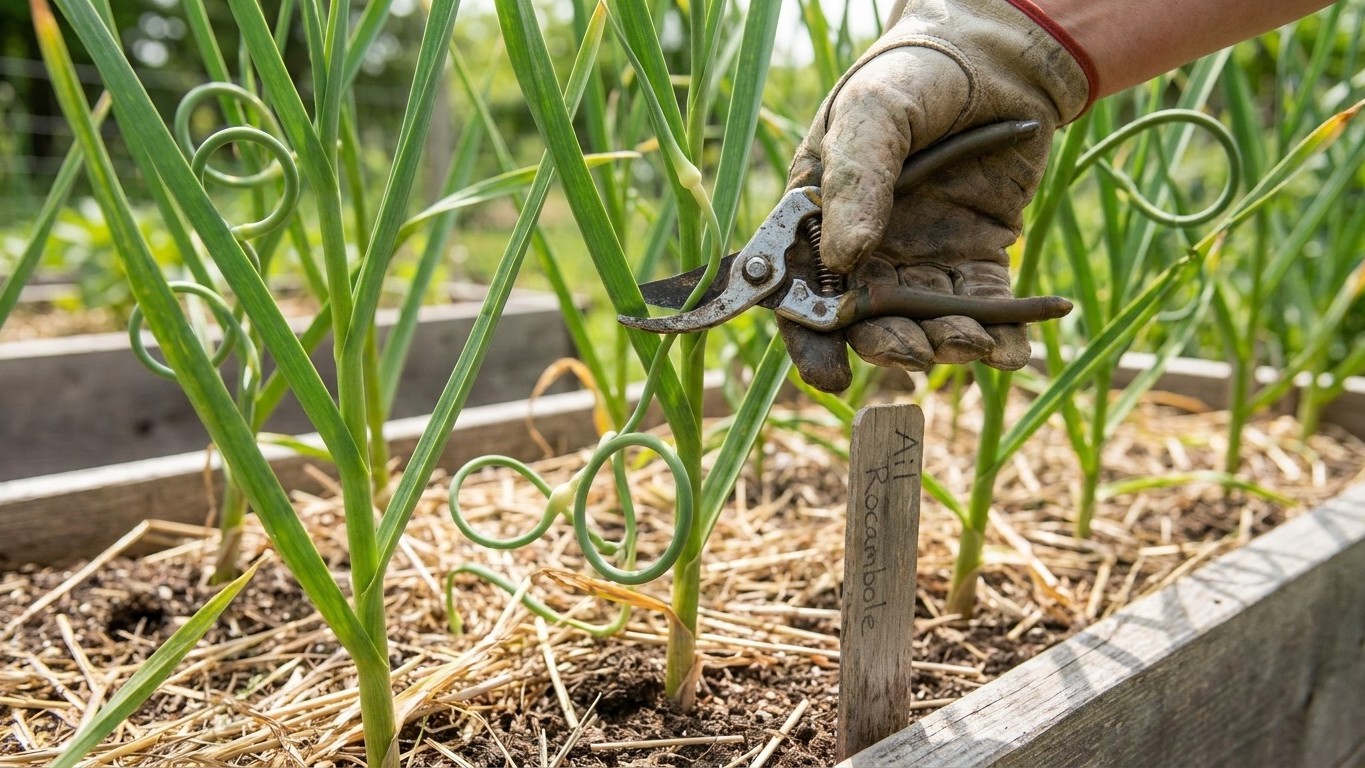

Cut garlic scapes once they have curled through one full loop, before the stalk straightens and starts reaching upward again. At that point the plant has stopped putting energy into the bulb and started building a flower stalk instead, and removing the scape sends that energy back down to the clove. Check the necks of your hardneck plants every few days once the first scapes appear, and snap or cut each one off just above the topmost leaf as soon as it curls.
Why this matters for garlic

Only hardneck garlic sends up a scape. It’s the stiff, curling flower stalk that rises from the center of the plant in early summer, and if you leave it alone it will straighten, grow a papery bulbil capsule at the tip, and keep drawing sugars and water away from the bulb below ground. Softneck garlic never does this, which is one reason softneck stores longer and hardneck tends to have the bigger, more complex flavor.
The problem with getting scape timing wrong is that you won’t know you got it wrong for months. Garlic goes into the ground in fall and doesn’t come out until the following summer, so a scape left uncut in June doesn’t show its cost until you’re pulling bulbs and find them smaller than they should be. There’s no way to go back and fix it once the bulb has finished sizing up. That delayed feedback is exactly why scapes deserve more attention than gardeners usually give them: a five-minute walk through the bed every few days in early summer is the whole fix, and skipping it is invisible until harvest.
The upside is real too. A scape you cut in time is a free vegetable. It’s tender, mild, garlicky, and good chopped into a stir-fry or blitzed into pesto, so removing it isn’t a sacrifice you’re making for the bulb’s sake. You get to eat the thing you’re pulling off anyway.
When to do it
Anchor the timing on the scape’s own shape, not on a date. The stalk emerges straight, then curls, first through a loop and a half, then a full loop, before it starts to straighten out again as the flower capsule at the tip matures. The window most growers aim for is that one-curl stage, when the scape has looped completely but hasn’t begun to unwind. Cut earlier and you get a more tender scape for eating. Cut later, once it’s straightened and toughened, and you’ve already let the plant spend several days feeding the flower stalk instead of the bulb.
Sources disagree on how strict this window really is. Some extension guides treat scape removal as something to do the moment you see it curl at all, on the theory that every extra day is a day of diverted energy. Others are more relaxed, noting that a scape left for a week or two past the first curl still gets removed before it does much damage, since the real energy drain ramps up once the bulbil capsule starts to swell. What both agree on is that leaving the scape until it straightens and the capsule opens is the mistake to avoid.
Because scape emergence tracks the plant’s growth stage rather than a fixed date, it will happen earlier in a warm spring and later in a cool one, and earlier in a mild-winter region than a cold one. If you’re not sure your garlic is even the scaping type, that goes back to what you planted: see Seed Garlic: Why Supermarket Bulbs Disappoint, and What to Buy for the difference between hardneck and softneck seed stock before you plant next fall.
How to do it
Scape removal is mechanically simple, but a few details change how clean the cut is and how much bulb you actually gain.
Cutting method and timing
- Where to cut: just above the top set of true leaves, leaving as much stem and leaf area on the plant as possible.
- Tool: a sharp knife, garden snips, or your fingers. Scapes are fibrous but not woody at the one-curl stage, so a firm snap usually works cleanly.
- Frequency: check the bed every two to four days once the first scapes show, since plants in the same row don’t all curl on the same day.
- What to do with the cut scape: use it fresh within a week or two, or chop and freeze it. It doesn’t cure or store the way a bulb does.
Cut one scape at a time as it reaches the right stage rather than waiting to do the whole bed at once. Hardneck varieties don’t scape in perfect unison, even within a single planted row, so a single pass through the bed will usually miss a third of them if you’re only checking once a week.
What the scape looks like at each stage
A scape that’s ready to cut has looped completely around itself, forming a full circle or figure-eight shape, and the stalk below the curl is still firm and green. If it’s just starting to bend, it’s early but still fine to cut for eating. If it’s straightened back out and the tip has swollen into a papery, bulbous capsule, you’ve missed the ideal window, and cutting it now still helps the bulb but won’t give you as tender a vegetable.
Don’t confuse scape removal with topping the whole plant. Cutting leaves along with the scape, or cutting the scape too low and taking extra stem tissue with it, reduces the leaf area the plant uses to keep feeding the bulb through the rest of the season. Only remove the scape itself, leaving all the true leaves intact. If you’re new to reading what stage your garlic is at generally, the same leaf-based logic carries through to harvest: see When to Harvest Garlic: Reading the Leaves, Not the Calendar for how leaf color and count tell you when to pull bulbs, several weeks after the last scape comes off.
What goes wrong
The most common mistake is simply not checking often enough. Scapes go from curling to straightened and tough in about a week, and if you’re only walking the garlic bed once every ten days, you’ll miss the ideal cutting window on a chunk of the planting every season. The tell is a scape that’s already straight and stiff, with a swollen tip, by the time you notice it. That plant’s bulb has been losing ground for days.
The second mistake is cutting too aggressively and taking leaf tissue along with the scape. Garlic bulbs size up almost entirely from photosynthesis happening in the leaves during the weeks after scape removal, so a plant with fewer leaves left standing has less capacity to fill out its cloves. This doesn’t show up until harvest, when bulbs from over-trimmed plants come out visibly smaller and sometimes with fewer, thinner cloves than bulbs from plants that kept full leaf cover.
Confusing scapes with the plant itself
New growers sometimes let the whole plant’s growth stall while they wait to decide whether to cut the scape at all, worried they’ll damage the plant. Garlic doesn’t need the scape to survive. It’s a flower stalk that, left alone, would eventually try to produce small bulbils at the top rather than help the underground bulb. Removing it is not an injury to the plant, it’s a redirection of resources the plant would otherwise spend on something you’re not trying to grow.
Finally, growers with softneck garlic sometimes wait around for scapes that are never coming, checking the bed daily through early summer for a stalk that a softneck variety simply doesn’t produce. If your planting stock came from a mixed order or you’re not sure what you planted, that uncertainty traces back to seed selection, not to anything you did wrong at scape time.
How this changes across the country
Scape timing itself doesn’t shift much by region, because it tracks the plant’s own growth stage rather than the calendar. What does shift is which type of garlic you’re growing in the first place, and that’s driven heavily by winter cold.
Hardneck garlic needs a real cold period to form a strong bulb and reliably produces scapes, which is why it dominates in cold-winter states like Minnesota, Vermont, Michigan, and much of the upper Midwest and Northeast. Growers there can expect scapes as a normal part of the crop every year and should plan on that weekly check-and-cut routine through early summer.
In mild-winter regions such as much of California, Georgia, and the Gulf Coast, softneck garlic is the more common and more reliable choice, and it does not produce scapes at all. Growers in those areas won’t see this task come up in a typical season unless they’ve planted hardneck stock as an experiment, in which case bulb size and scape production both tend to be less consistent than in a climate with a proper winter chill. If you’re deciding what to plant based on your own winters, that decision starts well before scape season: see Growing Garlic for how hardneck and softneck are chosen based on regional cold, and check with your state’s cooperative extension service for guidance specific to your county, since even within one state, a coastal county and a mountain county can call for different garlic types entirely.
Common questions
Do I have to cut garlic scapes or can I just leave them?
You don’t have to, but leaving them costs you bulb size. If you’re growing garlic purely for the scapes as a vegetable crop and don’t care much about bulb size, leaving a few uncut for eating over a longer window is a reasonable trade, though the plant will still put less into the bulb.
Can I eat garlic scapes raw?
Yes, though they’re strong raw, closer to a mild spring garlic than a typical vegetable. Most cooks blanch, saute, or blend them into pesto to soften the bite rather than eating them straight off the plant.
What happens if I cut the scape too late?
You’ll still get a bulb-size benefit compared to not cutting it at all, just a smaller one than if you’d caught it at the one-curl stage. The scape itself will also be tougher and less pleasant to cook with once it’s straightened and the tip has swollen.
Why didn’t my garlic produce any scapes?
It’s almost certainly softneck garlic, which doesn’t produce scapes regardless of how you grow it. Occasionally a hardneck plant skips scaping in a stressed or unusually young planting, but the far more common explanation is the variety itself.