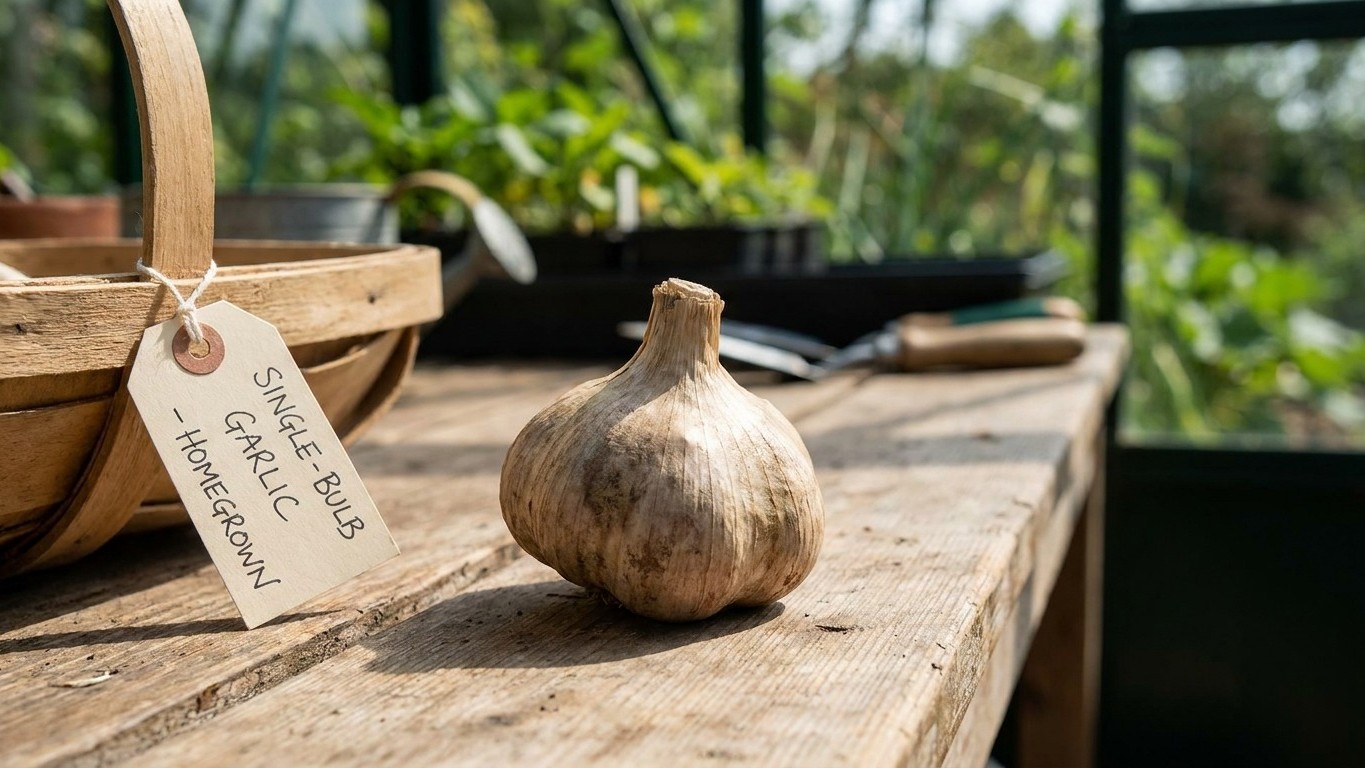

A garlic bulb that comes up smooth and undivided, with no clove seams under the wrapper, is what growers call a round. It happens because the plant never went through enough cold to trigger clove formation, and that decision was made back in autumn and winter, months before you ever saw a leaf. If you’re holding one now, save it. The single most useful thing you can do is replant that same round this coming autumn, using a full-size clove from a properly divided bulb as your other seed stock, and give both a complete cold season this time.
What you are looking at

Cut the bulb in half before you decide anything. A normal garlic head splits into individual cloves, each wrapped in its own papery skin, arranged around a central stem. A round has none of that structure. Inside the outer wrapper you find either a single solid, fleshy mass, or a few thick, concentric layers stacked like the rings of an onion, with no clove walls separating them. That single detail, the absence of internal clove skins, is what confirms a round and rules out almost everything else.
It is easy to confuse with a few other problems that also show up as a “disappointing” harvest. A bulb made of tiny, poorly filled cloves is a small-bulb problem, not a round, and it has different causes worth reading up on separately if that is what you are seeing (see Small Garlic Bulbs: The Four Things That Shrink a Harvest). Rot, soft spots, or a sour smell point to a fungal or bacterial problem, not a vernalization failure, and a round bulb should otherwise smell and feel like clean, firm garlic. If you grew elephant garlic and the bulb came up round in its first season, that is worth noting separately below, because it is not a failure at all.
One more check: peel back the wrapper and look for even a single seam. If you can find one partial division, even a lopsided one, you are looking at a bulb that started to split but ran out of cold before it finished, which still counts as a round for the purposes of what to do next.
What actually causes it
The cold requirement
Garlic cloves differentiate, meaning the bulb divides into separate cloves, in response to a sustained period of cold while the plant is small and mostly below ground. This process is set in motion during the autumn and winter after planting, well before you see much top growth in spring. If the bulb does not get enough consecutive cold, it grows through spring as a single undifferentiated mass instead of splitting into cloves, and by the time you notice a problem at harvest, the cause is nine months in the past.
The exact number of cold weeks and the temperature range that trigger division vary by cultivar and are the kind of figure your state’s cooperative extension service publishes for garlic growers in your specific climate. There is no single number that holds everywhere, so check your local extension’s garlic planting guide rather than relying on a rule of thumb from a different region.
Planting stock and timing
Three separate mistakes at planting time can each lead to a round. Planting too late in autumn shortens the cold window before the ground freezes or before spring warm-up begins, cutting the process off early. Planting undersized cloves, especially the tiny cloves saved from an already-small bulb, gives the plant less stored energy to complete division even if the cold is adequate. And planting bulbils, the small aerial seeds that form on a hardneck’s scape instead of true cloves, or planting a round from a previous season, will reliably produce another round in year one. That last case is not a failure, it is simply the first step of a two-year cycle that many growers use on purpose to multiply new stock.
What you can still do this season
Nothing changes what already happened underground last winter, but the round in your hand is not wasted. It is fully edible garlic, with the same flavor as a clove, just in one piece instead of several. Use it fresh in the kitchen the way you would use a large clove, or cure it alongside your other garlic if it is dry enough, since curing and storage work the same regardless of whether the bulb is divided.
The more useful option, if you want a full crop from this genetic line, is to set the round aside as seed stock. Store it the same way you would store any garlic destined for planting, in a cool, dry, dark spot, and replant it whole this coming autumn rather than eating it. Because it is already garlic tissue rather than a true seed or a bulbil, a round that gets a proper cold season the second time around will often divide normally the following summer. This is the standard way growers bulk up a new variety from bulbils over two seasons, and it works just as well when the round happened by accident.
If several plants in the row came up round while the rest split normally, look at what those particular plants had in common, whether they came from a different batch of seed cloves, sat in a colder or wetter corner of the bed, or were planted a few weeks after the rest. That comparison tells you more about next year’s planting than anything you can do to this year’s harvest.
What does not work
Feeding a round with extra nitrogen or a bloom-boosting fertilizer will not make it split, because the problem is a missed cold trigger, not a nutrient shortage. Garlic that never went through vernalization has no clove-formation signal to respond to, regardless of how well it is fed afterward.
Watering more, or less, has the same non-effect. Clove division is a temperature-driven process, and adjusting soil moisture after the fact does nothing to reverse a decision the plant made months earlier. Cutting the scape early does not help either. Scape removal redirects the plant’s energy into bulb size, which is useful for a plant that is already dividing normally, but it has no bearing on whether cloves formed in the first place. If you want to understand what a scape does tell you about bulb development, that is covered separately in Garlic Bolting Early: What the Scape Tells You About the Bulb.
Warming the soil earlier in spring with mulch or cover is another common attempt that misses the point. The plant needed cold, not heat, and by the time spring warmth arrives the window for triggering clove division has already closed for the season.
Getting it right next year
Choose better seed stock
Start with cloves pulled from a fully divided, disease-free bulb of decent size, not from bulbils, not from a round, and not from the smallest cloves in the bag. If you want to multiply a rare variety from bulbils, plan on two seasons and treat the first year’s round as an expected intermediate step rather than a failure.
Get the timing right
Garlic needs its full autumn-to-winter cold period completed before spring growth accelerates, and the safe planting window is decided by your local frost calendar, which varies a good deal across a single state. General guidance on the planting sequence, from clove selection through the growing season, is covered in Growing Garlic, but the specific date range for your area is worth confirming with your state extension service or a garden center that stocks local seed garlic, since it changes from one county to the next.
- Plant full-size cloves from a divided bulb, not bulbils or rounds, unless you are deliberately bulking new stock over two years.
- Plant within the local autumn window your extension service recommends, not later just to fit your schedule.
- Keep seed stock from different rows or batches labeled separately so a repeat problem is easy to trace.
Common questions
Can I eat a round garlic bulb, or is something wrong with it?
You can eat it. A round is fully mature garlic with the same flavor as a normal clove, it just never split into segments. There is nothing wrong with the tissue itself, only with the process that would have divided it.
Will planting the round next year give me a normal bulb, or another round?
It often gives a properly divided bulb the second time, provided the round gets a complete cold season this time. This is the same two-year process growers use when starting new stock from bulbils, and a round is simply further along than a bulbil would be.
My elephant garlic came up as one round bulb. Is that the same problem?
Elephant garlic commonly produces a round in its first year regardless of cold, since it is a different plant from true garlic and typically needs two seasons to reach a divided bulb. That is expected, not a sign that anything went wrong with your growing conditions.
Should I throw out the whole row if only some of the bulbs came up round?
No, harvest and eat the ones that split normally as usual, and only set the round ones aside as seed if you want to try replanting them. Mixed results in one row usually trace back to differences in clove size or position within the bed, not a problem with the whole planting.