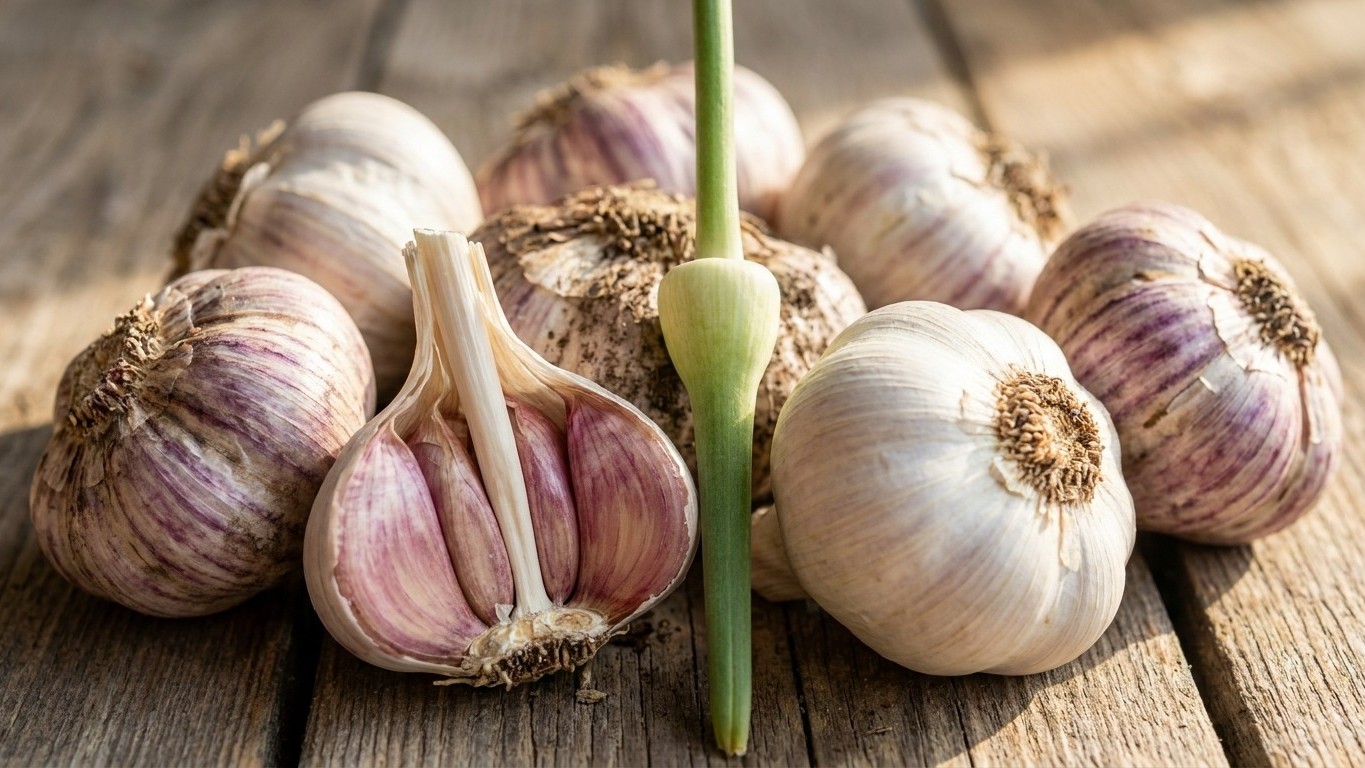

Rosewood garlic is a porcelain-type hardneck, and porcelains are the ones that demand a real winter to divide properly. Plant it where winters run cold enough and you get a head with four to twelve fat, easy-peeling cloves; skip that cold and you get a single round bulb, no cloves at all. The fix for a mild climate is refrigeration before planting, not a different garden technique.
What Music actually is

Rosewood belongs to the Porcelain family, one of the hardneck subgroups, marked by smooth, papery white wrappers over purple-blushed cloves. As a hardneck, it sends up a central stalk (a scape) each spring, something softneck types never do. The flavor, as described in seed catalogs, “starts mild and creamy, ending with a pleasant, spicy bite,” a profile porcelains are known for among cooks who want garlic that reads as complex rather than just hot.
Storage is the tradeoff. Hardneck: 4-12 cloves that peel easily, but keeps only 3-4 months at room temperature. That’s short next to a softneck braid that can hang in a pantry through winter. Rosewood is a variety to eat first, not to bank against next year’s planting season. No disease or pest resistances are published for this variety, so treat it as an unknown on that front rather than assuming built-in protection.
None of this tells you whether Rosewood will actually grow into a proper head in your yard. That depends entirely on cold, and that’s where most garlic advice stops being useful.
Will it get the cold it needs where you are
Garlic clove division is triggered by vernalization: a sustained stretch of cold after planting, not just a frost or two, that signals the plant to split into segments instead of staying a single round bulb. Skip that cold exposure and a grower lifts what’s called a “round,” a solid, undivided bulb that looks nothing like the garlic in a mesh bag at the store. This is the single most common failure with hardneck garlic, and it’s rarely explained clearly.
Porcelains like Rosewood are among the hardneck types that want a genuinely cold winter, more so than many softnecks bred for milder regions. In practice, that means gardens in USDA hardiness zones roughly 3 through 7, where winter lows regularly drop well below freezing for weeks at a stretch, give this variety the cold it’s built for without any intervention. Plant the cloves in fall, let the ground do the rest.
Zones 8 and 9 sit in marginal territory. Winters there dip below freezing on and off but rarely hold cold long enough or deep enough to guarantee full clove division every year. Some seasons work; others produce disappointing rounds. Zone 10 and warmer, think coastal and low-desert Southwest and peninsular Florida, essentially don’t deliver the sustained chill a porcelain hardneck needs, and Rosewood specifically will struggle there without help.
For gardeners in that marginal or warm territory, there are two honest paths, not a shrug and a “don’t bother”:
- Refrigerate the cloves before planting. Storing seed cloves at refrigerator temperature for several weeks ahead of planting substitutes for the missing field cold and is the standard workaround growers in mild climates use for hardneck varieties.
- Grow a softneck type instead. Softnecks generally tolerate mild winters far better and don’t demand the same depth of cold to divide, making them the lower-effort choice south of that marginal zone.
Neither option is a downgrade. It’s just matching the variety to the climate, which is the entire game with overwintered garlic.
When to put the cloves in
Garlic goes in the ground in autumn and comes out the following summer, which surprises gardeners used to spring planting for nearly everything else. The anchor point isn’t a date on a calendar; it’s the first fall frost in a given area, because what matters is giving the cloves enough time to root before the ground freezes solid, without so much time that they push a lot of leafy top growth that then gets battered by winter.
In cold-winter regions, that generally means planting somewhere around four to six weeks before the ground is expected to freeze hard, which for much of the northern tier and mountain West often lands in the second half of September through October. Gardeners in milder, temperate zones, think much of the mid-Atlantic and parts of the Pacific Northwest, usually plant later, often into November, since the ground stays workable and frost-free longer into the year.
Warm-region growers face the opposite problem: not too little time before freeze, but not enough sustained cold once the clove is in the ground, which loops back to the refrigeration workaround already covered. In those areas, planting often shifts to late fall or even early winter, timed so the cold treatment and the ground temperature line up.
It’s worth being upfront that regional guidance genuinely disagrees here rather than converging on one clean rule. A planting window that works in a Zone 5 clay soil doesn’t map cleanly onto sandy soil in a milder zone, and local frost timing varies enough within a single state that neighbors a few hundred feet higher in elevation can be two or three weeks apart. Treat the frost date as the anchor and adjust from local experience rather than chasing an exact date on a bag.
Hardneck or softneck: what this one asks of you
Rosewood is a hardneck, and that habit shapes almost every decision after planting. Hardneck varieties send up a stiff central stalk, the scape, in late spring or early summer, and that scape needs to be cut off before it fully curls and flowers. Leaving it on doesn’t produce seed worth harvesting; garlic scapes are cut, not pollinated, and cutting them redirects the plant’s energy into bulb growth instead of the stalk.
In exchange for that extra step, hardnecks like Rosewood give fewer cloves per head, but each one is noticeably larger and peels far more easily than the small, fiddly cloves typical of softneck types. That’s a real advantage at the cutting board. The tradeoff is storage life: hardnecks like this one run 3-4 months at room temperature, well short of the six-to-ten-month shelf life softnecks are known for, and hardnecks can’t be braided the way softnecks can, since the stiff stalk doesn’t bend.
This pairs directly with the climate discussion above. Hardnecks like Rosewood are the natural fit for long, cold winters, both because that’s the cold they need to divide and because gardeners in those regions tend to use garlic up faster over a shorter storage season anyway. Softnecks earn their keep in mild-winter regions and for anyone who wants garlic to last well into the following spring.
Growing and curing it without losing the crop
Plant individual cloves pointed-end up, roughly 2 inches deep and about 6 inches apart, in loose, well-drained soil; garlic sitting in heavy, waterlogged ground rots before it ever divides. A mulch layer of straw or shredded leaves, several inches thick, matters more for garlic than for most fall plantings because it insulates the cloves through freeze-thaw cycles over winter and helps hold moisture during the following spring’s growth spurt.
Watering matters through spring but needs to stop well before harvest. Cut off irrigation roughly two to three weeks before the expected lift date so the outer wrapper layers can dry down rather than staying soft, which is part of what determines how well the head stores afterward.
The signal that a head is ready to lift is the foliage: when roughly the bottom third to half of the leaves have browned and died back while the upper leaves are still green, the bulb is generally mature. Pulling too early means underdeveloped cloves; waiting too long risks the wrapper splitting open, which invites rot and shortens storage life even further on a variety that’s already limited to 3-4 months at room temperature.
Curing is the step most home growers rush, and it’s the one that determines whether that short storage window gets used or wasted. Move whole plants, unwashed, to a shaded, well-ventilated space out of direct sun and rain for two to three weeks, until the necks are fully dry and the outer wrappers feel papery. Only after that should tops and roots be trimmed and the heads moved to storage. Curing badly, or skipping it to save time, is the classic mistake that turns a good harvest into a moldy one within weeks.
Common questions
Can Rosewood garlic grow in a warm climate at all?
It can, with a workaround. Refrigerating the seed cloves for several weeks before planting substitutes for the sustained field cold this porcelain hardneck needs to divide properly. Without that step, gardens in consistently warm winter regions risk pulling undivided rounds instead of full heads.
Why did my garlic come up as one round bulb instead of separate cloves?
That’s the classic sign of insufficient winter cold, known as inadequate vernalization. The clove sprouted and grew but never received the sustained chill needed to trigger division into segments, a common outcome for hardneck porcelains planted in marginal or warm zones without pre-chilling.
Do I need to cut the scape on Rosewood garlic?
Yes. As a hardneck, Rosewood sends up a scape in late spring that should be cut before it fully curls, directing the plant’s energy into the bulb rather than the stalk. The scape itself is a byproduct of the growth habit, not something to leave for seed.
How long will Rosewood garlic actually keep after harvest?
Expect 3-4 months at room temperature once cured, shorter than most softneck varieties. Since it doesn’t hold as long in storage, it’s a variety best used earlier in the kitchen rotation rather than saved as a winter staple.