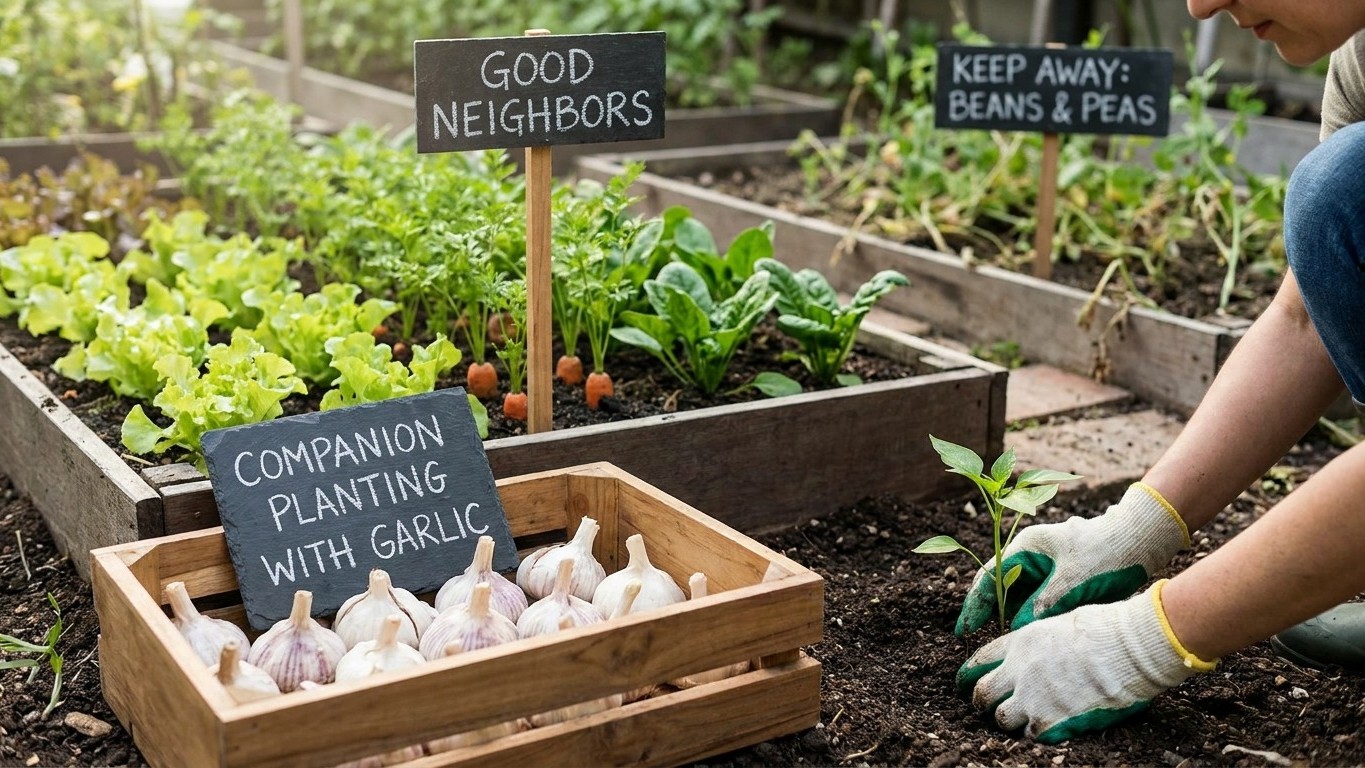

Garlic grows well next to strawberries, brassicas, carrots, and roses, all of which seem to benefit from the sulfur compounds garlic releases into the soil. Keep it well away from beans, peas, and asparagus, since garlic’s root activity interferes with how those crops feed themselves. The single action that follows: sketch your bed layout before a single clove goes in the ground, and keep any legume crop at least a full row’s width from where the garlic will sit.
Why this matters for garlic

Garlic occupies its bed for the better part of a year, from clove to cured bulb, so a bad neighbor does not just crowd it for a season. It works against the crop the entire time the roots are developing underground. Plant garlic next to a heavy nitrogen feeder like beans or peas and both crops lose out: the legumes struggle to fix nitrogen properly because garlic’s root exudates interfere with the rhizobia bacteria they depend on, and the garlic pulls in less of the sulfur and phosphorus it needs to size up its cloves.
The mistake does not announce itself at planting time in the fall. It shows up the following June or July, at harvest, as bulbs that are undersized, single-cloved, or slow to fill out even though the tops looked fine all spring. By then the bed has already given up nine months of growing time that cannot be recovered this season. The correction has to happen at planting, not after the bulbs are in the ground, because garlic does not tolerate being disturbed or interplanted mid-season the way a fast annual would.
Good companions work in the opposite direction. Strawberries, brassicas, carrots, and roses are commonly interplanted with garlic because its strong-smelling sulfur oils are thought to confuse aphids and other soft-bodied pests that would otherwise settle on the neighboring crop. None of that benefit substitutes for correct spacing or timing. It is an added bonus once the basics are handled, not a fix for a bed that is too crowded to begin with.
When to do it
Garlic goes into the ground in fall, timed to the first hard frost in your area, so the cloves root in before the ground freezes but do not push up much leaf growth until spring. That timing is covered in detail on Growing Garlic, and it is the anchor point for everything else planted in the same bed. Companion crops fall into two groups relative to that date.
Perennial companions like strawberries and roses should already be established, or go in around the same fall window, since they will not be disturbed again until garlic is lifted the following summer. Annual companions such as carrots, lettuce, and brassicas are usually sown the following spring, tucked between the emerging garlic rows once the shoots are visible and it is clear exactly where the rows are. Planting them any earlier risks digging into cloves you cannot yet see.
Sources do not fully agree on how tight that spring interplanting window should be. Some extension programs recommend waiting until garlic shoots are several inches tall before direct-seeding anything nearby, so the two root systems are not competing while both are still establishing. Others treat early interplanting as fine as long as the companion crop is shallow-rooted and set well off to the side of the row. When the two pieces of advice conflict, wait for garlic rows to be unmistakable rather than guessing at spacing from bare soil.
Whatever goes in nearby, keep beans, peas, and other legumes out of that bed for the entire nine-month cycle, not just at the fall planting date. A legume sown in spring right next to overwintering garlic causes the same nitrogen-fixation problem as planting the two together in the fall.
How to do it
Start with the garlic itself, since every companion decision is measured against its rows. Individual cloves are commonly set about two inches deep, four to six inches apart within the row, with rows spaced twelve to eighteen inches apart, pointed end up. Those figures come from general planting practice and hold regardless of state, though the fall planting date they are counted back from does not, so check your own last-frost guidance before working backward.
Good companions
The table below lists the pairings most often recommended, along with the plant family and the reasoning behind the pairing. Rotating families through the bed matters as much as the pairing itself, since garlic and its companions should not follow the same family in the same soil year after year.
| Companion | Family | Reported benefit |
|---|---|---|
| Strawberries | Rosaceae | Garlic’s sulfur compounds are thought to discourage aphids and spider mites that target strawberry foliage. |
| Brassicas (cabbage, broccoli, kale) | Brassicaceae | Garlic’s scent may disrupt cabbage moths and aphids that locate host plants by smell. |
| Carrots | Apiaceae | The two crops do not compete heavily for the same soil nutrients, and garlic’s scent may reduce carrot rust fly pressure. |
| Roses | Rosaceae | A long-used pairing meant to reduce aphid and Japanese beetle pressure on rose canes. |
| Tomatoes | Solanaceae | Garlic is credited with reducing spider mite populations on tomato foliage nearby. |
What to keep away
The plants below are the ones to route around the garlic bed entirely, not just space out within it.
- Beans and peas (legumes): garlic’s root exudates interfere with the rhizobia bacteria that fix nitrogen on legume roots, stunting both crops at once.
- Asparagus: the two share the same soil depth and compete directly for water and nutrients while garlic’s roots are developing slowly over winter.
- Sage and other strongly aromatic herbs: some growers report slower growth when these are planted too close to garlic, though the evidence for this pairing is more anecdotal than for legumes.
Leave at least a full pathway or bed edge, not just a single row, between garlic and any legume planting. A narrow buffer still lets roots overlap underground even when the tops look well separated above it.
What goes wrong
The most common mistake is planting a legume cover crop or a bean succession right where garlic went in the previous fall, without accounting for how long garlic occupies that ground. The bed looks empty in early spring because garlic is still just a few inches of leaf, and it is tempting to tuck peas in around it. The nitrogen-fixation problem this causes on the peas does not show up until they flower weeks later and stay pale and slow compared to peas grown elsewhere in the same garden.
A second failure is interplanting too early and severing cloves that have not yet sent up visible shoots. This shows up immediately as gaps in the garlic row once growth resumes, but by then the damage is done and there is no way to replant a clove mid-cycle. Waiting for shoots to be unmistakable before digging nearby avoids this entirely.
A third, slower problem is skipping rotation. Garlic and its allium relatives should not go back into the same bed in consecutive years, and neither should a companion from the same family as the previous year’s crop. This failure is invisible for a full season or two before soil-borne disease pressure builds and bulbs start coming up smaller and more prone to rot in storage, a problem covered in more depth on Curing Garlic: The Weeks That Decide How Long It Keeps. By the time it is obvious in the cured crop, the only fix is a different bed next year, not a different companion.
How this changes across the country
Growers in cold-winter states such as Minnesota, North Dakota, and Maine work with a longer window of frozen or near-frozen soil, so garlic’s fall planting date and mulch depth carry more weight there than the companion planting choice itself. A thick mulch layer protects cloves through a harder winter, and any perennial companion planted alongside needs to tolerate the same conditions without needing separate winter protection.
Mild-winter regions
In mild-winter states along the Gulf Coast and in parts of the Southeast, garlic goes in later relative to the calendar year and the ground rarely freezes solid, which gives more flexibility for interplanting annual companions earlier in the season since there is little risk of digging into dormant, unrooted cloves. The tradeoff is a shorter chilling period for the garlic itself, which affects bulb formation more than any companion planting choice does.
Because these figures shift by hardiness zone and by how far inland or coastal a location is, check your state extension service’s fall planting guidance for the specific frost and mulch timing that applies to your county rather than relying on a single national date. The companion planting principles above, keeping legumes away and grouping garlic with strawberries, brassicas, carrots, or roses, hold regardless of which zone you garden in even though the calendar dates around them do not.
Common questions
Can I plant garlic next to onions or leeks?
You can, since they will not harm each other directly, but there is little benefit either. All three are alliums competing for the same nutrients, and grouping them together makes crop rotation harder the following year because the whole bed needs to move to a new family, not just part of it.
Will garlic actually keep pests off my tomatoes?
It may reduce spider mite numbers somewhat, but the evidence for this is largely anecdotal rather than tested at scale. Treat it as a mild bonus from a pairing that already works for soil and space reasons, not as pest control on its own.
Can garlic and strawberries share the same bed permanently?
Only if you are comfortable disturbing the strawberry planting once a year, since garlic is lifted every summer while strawberries stay put for several seasons. Most growers keep the two in adjoining beds instead of interplanted in the same rows, so the garlic harvest does not mean tearing through established strawberry crowns.
I already planted beans too close to my garlic. Is it too late to fix?
It is not a lost cause, but there is no way to move garlic once it is rooted in for winter. Thin the beans back to give more distance, watch for the pale, stunted growth that signals nitrogen trouble, and plan on a wider buffer or a different bed pairing next season.