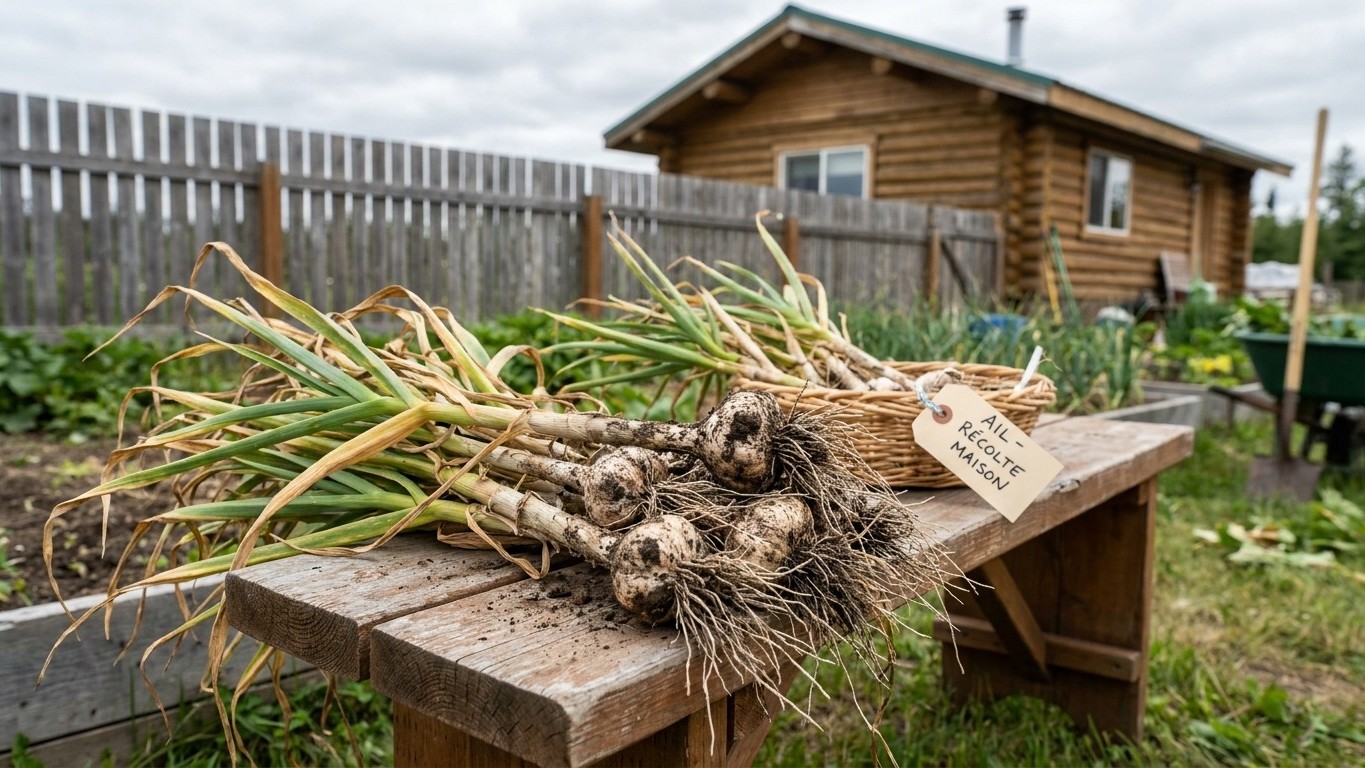

Garlic goes into Alaska ground in early September, and the reason is simple: it needs three to four weeks of root time before the ground freezes solid, without pushing a green shoot up where the first hard frost can burn it back. Walk your yard now and check where the first fall freeze usually lands for your district, because that date, not the calendar month, is what sets your real planting day. Once you know it, count back three to four weeks and that’s your window.
The short answer for Alaska

Plant Garlic in early September across the cultivars carried for this territory, whether you’re setting out a hardneck like German White or a softneck like Inchelium Red. That date is not a guess. It is built backward from NOAA’s 1991-2020 Climate Normals, which put the first fall freeze (32°F) at the Anchorage station in a window of September 22 to October 1. Early September lands roughly three to four weeks ahead of that freeze window, enough time for a clove to push roots into the soil before the ground locks up, but not so early that a hardneck’s shoot breaks the surface and gets caught by the first hard freeze.
This window moves for a reason. NOAA’s freeze data describe a range, not a single day: in roughly one year out of two the actual freeze at Anchorage falls later than this range’s midpoint, and in others it falls earlier. A planting date that only accounts for the midpoint is planning for an average year, not the one that actually shows up. That is why the recommendation is a window, early September, rather than a single circled date.
The Anchorage station (USW00026451) describes one city on Cook Inlet, not the whole state. Anchorage sits among the mildest inhabited parts of Alaska, with roughly 143 frost-free days in an average year. The Interior and the areas farther north run a much shorter season. Anyone gardening outside the Anchorage bowl needs to shift the window earlier, sometimes by weeks, to match a shorter and earlier-arriving fall. For the broader rhythm of the crop, from clove selection to summer harvest, see Growing Garlic in Alaska.
Working it out for your own garden
The formula behind the date
The early-September figure for garlic in this territory is not read off a chart, it is calculated. Take NOAA’s 1991-2020 Climate Normals first fall frost window for your reference station (September 22 to October 1 for Anchorage), then count back three to four weeks. That gap gives the clove time to grow roots and settle into the soil before a hard freeze locks the ground up, without pushing a green shoot above ground where the first freeze can burn it back. Run the same arithmetic against your own district’s climate normals rather than borrowing Anchorage’s, because a single reference station cannot describe a state this large.
Counting back three to four weeks from a frost range gives you another range, not a single day. If your local frost data reads two weeks earlier than Anchorage’s, shift the whole planting window two weeks earlier too, and keep it as a range rather than a date circled on the calendar.
What moves the local frost date
A handful of site factors change how early cold settles on a given garden, sometimes by two weeks in either direction from what a regional station reports:
- Elevation – a garden a few hundred feet higher than the valley floor cools faster and holds frost pockets longer into spring and earlier into fall.
- A large lake or the coast nearby – open water holds heat into autumn and can push a garden’s first frost later than an inland station at the same latitude.
- Slope and aspect – cold air drains downhill and pools in low ground, so a garden at the bottom of a slope frosts before one partway up it.
- Soil drainage – heavy, wet soil holds cold and takes longer to warm in spring, which matters again the following June when the clove needs to resume growth.
None of these factors change the underlying logic, only the date it lands on. The three-to-four week gap between planting and expected hard freeze still applies, wherever your garden sits. Keeping your own frost log for a couple of seasons is the fastest way to find out exactly where inside the regional range your particular garden falls, since a published normal describes a weather station, not the microclimate under a windbreak or against a south-facing wall.
What changes across Alaska
The Interior runs a shorter and more extreme season than the Cook Inlet basin where the Anchorage station sits. Continental winters there settle in earlier and harder, so a fall planting date calculated from Anchorage’s September 22 to October 1 frost window (NOAA’s 1991-2020 Climate Normals) needs to move earlier for any Interior garden, not later. The same caution applies further north, where the growing season is shorter still.
Anchorage itself sits among the mildest inhabited parts of the state, with an average frost-free season of roughly 143 days. That mildness comes largely from Cook Inlet’s moderating water, the same effect that keeps many coastal gardens in the state running warmer, later into fall, than inland sites at a similar latitude. A garden right on the water can often push its planting date later than one just a few miles inland on the same soil.
Daylight offsets a short season
Alaska’s long summer daylight is the one factor that works in the gardener’s favor across the whole state. A short frost-free season sounds like a hard limit, but extended daylight through the growing months drives faster leaf growth once garlic resumes in spring, which is part of why the crop performs here despite a season that would be marginal at the same frost-free day count farther south. That does not change the fall planting math, but it explains why growers across such a wide range of local climates still get a full bulb by summer.
Whichever region you garden in, the same catalogue of cultivars applies, only the calendar shifts. See Garlic Varieties That Suit Alaska Winters for how hardneck and softneck types perform once that date is set.
The mistakes this climate punishes
Planting too late, or too shallow
The single costliest mistake in this climate is planting so late that the clove has not rooted before the ground freezes hard. A clove that goes in without established roots sits exposed to frost heave through fall and winter, and heaving breaks the fine roots that anchor it, which shows up as poor spring growth or a bulb that never sizes up. Planting at the correct depth, then mulching heavily as soon as the clove is in, is what buys the root system time before the ground locks up.
The reverse mistake, more common in a mild year, is treating the September 22 to October 1 frost window (NOAA’s 1991-2020 Climate Normals) as the day to plant rather than as the day to be finished. A clove needs those three to four weeks of rooting time even in a year when the first freeze arrives late. Waiting for a forecast frost to trigger planting, instead of working from the calendar date, is how a mild fall still produces a poorly rooted bed.
Choosing the wrong type for the winter you’ll actually get
Hardneck cultivars, including Chesnok Red and German Red, generally tolerate harder winters than softnecks such as Lorz Italian, which is part of why hardneck types dominate the list of cultivars suited to this territory. Planting an unmulched softneck bed and assuming it will winter like a hardneck is a mistake that only shows up the following June, when the stand is thin.
Disease risk does not disappear because winters are cold
Cold winters do not clear a garden of garlic pathogens. UC ANR’s Pest Management Guidelines for onion and garlic (Publication 3453) list white rot, caused by Sclerotium cepivorum, as active in soil temperatures of 50 to 75°F, a range that overlaps the mean air temperature of June and July even in a short Alaska season. Air and soil temperature are not the same measurement, and a monthly average hides plenty of warmer days within it, but the overlap means white rot is a live risk in the warmest two months of the growing season, not something a cold winter rules out. The safest guard is certified disease-free planting stock, not the climate.
Checking this against your county
Every figure above comes from one reference station near Anchorage, and Alaska’s geography makes a single station a poor stand-in for the whole state. Before you commit to a planting date, check your own area’s frost record and any local planting guidance with the University of Alaska Fairbanks Cooperative Extension Service. Its district offices track conditions closer to your own garden than a national dataset built around one Anchorage-area station ever will, and they are the right first call if your county’s frost pattern looks different from what NOAA’s normals describe here.
Common questions
What if I miss the early September window?
Planting into mid-September is still workable in most years, since NOAA’s 1991-2020 Climate Normals put the Anchorage-area frost at September 22 to October 1, not a hard cutoff on the calendar. Push mulch on heavier and deeper if you plant later, since the clove has less time to root before the ground cools.
Does garlic that sprouts in fall survive the winter?
A shoot that breaks the surface before winter is not automatically lost, but it is more exposed to freeze damage than a clove that has only rooted below ground. A thick mulch layer over the row protects the growing point through the coldest months, and most plants push new growth again once the soil warms in spring.
Should I break the bulb into cloves before planting?
Yes, separate the bulb into individual cloves right before planting and set out only the largest, healthiest ones with the papery skin intact. Save the smallest cloves for the kitchen instead of the garden bed, since undersized cloves tend to produce undersized bulbs.
Can I Plant Garlic in spring instead of fall in Alaska?
Garlic can technically go into the ground as soon as the soil can be worked in spring, but it needs a period of cold to divide properly into cloves, which a fall planting gets naturally over winter and a spring planting has to catch up on. Fall planting ahead of the first frost is the more reliable route in this climate, which is why the cultivars carried for this territory are all listed as fall-planted.
The Moon calendar is a separate, older custom: see when to plant garlic by the moon, written as tradition rather than fact.