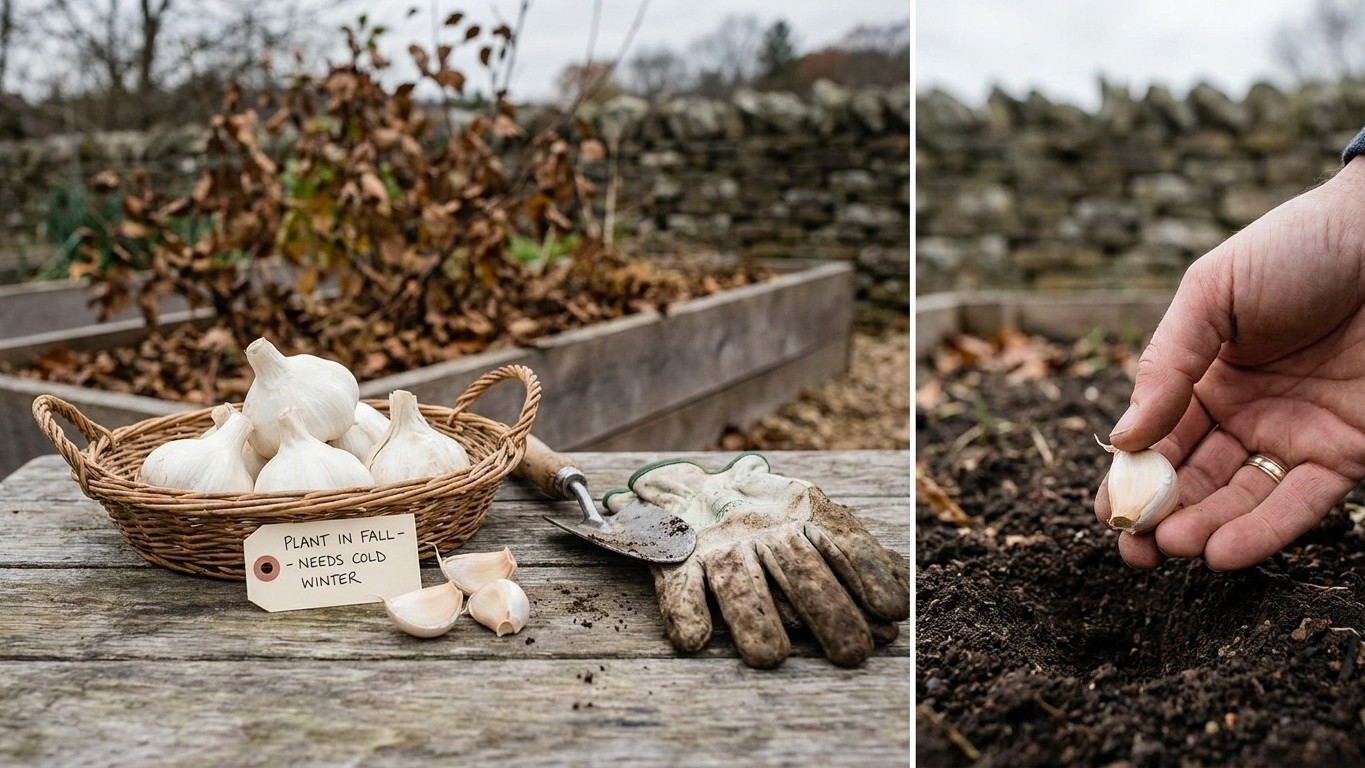

Georgian Crystal is a Porcelain hardneck garlic, grown for its thick white wrapper, blunt raw heat and a small number of very large, easy-peeling cloves. Porcelain types ask for one of the longest stretches of real winter chill of any garlic, more than most Rocambole or Artichoke varieties need, and without it the clove never divides into a head. Check whether your area logs enough sustained cold each winter before you order bulbs, because that single fact decides whether Georgian Crystal is worth planting or whether a softneck belongs in your ground instead.
What Georgian Crystal actually is

Botanically, Georgian Crystal sits in the Porcelain group, the same family as Music and German White. It is a true hardneck: a single stiff, woody stalk runs up the center of the bulb and pushes out a curling scape in early summer. Around that stalk sit just four to six cloves, arranged in a single ring, each one large enough to peel with a thumbnail rather than a knife. That low clove count is a Porcelain trademark, not a flaw. Fewer, bigger cloves mean less papery waste and faster prep at the cutting board.
Seed garlic catalogs describe the flavor as rich and hot eaten raw, settling into a deep, full garlic taste once cooked, a profile typical of Porcelain types generally. For storage, expect it to hold up for a few months in a cool, dry, dark spot once properly cured, shorter than a softneck braid will last but long enough to carry most households from summer harvest into the darker months. If you want the full spread of botanical types before you commit to this one, the Garlic Varieties overview lays out how Porcelain compares with Rocambole, Purple Stripe, Artichoke and Silverskin.
What Georgian Crystal tastes like, and what to do with it
Being a Porcelain hardneck puts Georgian Crystal in the family typically prized for the sharpest raw bite of any garlic type, and that initial heat is real here too. But where most Porcelains keep pushing that intensity all the way through, Georgian Crystal pulls back: what settles in is a smooth, slightly smoky flavor that is not too hot. That is a break from the group’s reputation, not a restatement of it, and it is worth taking at face value rather than assuming this bulb behaves like Music or German White in the mouth.
The mechanism behind that shift is heat, not variety magic. Raw garlic owes its sting to a chemical reaction that fires the moment a clove is cut or crushed; the harder and finer you work it, the more of that reaction you get. Cooking interrupts it, and the interruption is progressive — a quick sauté mutes the bite, while low, slow roasting shuts the reaction down almost entirely and lets natural sugars come forward instead. Because Georgian Crystal is already smoky and smooth rather than aggressively hot, roasting it doesn’t just tame heat, it has less heat to tame, so the sweetness shows through faster and more fully than it would in a harsher Porcelain.
That makes raw or lightly cooked preparations the place to actually taste what sets this variety apart: a thin shaving over tomatoes, a raw clove worked into dressing, or a light finish stirred into a dish off the heat. Full roasting is still worthwhile, but expect a mellow, spreadable sweetness rather than a dramatic transformation, since there wasn’t much sharpness to begin with. For long-simmered sauces and braises, its cooked character will read as clean and rounded rather than as a standout note — pleasant, but not the dish where this clove’s particular identity is easiest to notice.
Will it get the cold it needs where you are
Garlic clove division is triggered by a sustained run of cold after planting, generally weeks spent under 40°F. Skip that exposure and the plant puts its energy into one round, undivided bulb instead of a head of cloves. This is the single most common reason a first-time garlic grower ends up disappointed, and it has nothing to do with soil, water or fertilizer. It is entirely about winter.
Where the cold falls short
At the tight end, reference stations in Los Angeles, Houston, Jacksonville, New Orleans and Phoenix log essentially zero weeks under 40°F in a typical winter, against roughly six weeks a Porcelain hardneck wants. In California, Texas, Louisiana, Florida, Hawaii and Arizona, planting Georgian Crystal straight from the bag is a real gamble. You have two honest options: refrigerate the cloves for several weeks before planting to fake the chilling they would otherwise miss, or drop the hardneck plan and grow a softneck type from the Artichoke or Silverskin group instead, which asks for far less cold to size up properly.
Where the cold is generous but the season is short
At the other extreme, places like Prince Edward Island and stations across Alaska, Yukon, the Northwest Territories, Alberta and Nunavut have the opposite problem. Cold is never in short supply there, but the cumulative growing-season heat needed to size the bulb is thin. Charlottetown’s climate puts the season at roughly 1,569 accumulated degree-days, workable but tight, so an early cultivar and a black plastic mulch to pull in extra soil heat make a real difference. Anchorage runs closer to 917 degree-days across the year, Whitehorse and Yellowknife lower still, and at those totals a high tunnel or greenhouse finish is what turns a marginal crop into a reliable one.
| Territory (reference station) | Cold vs. heat situation | Verdict | What to do |
|---|---|---|---|
| California (Los Angeles) | 0 weeks under 40°F of roughly 6 needed | Risky | Refrigerate cloves, or plant a softneck |
| Texas (Houston) | 0 weeks under 40°F of roughly 6 needed | Risky | Refrigerate cloves, or plant a softneck |
| Florida (Jacksonville) | 0 weeks under 40°F of roughly 6 needed | Risky | Refrigerate cloves, or plant a softneck |
| Prince Edward Island (Charlottetown) | Cold is ample; roughly 1,569 degree-days for ripening | Comfortable but tight | Early cultivar, plastic mulch for extra heat |
| Alaska (Anchorage) | Cold is ample; roughly 917 degree-days for ripening | Comfortable, heat-short | Finish under a high tunnel or greenhouse |
When to put the cloves in
Garlic is a fall-planted, summer-lifted crop everywhere it is grown as a hardneck, and Georgian Crystal is no exception. The date that matters is not a number on a calendar, it is your first fall frost, because everything else is measured backward from it.
In regions with a long, cold winter, growers plant relatively early, giving roots time to establish while the ground is still workable, then letting the plant sit dormant through the coldest stretch. In milder regions with a short or shallow winter, planting happens later, closer to the point where the ground finally cools, because planting too early there risks pushing soft top growth that a stray warm spell then encourages further, leaving it exposed when a real cold snap finally arrives. The territories in the table above show this pattern already: Prince Edward Island and the far northern territories set cloves out in late summer or early fall, while Gulf Coast stations like Houston and New Orleans wait until deep into fall before the ground even starts to cool.
The rule that decides the exact week, wherever you garden, is the same: cloves need enough time to grow roots before the ground freezes hard, but not so much time that they push several inches of leaf above ground first. State extension services differ on how they phrase that window, and some are more conservative than others, so check the current fall planting guidance from your own state’s extension service or land-grant university rather than borrowing a date meant for a different climate.
Hardneck or softneck: what this one asks of you
Georgian Crystal’s Porcelain classification makes it a hardneck through and through, and that habit sets the whole growing rhythm. In early summer it sends up a scape, a curling flower stalk that should be cut off while still tender, both to eat and to keep the plant’s energy going into the bulb rather than the stalk. Leave it uncut and the bulb finishes noticeably smaller.
Hardneck types like this one trade quantity for size: four to six large cloves per bulb instead of a softneck’s dozen or more small ones, each one easy to peel in one piece. What you lose is shelf life. A well-cured hardneck bulb holds for a few months in good storage, while a softneck braid can carry a household most of the way to the next harvest. Rocambole types like Spanish Roja share this same trade-off and the same cold requirement, while a fellow Porcelain such as Georgian Fire makes a useful side-by-side comparison if you are trying to decide between two hardnecks with similar climate demands. As a rule of thumb, hardneck garlic belongs in gardens with a genuine winter, and softneck belongs where winter barely shows up.
Growing and curing it without losing the crop
Plant individual cloves root-down, about two to three inches deep and four to six inches apart, in loose, well-drained soil. A generous layer of straw mulch matters more here than for a spring-planted crop, because it buffers the freeze-thaw cycles that can heave a clove partway out of the ground over winter and expose it to cold air it was never meant to feel directly.
Reading the plant, not the calendar
Stop watering once the lower leaves start to yellow and die back, usually a few weeks before the expected harvest, since wet soil late in the season encourages rot rather than growth at that point. Georgian Crystal is ready to lift when roughly half the leaves have browned and the rest are still green: pull one test bulb, and if the cloves have separated cleanly under a tight wrapper, the rest are ready too.
Curing is where most losses actually happen, more often than any pest or disease. Lay or hang the whole plants, tops still attached, somewhere shaded, dry and airy for several weeks until the wrapper turns fully papery and the neck tightens down hard. Only then trim the roots and tops and move the bulbs into storage. A bulb cured too fast, in sun or without airflow, will mold from the inside before you ever notice a problem.
Common questions
Can I grow Georgian Crystal in a raised bed?
Yes, but raised beds freeze and thaw faster than ground-level soil because they lose heat from more sides. Mulch heavier than you would in an in-ground row, since the clove is more exposed to temperature swings that can heave it upward over winter.
What happens if I plant it in spring instead of fall?
Spring-planted cloves usually miss the cold exposure they need and form a single round bulb instead of a divided head. If fall planting is not possible, refrigerating the cloves for several weeks before a spring planting is the closest workaround, though results are still less reliable than a proper fall start.
Is Georgian Crystal basically the same as Music garlic?
They belong to the same Porcelain group and share the low clove count, thick white wrapper and hardneck habit. Differences in flavor intensity and bulb size between named Porcelain cultivars are usually modest and often depend more on your soil and season than on which cultivar you planted.
Do I have to cut the scape?
Cutting it is standard practice for hardneck garlic because it redirects the plant’s energy into bulb size rather than the flower stalk. You can leave a few scapes uncut to harvest and eat, but expect those particular bulbs to finish somewhat smaller.