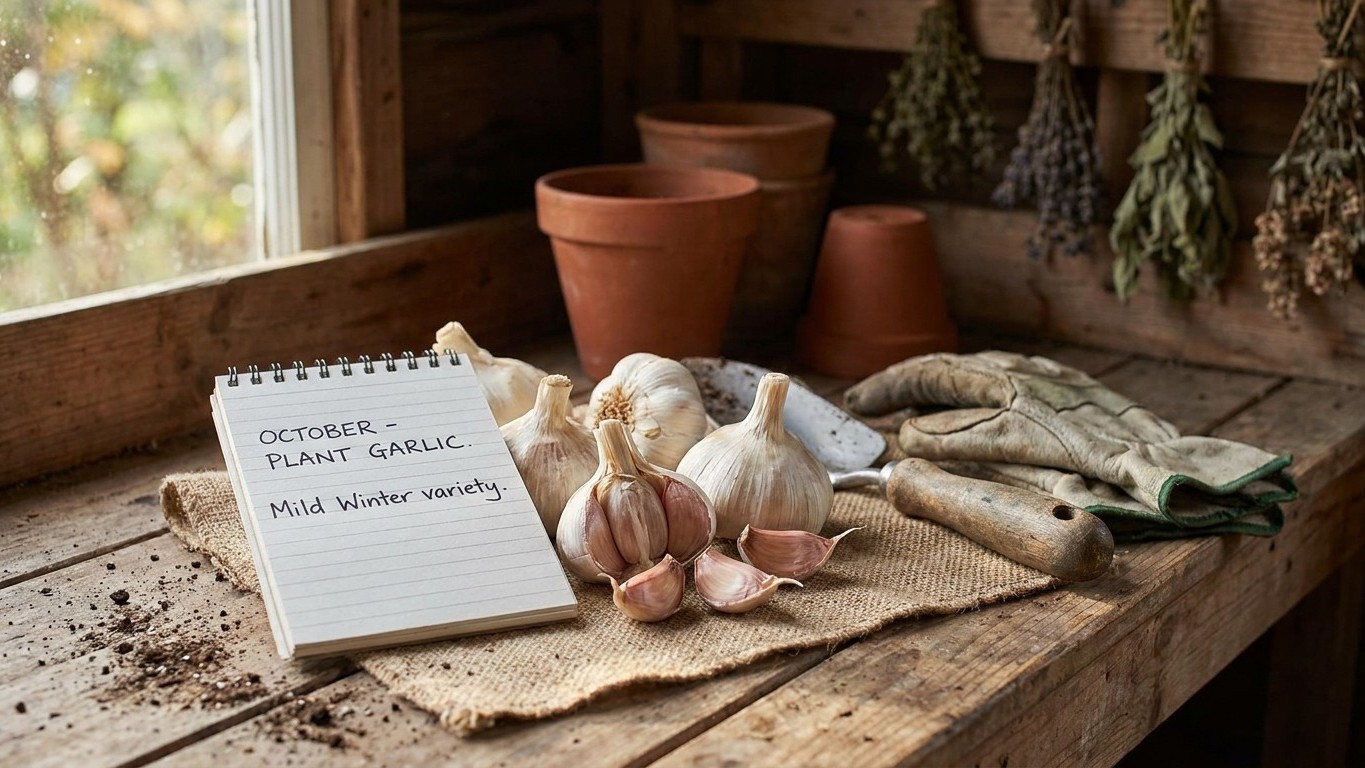

Nootka Rose is a softneck Silverskin garlic, the braiding type that keeps longer in storage than any hardneck, and it needs less winter cold before the clove will split into a head. That threshold is still real, roughly six weeks with temperatures under 40°F, and it is short by garlic standards but not short enough for every mild-winter garden. Check your nearest weather station’s winter temperature record before you order this one, and if the numbers fall short, plan to refrigerate the seed cloves rather than skip the chill altogether.
What Nootka Rose actually is

Nootka Rose belongs to the Silverskin group, the same family as Inchelium Red and California Early, and it is a true softneck: no scape, no seed stalk to cut, just a round bulb wrapped in tight, papery skins with a rose-pink blush that gives the variety its name. Under those wrappers sit many small cloves, often fifteen to twenty per bulb, arranged in overlapping layers rather than the single neat ring a hardneck produces.
Catalogue descriptions of Silverskin types generally place Nootka Rose’s flavor as milder than a Rocambole or Porcelain when raw, with more heat showing up once it is cooked down. That mildness is one reason Silverskin garlic ends up braided and sold whole rather than broken into single-clove packs at the market.
The trait that matters most for a home grower is storage life. Silverskins keep longer in a pantry or root cellar than any other garlic type, commonly outlasting hardnecks by several months when cured well. That alone is the reason many gardeners in mild-winter regions choose a Silverskin over a Porcelain or Rocambole, even before the cold requirement enters the decision. For a wider comparison of types and their keeping qualities, the Garlic Varieties guide breaks down the four botanical groups side by side.
What Nootka Rose tastes like, and what to do with it
Nootka Rose is the exception inside its own group. Silverskins as a category lean mild, which is why they get braided and eaten whole rather than singled out for flavor, but Nootka Rose is described as quite strong for a softneck, with a rich, bold taste that doesn’t match the gentler profile typical of Inchelium Red or California Early. That’s a real break from the family average, not a rounding-down to it, and it’s worth taking at face value rather than assuming the bulb must taste like a standard Silverskin underneath.
The mechanism still applies, though. Raw garlic bite comes from compounds that soften with heat, and long roasting will caramelize any variety toward sweetness, Nootka Rose included. So its boldness is most obvious in raw or lightly cooked states — minced into a dressing, worked into a salsa verde, or added near the end of a sauté — where the strong character has less time to be cooked away. Push it through a long roast and it will mellow like anything else, though starting from a bolder baseline than a milder Silverskin means there’s more flavor left even after that softening.
That makes it a useful bulb for cooks who want a softneck’s storage advantage without giving up much on taste. Cured bulbs hold for six to nine months, long enough to carry a kitchen from one harvest to the next, and because the flavor is stronger than a typical Silverskin, it doesn’t disappear into the background the way milder softnecks can when used raw in small amounts. Beyond that, no specific notes on heat level, aftertaste, or aroma compared to hardneck types are published, so it’s best treated as a bold, storable white-skinned garlic rather than assigned qualities that haven’t actually been recorded for it.
Will it get the cold it needs where you are
Garlic clove division depends on a run of cold weather after planting. Skip it, and the plant grows into a single round bulb instead of a head divided into cloves, no matter how well you water or fertilize it. Nootka Rose asks for less of that cold than a hardneck, which is exactly why catalogues market it toward mild-winter gardeners, but “less” is not “none,” and several genuinely warm states do not clear the bar in an average year.
Where the winter falls short
In California, using Los Angeles as the reference station, winter temperature records show essentially zero weeks below 40°F against the roughly six weeks Nootka Rose needs. The clove will not divide under those conditions. The same shortfall shows up in Louisiana, where New Orleans records point to the same zero-week gap, even though growers there can still set cloves out from late November into mid December for a first harvest in late August. Texas, watched from Houston, and Florida, watched from Jacksonville, both show the identical pattern: a workable fall planting window, early November into late November, but no meaningful stretch of chill to divide the clove once it is in the ground. Hawaii and Arizona land in the same risky category for the same reason. In every one of these states, the fix is not to abandon the crop. Refrigerate the seed cloves for the missing weeks before planting, holding them near 40°F for about the shortfall period, or plant a type bred to need even less cold than a Silverskin, and check your state extension service for a chilling protocol suited to your county.
Where cold is never the problem
At the other extreme, cold is abundant and heat is what runs short. In Yukon, tracked from Whitehorse, the growing season accumulates only around 600 degree-days across the year, the lowest total among the territories reviewed here, even though cloves set out in early August and lifted by mid April face no shortage of winter chill at all. Nunavut, watched from Rankin Inlet, is even more extreme on the heat side at roughly 159 degree-days for the year, despite a similarly comfortable cold supply. In both cases the limiting factor is total accumulated warmth, not the six weeks of chill Nootka Rose needs to divide. A high tunnel or unheated greenhouse that traps daytime heat without blocking the cold nights solves the problem in a way that no amount of extra chilling can.
When to put the cloves in
Garlic goes in the ground in fall and comes out the following summer, and the exact window is set by the first fall frost rather than by a date on the calendar. The cloves need enough time to root into the soil before it freezes hard, but not so much time that they push a lot of green top growth before winter sets in. Top growth that gets caught by a hard freeze can set the whole plant back, and roots that never form leave the clove sitting loose and vulnerable.
The territories named above show how wide that window actually runs. In cold-winter Alaska, watched from Anchorage, growers set cloves out in early September for a first harvest around mid May. Further north still, Northwest Territories, tracked from Yellowknife, and Alberta, tracked from Calgary, both plant in late August. Contrast that with the mild-winter South: New Orleans-area growers in Louisiana plant as late as mid December, and Houston-area growers in Texas finish by late November. The gap between an early-August planting in the Yukon and a mid-December planting in Louisiana is not a rounding error. It is the entire difference between a climate where the ground freezes hard and one where it barely dips below freezing at all.
Because that window shifts so much by region, and because state extension services do not all agree on exactly how many weeks before the ground freezes is ideal, treat any single date you find online with suspicion unless it is tied to your own state’s extension guidance. The safest approach is to work backward from your area’s typical first fall frost, using your state’s cooperative extension office as the source for that date, and plant late enough to avoid a flush of tender top growth but early enough for roots to take hold.
Hardneck or softneck: what this one asks of you
Nootka Rose is a softneck, and that habit shapes almost everything about growing and using it. It sends up no scape, so there is nothing to cut back in early summer the way a hardneck grower has to. In exchange for skipping that step, you get more cloves per bulb, each one smaller than what a hardneck like German Red produces, and a papery wrapper that peels less cleanly than a hardneck’s but braids beautifully once cured.
That trade runs in a consistent direction across garlic types generally: hardnecks like German Red, a Rocambole, are bred for regions with a real winter and give you fewer, larger, easy-peel cloves that do not store as long. Softnecks and the Artichoke types closest to them, such as Red Toch, lean the other way, favoring milder winters and rewarding the grower with smaller cloves in greater number and a bulb that lasts in storage for months rather than weeks. Nootka Rose sits solidly in the softneck camp, which is exactly why its cold requirement runs lower than a Rocambole’s and why it shows up on seed lists aimed at Southern and coastal gardeners rather than growers in a hard-winter state.
The practical upshot: if your garden is in a state where German Red or another true hardneck struggles to bulb properly because winter isn’t cold enough, a Silverskin like Nootka Rose is very likely the better fit, provided the chill crossing described above still clears its lower bar.
Growing and curing it without losing the crop
Plant cloves pointed end up, spaced a few inches apart in rows roughly a foot apart, at a depth of about two inches of soil above the tip. Mulch heavily right after planting, more heavily than you would for a spring-planted crop, because an overwintered clove needs the mulch to buffer soil temperature swings and to suppress the winter weeds that would otherwise compete with a plant that is barely growing.
Reading the plant, not the calendar
Stop watering several weeks before you expect to lift the bulbs. Wet soil at harvest time invites rot and stains the wrappers, which shortens storage life even if the cloves themselves are sound. The plant tells you when it is close: watch for the lower leaves to yellow and die back while the upper leaves stay green, generally somewhere around five to six green leaves remaining is the traditional signal growers use across garlic types, though your own state extension office may publish a more specific local guideline worth checking.
Signs it is time to check a test bulb rather than lift the whole bed at once:
- Bottom third to half of the leaves have browned and dried
- The remaining green leaves have lost some rigidity but are not collapsed
- A test bulb dug up shows distinct, plump cloves under a still-intact wrapper
Lift with a fork rather than pulling by the stalk, since a snapped neck on a bulb you meant to store is a bulb that will not keep. Cure the whole plant, roots, stalk, and all, in a shaded, airy spot out of direct sun for several weeks until the outer wrappers are fully dry and papery and the neck has tightened down hard. Curing badly or lifting late are the two mistakes that cost growers the whole crop in storage, not in the field, so resist the temptation to trim and box up bulbs the same day they come out of the ground.
Common questions
Can I plant Nootka Rose in spring instead of fall?
You can, but you will likely get small, undivided bulbs, because spring planting skips most of the cold period the clove needs to split. Fall planting followed by an overwinter chill period, natural or refrigerated, is how Silverskin types are meant to be grown.
Does Nootka Rose send up a scape I need to cut?
No. It is a softneck, and softnecks do not produce the curling flower stalk that hardneck growers cut off in early summer. If you see a stiff central stalk forming on a garlic plant, it is a hardneck variety, not a true Silverskin.
How long will Nootka Rose actually keep once it’s cured?
Longer than almost any hardneck, provided it was cured properly and stored somewhere cool, dry, and dark. Silverskin types are generally regarded as the longest-keeping garlic group, which is a large part of their appeal for a home pantry.
Is Nootka Rose the same thing as ordinary grocery store garlic?
Not exactly, though it is closely related in type. Much of the garlic sold in supermarkets is a Silverskin or softneck strain grown commercially in mild-winter regions, so the habit and storage life are similar, even if the specific cultivar on the shelf is not named Nootka Rose.