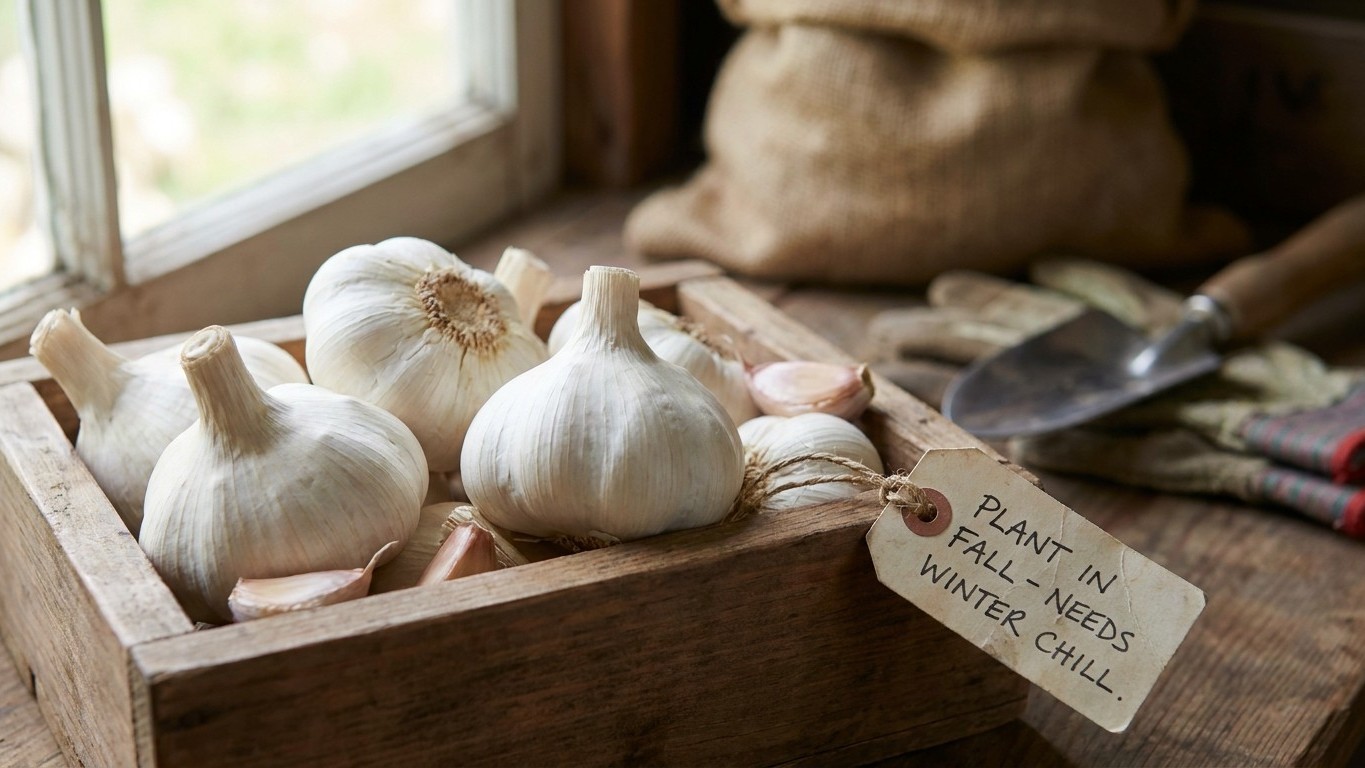

Georgian Fire needs about six weeks of nights under 40°F after you plant it, or the clove you buried just sits there and comes up as one round bulb instead of a head of cloves — so before you order anything, look up your first fall frost date and count backward to see if your winter actually delivers that stretch of cold. If it doesn’t, the fix is easy: plant it in fall like any hardneck, but if you’re in a mild-winter spot, start refrigerating the cloves now so they get the chill underground can’t give them.
What Georgian Fire actually is

Georgian Fire belongs to the Porcelain group, the same family as Music and German Rocambole-adjacent types that gardeners in cold climates favor for size and storage. It’s a true hardneck: a stiff central stalk called a scape pushes up in late spring, and the bulb forms around it as four to six large cloves under a smooth white or faintly ivory wrapper. Seed garlic catalogs describe the flavor as sharp and persistent, hotter than most softnecks straight off the plant, mellowing only a little with cooking.
Porcelain types are not the longest keepers in the garlic world. Catalog listings typically put Georgian Fire’s storage life at a few months in a cool, dry, dark spot, shorter than a softneck like Inchelium Red will give you, but the tradeoff is bulb size and that flavor. If you’re new to the different types on offer, the full rundown of Porcelain, Rocambole, Purple Stripe, Artichoke and Silverskin groups is worth reading before you commit a bed to any one of them, and the garlic varieties overview lays out how they differ in the ground, not just on the plate.
What Georgian Fire tastes like, and what to do with it
The clove itself tells you what’s coming: strip back the tan skin on each of the four to six segments and you get a flavor that’s been bred to hit hard and then round out, rather than just burn. That combination — real heat with a spice note that keeps it from tipping into harsh — is what sets Georgian Fire apart from a porcelain garlic that’s simply hot and nothing else. The spice reads almost like background pepper, not a separate taste, but enough to keep the punch from feeling one-dimensional.
That balance matters most raw. Grate or mince a clove straight into a dressing, a salsa, or a finishing oil and both halves of the flavor show up at once: the sharp bite hits first, the spice lingers after. This is the form in which Georgian Fire earns its name — cooked gently, in a quick sauté or a pan sauce, the heat fades fast and you’re left mostly with the spice note and a milder version of the garlic flavor underneath.
Long, slow heat changes the calculation entirely. Roast a whole head at low temperature until the cloves go soft and amber, and the sugars that heat draws out of any garlic will dominate — Georgian Fire will turn sweet and spreadable like the rest of its species, and the spice that defines it raw will read as a faint warmth in the background rather than a flavor you’d pick out blind. If you want this variety’s actual character on the plate, use it raw or barely cooked; save the long roast for when you want sweetness instead, because at that point the variety and the group become nearly indistinguishable. Beyond that, no tasting notes for aged or dehydrated forms of Georgian Fire are published, so treat fresh raw and fresh cooked as the two states worth planning a dish around.
Will it get the cold it needs where you are
Hardneck garlic like Georgian Fire needs roughly six weeks of temperatures below 40°F after planting to trigger clove division. Skip that and the clove stays whole. This is the single most common reason a first-time grower plants a beautiful bulb and harvests a disappointing single round the following summer, and it has nothing to do with soil, spacing or how carefully the cloves were separated.
Where the winter falls short
In California, measured at the Los Angeles station, and across Louisiana, Texas, Florida, Hawaii and Arizona, winters at the reference stations for those states deliver essentially zero weeks below 40°F, against the six a hardneck like this one wants. The verdict for Georgian Fire in all of them is risky, not impossible. Two real fixes exist: refrigerate the cloves for several weeks before planting to simulate the chill they won’t get in the ground, or plant a softneck type instead, an Artichoke or Silverskin, which asks for far less cold to begin with.
At the other end, Prince Edward Island, measured at Charlottetown, gets enough cold to satisfy the chill requirement but only just, with a seasonal heat total (measured in growing degree-days) that leaves the margin thin. An early-maturing planting and a black plastic mulch to warm the soil both push the odds back in the grower’s favor there.
Farther north still, Alaska (Anchorage), Yukon (Whitehorse), the Northwest Territories (Yellowknife), Alberta (Calgary) and Nunavut (Rankin Inlet) satisfy the chill requirement without effort. Their problem is the opposite one: total seasonal heat is too low for the bulb to size up properly regardless of how long the cold lasts, with Nunavut’s cumulative heat running lowest of the group. A greenhouse or hoop tunnel to extend the warm months is the standard answer in that range, not a change of variety.
| Region (station) | What the winter supplies | Verdict | What to do about it |
|---|---|---|---|
| California (Los Angeles) | 0 weeks below 40°F, of 6 needed | Risky | Refrigerate cloves, or plant a softneck |
| Texas (Houston) | 0 weeks below 40°F, of 6 needed | Risky | Refrigerate cloves, or plant a softneck |
| Florida (Jacksonville) | 0 weeks below 40°F, of 6 needed | Risky | Refrigerate cloves, or plant a softneck |
| Prince Edward Island (Charlottetown) | Chill met, seasonal heat marginal | Workable | Early-maturing planting, plastic mulch |
| Alaska (Anchorage) | Chill met, seasonal heat low | Workable | Greenhouse or hoop tunnel |
| Nunavut (Rankin Inlet) | Chill met, seasonal heat very low | Workable | Greenhouse or hoop tunnel |
When to put the cloves in
Garlic goes into the ground in autumn and comes out the following summer, and the exact window depends on your first fall frost, not the calendar. The goal is roots down before the ground freezes solid, with little or no top growth showing above the soil. Plant too early and the shoot pushes up into a hard freeze; plant too late and the clove never anchors before winter locks the soil.
In the warm-winter states where Georgian Fire is already a stretch, growers in Louisiana around New Orleans typically set cloves out from late November into mid December, and in Texas near Houston the window runs from early to late November, both well after the First Frost has already passed through. First ripe bulbs in those areas come off in early to late August the following year.
At the cold end, the calendar moves months earlier. Growers near Anchorage, Alaska, are in the ground by early September, and in the Yukon around Whitehorse, planting happens as early as early August, months ahead of the warm-state dates, because the ground freezes hard and early and the clove needs every week it can get to root beforehand. Prince Edward Island growers near Charlottetown plant in late September.
Extension offices in different regions genuinely disagree on how many weeks of root time a clove needs before hard freeze, and that’s not an oversight, it reflects real differences in how fast the ground freezes locally. Check your state or provincial extension service for the recommended local window rather than borrowing a date from a national guide.
Hardneck or softneck: what this one asks of you
Georgian Fire is a hardneck, and that decision was made for you the moment you chose this variety. Hardnecks send up a scape in late spring that should be cut once it curls, both to redirect the plant’s energy into the bulb and to give you a genuinely good stir-fry green in the meantime. In exchange you get fewer, larger cloves that peel easily under a fingernail, a real advantage at the cutting board, but a shorter shelf life than a softneck offers.
Softnecks run the opposite trade. More cloves per bulb, each one smaller and a little more work to peel, but a bulb that stores for months rather than weeks and a neck pliable enough to braid. That’s the type worth reaching for if your winters land in the risky column above: a variety like Inchelium Red, an Artichoke type, asks for less cold to divide properly and is built for exactly the mild-winter conditions where Georgian Fire struggles. The Inchelium Red growing guide covers that timing in full.
If you’re in a genuinely cold climate and want to compare Georgian Fire against another hardneck with similar chill demands, German Red is a Rocambole type with the same long-winter requirement and a similar spring scape habit, and the German Red planting guide walks through the same crossing of chill hours against winter temperature for that variety specifically.
Growing and curing it without losing the crop
Plant cloves pointed end up, root plate down, at a depth of a few inches and spaced roughly six inches apart in rows a foot or so apart, adjusting slightly for your soil. A loose, well-drained bed matters more for garlic than most crops, since a clove sitting in wet clay over winter is a clove that rots before it ever sprouts.
Mulch, water, and knowing when to stop
Mulch matters more here than on a spring-planted crop, because this clove sits in the ground through the coldest months of the year. A few inches of straw insulates the soil against freeze-thaw cycles that heave a rooting clove right out of the ground, and it goes down right after planting, not in spring. Pull it back gradually once new growth appears so the soil can warm.
Water regularly through spring while the bulb is sizing, then stop watering a few weeks before you expect to lift, since a wet bulb at harvest cures poorly and rots in storage instead of drying down. The signal to lift is the foliage: when the lower third to half of the leaves have browned and died back but the upper leaves are still green, the bulb is at its peak. Wait for the whole plant to yellow and you risk the wrapper splitting and cloves separating in the ground.
- Lift by loosening soil with a fork rather than pulling by the stalk
- Brush off loose soil but leave roots and tops attached
- Cure in a shaded, dry, airy spot out of direct sun
- Wait until the outer wrappers are fully papery before trimming stalks and roots
Curing badly is the other way growers lose a crop that looked fine at harvest. Bulbs piled in the sun or stacked without airflow mold from the inside before the wrapper ever looks wrong from the outside, so give each bulb room to breathe until it’s genuinely dry through.
Common questions
Can I just plant Georgian Fire in spring instead of fall?
Not with any real chance of a divided bulb. Hardneck types like this one need the sustained cold that only an overwintering planting provides, and a spring-planted clove almost always bulbs up as a single round with no clove division at all.
How do I know if my winter is cold enough without checking a table like the one above?
Look up your area’s average number of days per year below 40°F through your state or provincial extension service or NOAA’s climate data, and compare it against the roughly six weeks hardneck garlic needs. If you’re close to that line, refrigerating cloves before planting removes the guesswork.
What happens if I forget to cut the scape?
The bulb still forms, but it comes in smaller, since the plant spends energy on the scape and any bulbils it forms up top instead of putting all of it into the underground bulb. Cutting the scape when it curls is worth doing every year, not just when you remember.
Is Georgian Fire the same as regular Porcelain garlic I’d buy at the store?
Almost certainly not. Grocery store garlic is nearly always a softneck grown for uniform size and long shelf life, not a named Porcelain hardneck cultivar, and it won’t have been selected for the flavor or cold requirements described here.