
Music garlic is a Porcelain-type hardneck grown for a handful of huge, easy-peel cloves with a medium hot, true garlic flavor, but it only becomes that head of cloves after a real run of winter cold splits the bulb apart. Hardneck garlic like Music needs roughly six weeks of temperatures below 40°F after planting to vernalize properly. Skip that cold stretch and you lift one round, undivided bulb instead of a cluster of cloves. Check how many weeks your area typically sits below 40°F before you order seed stock, and if that number comes up short, plan now to refrigerate your cloves or grow a softneck type instead.
What Music actually is

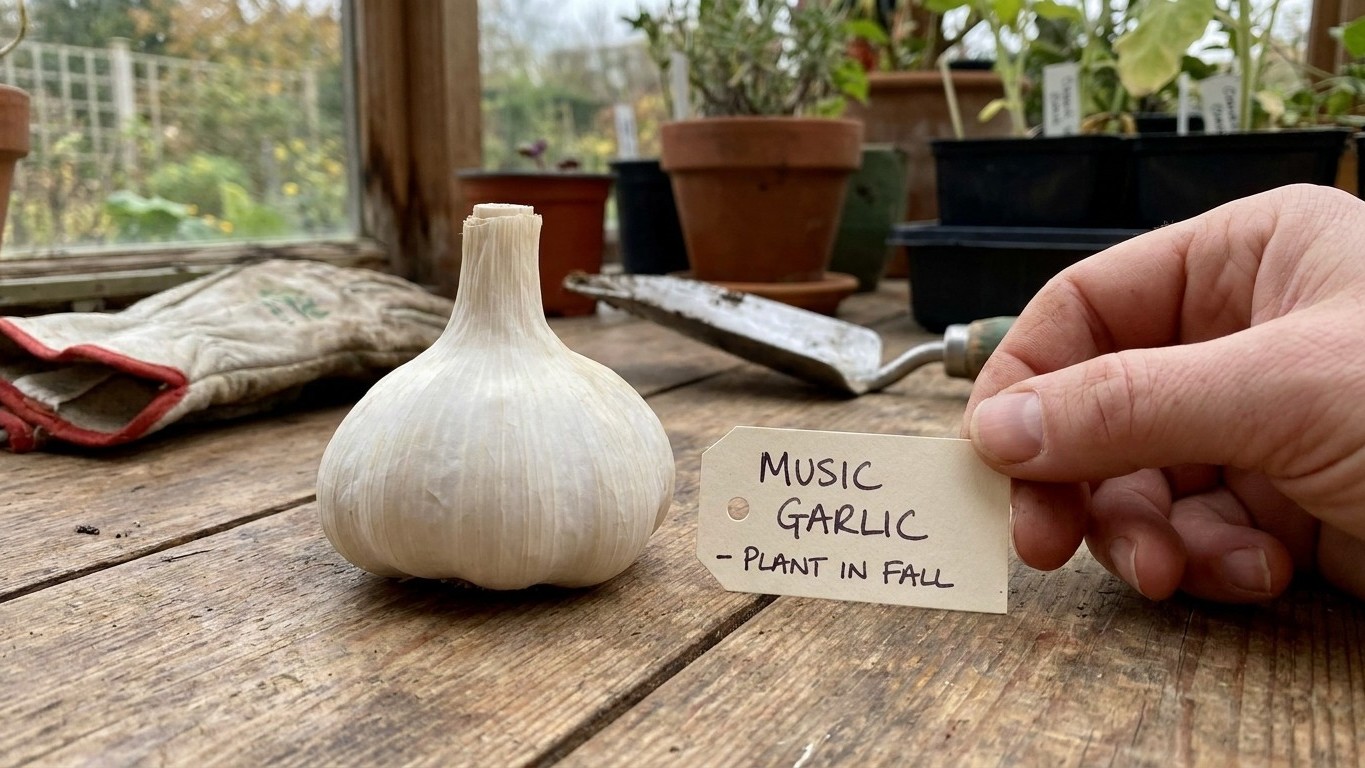
Music is a porcelain garlic, and it wears the family’s usual signature: a bulb wrapped in smooth, bright white skin, holding just four to six cloves, each one large, easy to peel, and satisfying to cook with. Porcelain garlics are the type most often grown for their big, showy heads and strong flavor, and Music does not stray from that pattern in appearance, even if its taste tells a slightly different story.
The taste itself is medium hot, a true garlic flavor without the sharper, lingering burn that some porcelain varieties are known for. This is worth noting plainly: where porcelain garlic has a reputation for intensity, Music sits closer to the middle of the heat scale. It is not a mild garlic, and it is not blandly sweet either — it is a clean, honest garlic taste with real bite, just not the most aggressive bite in its type. That balance is part of why growers and cooks single out Music by name rather than simply reaching for “a porcelain.”
Like all porcelain garlics, Music is a hardneck. It sends up a firm central stalk and produces a scape in early summer, which most growers cut off so the plant’s energy goes into the bulb rather than the flower. Hardneck garlics like Music also tend to be the more cold-hardy of the two garlic groups, which suits gardeners in colder climates well.
Storage is the one place where porcelain type and Music line up with expectations less favorably than softnecks. Music keeps reasonably well, typically for a few months in a cool, dry, dark place, but it does not match the long shelf life of softneck braiding garlics. It is best treated as a variety to enjoy across autumn and winter rather than one to stretch all the way to next year’s harvest.
What Music tastes like, and what to do with it
Being a hardneck sets real limits on Music before a single clove reaches the kitchen. Hardneck garlics put their energy into a stiff central stalk and a scape, and in exchange they generally hold less time in storage than softneck types, which lack that stalk and can be braided into ropes that hang for the better part of a year. Music will keep well through the fall and into winter with reasonable care, but it is not the garlic to count on come late spring. That trade is the reason hardnecks like Music are grown at all: the stalk and scape production tends to go along with the deeper, more layered flavor porcelains are prized for, and Music delivers that true garlic taste rather than the flatter profile softnecks are sometimes accused of.
Where that flavor actually lands depends on how it’s cooked. Eaten raw — minced into a dressing, crushed for aioli, rubbed onto bread — Music shows its real character: medium heat, a clean bite, nothing shy about it. That is the moment to reach for it if the point of the dish is garlic itself. Cook it down in a sauté or simmer it into a broth, though, and the sharpness recedes; heat converts the compounds responsible for bite, so a sauce built on Music will taste rounder and milder than the raw clove promised. Push it further into a low, slow roast — a whole head wrapped in foil, or cloves confited in oil — and the transformation goes all the way to sweet, spreadable, and mellow, with almost none of the original heat left standing.
So the same bulb can read as assertive or gentle depending entirely on where in the cooking process it’s used, and knowing that is more useful than any single word like “medium hot” on its own.
Will it get the cold it needs where you are
This is the question that decides whether Music is worth planting at all, and it has nothing to do with whether your winters feel cold to you. It is about a specific, measurable stretch of weather: a run of about six weeks with temperatures below 40°F sometime after planting. That cold is what tells the clove to divide. Without it, the plant keeps growing as a single vegetative bulb, no different from an onion, and you dig up one round lump instead of a head you can break into cloves.
Where the cold falls short
In California, measured at Los Angeles, the typical winter delivers zero weeks below 40°F against the six weeks Music needs. The same shortfall shows up in Texas at Houston and in Florida at Jacksonville, and in Louisiana it is no different. These are not marginal misses. The gap is the entire requirement, not a week or two of it. Hardneck types are the most cold-demanding garlic there is, so a Porcelain like Music is exactly the wrong choice for a Gulf Coast or Southern California garden unless you intervene.
The two real fixes are refrigerating the cloves for several weeks before planting, which fakes the cold the ground never provides, or switching to a type that does not need that vernalization signal at all: a softneck of the Artichoke or Silverskin type, the same kind covered in Silver Rose Garlic: When to Plant the Silverskin Heads That Suit a Mild Winter, which is built for exactly this climate.
Where the cold is generous but the season is short
Go to the opposite extreme and the problem flips entirely. In Prince Edward Island, measured at Charlottetown, cold is never in short supply, but the growing season only accumulates around 1,569 degree-days of warmth across the year, which the local guidance calls tight even for an early variety. In Alaska, measured at Anchorage, the figure drops to roughly 917 degree-days. In both places the limiting factor is not vernalization, it is whether enough cumulative summer heat arrives afterward to size the bulb up before frost ends the season. A tunnel or a plastic mulch that warms the soil earlier in spring is the practical answer there, not a change of variety.
| Territory | Reference station | Verdict | Limiting factor |
|---|---|---|---|
| California | Los Angeles | Risky | 0 of 6 weeks below 40°F |
| Texas | Houston | Risky | 0 of 6 weeks below 40°F |
| Florida | Jacksonville | Risky | 0 of 6 weeks below 40°F |
| Prince Edward Island | Charlottetown | Comfortable, tight | ~1,569 degree-days of warmth |
| Alaska | Anchorage | Comfortable, needs season extension | ~917 degree-days of warmth |
When to put the cloves in
Garlic goes in the ground in fall and comes out the following summer, but the exact window depends entirely on your first fall frost, not on a date on the calendar. The cloves need enough time to grow roots before the ground freezes solid, but not so much time that they push a lot of leafy top growth, which just gets damaged by winter cold and wastes the plant’s early energy.
In warm winter areas, planting happens much later relative to frost because there is effectively no hard freeze to race against. In Louisiana, set-out runs from late November into mid-December with the first ripe bulbs the following late August. Texas and Florida follow a similar late-fall pattern, both setting out in November with bulbs ready by early August. That late timing is only sensible in places warm enough that the ground never locks up, and it is also exactly the timing you’d pair with the refrigeration workaround described above, since the natural cold still is not going to show up on its own.
In cold winter areas the opposite logic applies: plant early enough that roots establish before a hard freeze locks the soil, since there is no mild stretch left to wait for. Prince Edward Island sets out in late September for bulbs the following early June. Alaska plants even earlier, in early September, for harvest by mid-May. Regional extension guidance genuinely disagrees on the exact number of weeks before frost that is ideal, and that disagreement is real, not something to smooth over. Use your own first fall frost date as the anchor and count backward a handful of weeks, checking your local extension office for the number they favor in your specific county.
Hardneck or softneck: what this one asks of you
Music is a hardneck through and through, and that fact drives almost everything about growing it day to day. Every plant sends up a curling flower stalk called a scape in early summer, and it has to be cut off well before harvest or the plant wastes energy on it instead of sizing the bulb. That same hardneck habit is what gives you fewer, much larger cloves, arranged in a single easy-to-peel ring, compared with the many small cloves packed into a softneck bulb.
The tradeoff runs the other way in storage. A hardneck like Music keeps for a few months at most under good conditions, while a softneck can hold for the better part of a year in a cool, dry pantry. That difference is exactly why hardnecks make sense in places with long, genuinely cold winters, the same climates that satisfy their vernalization requirement in the first place, and why softnecks dominate in mild-winter regions where the cold never arrives on schedule. If you want a hardneck with a different flavor profile but the same cold-country logic, Persian Star Garlic: When to Plant the Purple Stripe Heads That Need a Real Winter sits in the same category as Music. If your winters run mild, the softneck route in the Silver Rose guide linked above is the more reliable path than fighting Music’s cold requirement every year.
Growing and curing it without losing the crop
Planting and the growing season
Set cloves root-down about two inches deep and around six inches apart, in a bed that drains well since sitting water rots cloves before they ever root. Mulch heavily right after planting with straw or shredded leaves. This matters more for garlic than for almost anything else you overwinter, because the mulch insulates the soil against the freeze-thaw cycles that heave half-rooted cloves right out of the ground. Pull the mulch back partway in spring once growth resumes, so the soil can warm and the shoots aren’t smothered.
Knowing when to stop and when to lift
Cut scapes as soon as they curl, both for the cooking bonus and because leaving them on measurably reduces bulb size. Stop watering about two weeks before you expect to harvest, since wet soil right up to lifting encourages staining on the wrappers and shortens storage life. The signal to dig is foliage: when the lower leaves have browned back but four or five upper leaves are still green, the bulbs are sized and the wrappers are still intact enough to protect the cloves. Waiting for the whole plant to die back is the classic mistake. By then the wrappers have often split underground and the bulb won’t store at all.
- Lift gently with a fork, never by pulling the stalk, which tears wrappers
- Brush off loose soil but do not wash the bulbs
- Cure in a shaded, airy spot out of direct sun for several weeks
- Trim roots and stalks only after the wrappers are fully dry and papery
Good airflow during curing matters as much as the harvest timing itself. Bulbs stacked or bagged before they’re dry will mold from the inside out, and by the time you notice, the whole batch is usually compromised.
Common questions
Can I plant Music garlic in spring instead of fall?
You can, but you’ll get small, undivided bulbs at best. Spring planting skips the cold period entirely unless you refrigerate the cloves for several weeks first, and even then the bulbs tend to run smaller than a properly overwintered crop.
What happens if I plant Music where winters aren’t cold enough?
You’ll harvest a round, single bulb instead of a head divided into cloves, since the cold signal that triggers division never arrived. Refrigerating cloves before planting or switching to a softneck variety are the two working fixes.
How is Music different from other Porcelain garlics like German White?
The differences between Porcelain cultivars are mostly minor: clove count, wrapper color intensity, and days to maturity vary a little by catalog, but all share the same big-clove habit and the same cold requirement. Check the specific catalog listing for maturity days, since those are counted from planting and shift a bit with the season.
Do I need to cut the scape on Music garlic?
Yes, and skipping it is one of the more common mistakes with hardneck garlic. Leaving the scape to grow diverts energy away from the bulb and results in a noticeably smaller harvest.