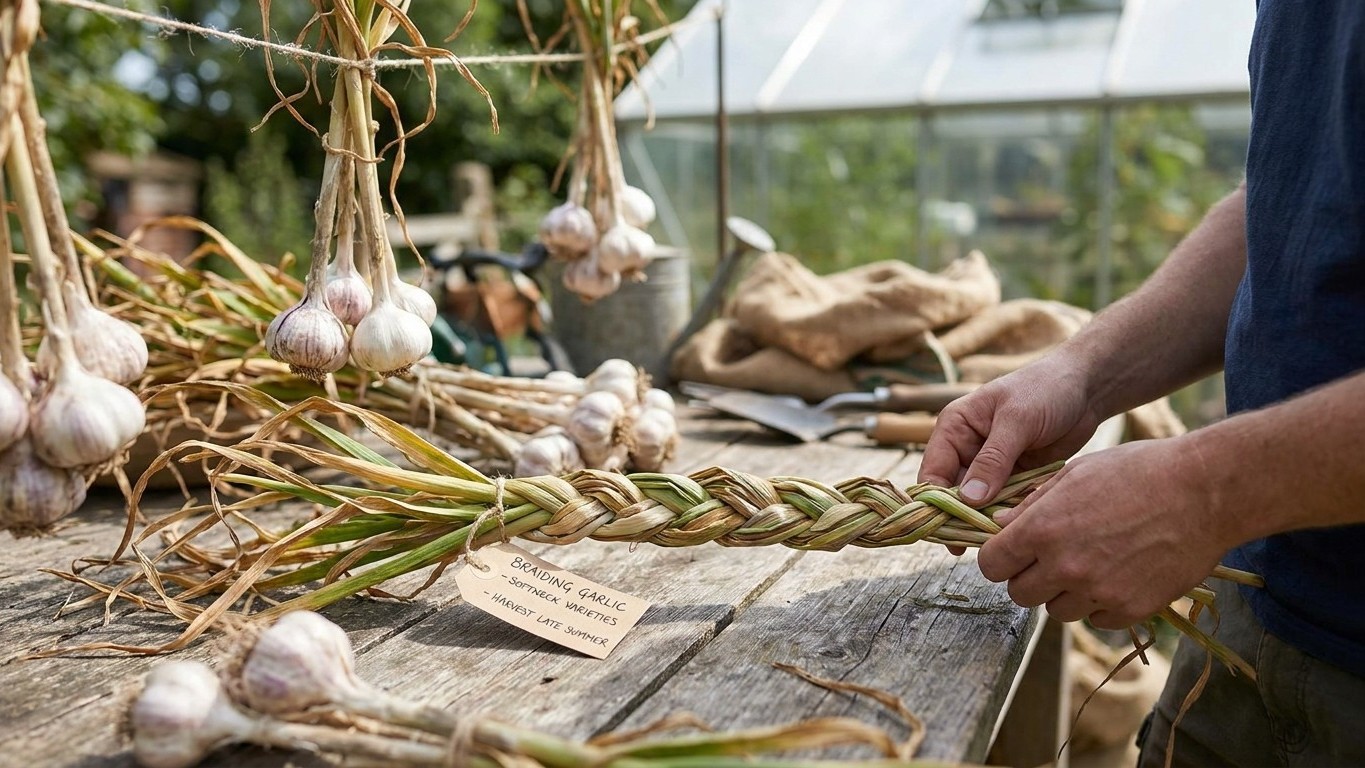

Softneck garlic (Allium sativum var. sativum) is the only type that braids well, because its leaves stay flexible right down to the bulb after curing. Hardneck garlic (Allium sativum var. ophioscorodon) sends up a stiff central stalk that turns woody as it dries, so it snaps rather than bends. If you want braided garlic for the kitchen or to sell, plant a softneck variety and let the harvested bulbs cure until the leaves are dry but still supple before you start weaving.
Why this matters for garlic

Get the variety wrong and you find out fast, not nine months later. Braiding happens right after harvest, while the bulbs are curing, so a grower who plants an all-hardneck patch expecting a wall of braided garlic discovers the problem within a couple of weeks, not next spring. The stiff central stalk that hardneck garlic pushes up each year, the same one that produces the scape you’d otherwise cut off in early summer, turns to something close to a dowel rod once it dries. Try to fold it and it cracks.
Softneck garlic never grows that rigid stalk. Its leaves wrap around each other in loose, overlapping layers all the way to the bulb, which is exactly the structure a braid needs. The decision that determines whether your harvest can be braided is made at planting time, when you choose the variety, not at harvest when you pick up the leaves and start weaving. By the time the bulbs are out of the ground and curing on a rack, there is no fix. You can still eat a hardneck harvest, cure it, and store it, but you cannot braid it, no matter how patient you are with the leaves.
This matters most for anyone selling at a farmers market or giving braids as gifts, where the look of the finished braid is the point, not just the garlic inside it.
When to do it
Braiding is a post-harvest task, so the trigger is the plant’s own growth stage, not a date on the calendar. Garlic is generally ready to pull once the lower leaves have died back and turned brown while the upper leaves are still green, a stage that arrives at a different point in the season depending on your climate and the variety’s maturity length. Pull too early and you get papery, immature bulbs that shrink further in storage. Pull too late and the wrappers start splitting underground, and a split bulb won’t hold together in a braid.
After harvest, the bulbs need to cure before you touch them with a braiding cord. Curing dries the outer skins into the tough, papery wrapper that protects the cloves, and it happens in a shaded, airy spot out of direct sun over several weeks. The window for braiding falls in the middle of that curing period, after the outer leaves have dried down enough to stop feeding moisture into the bulb, but before the whole plant dries so far that the leaves turn brittle and snap instead of bending.
In humid climates, curing tends to take longer than in dry climates, which pushes the braiding window later; check with your state’s extension service for typical curing times in your area. You can also test a bulb from your own batch directly: bend a leaf near the neck, and if it folds without cracking, you’re in the window.
How to do it
Choosing and preparing the bulbs
Only softneck garlic works for a traditional braid. Within that group, the two market classes behave a little differently. Artichoke types, including ‘Inchelium Red’ and ‘California Early’, have thick, waxy leaves that are easy to grip but bulkier to weave. Silverskin types, including ‘Silver White’ and ‘Nootka Rose’, have thinner, more supple leaves and are the class most commercial braiders favor, because they hold a tight weave and dry to a pale, attractive finish. Seed catalogs list days to maturity for these cultivars in roughly the 200 to 240 day range counted from fall planting, a figure that shifts by a week or two depending on the season and your local frost window, so treat it as a starting point rather than a fixed date. If you haven’t planted yet, the basics of getting a crop to this stage are covered in Growing Garlic.
| Type | Example cultivars | Catalog days to maturity | Braiding result |
|---|---|---|---|
| Artichoke softneck | ‘Inchelium Red’, ‘California Early’ | ~200-220 days | Thick leaves, sturdy but bulky braid |
| Silverskin softneck | ‘Silver White’, ‘Nootka Rose’ | ~200-240 days | Thin, pliable leaves, tightest classic braid |
| Hardneck (porcelain, rocambole, purple stripe) | ‘Music’, ‘Spanish Roja’, ‘Chesnok Red’ | ~200-240 days | Stiff woody scape, cannot be braided |
Leave the leaves on when you harvest. Don’t trim them the way you might for garlic destined straight for the fridge or pantry. You need every inch of stalk for the weave, and once cut, it can’t be added back.
The weave
Start with three of your best-necked bulbs, leaves still attached, and cross the leaves the way you’d start a hair braid, left over center, right over center. Once you have two or three crosses locked in, add a new bulb’s leaves into the strand every time you cross, alternating sides so the braid stays balanced and doesn’t twist to one side. Keep the bulbs snug against the ones before them. Loose spacing looks messy and lets the finished braid sag under its own weight, especially once you’re carrying a dozen or more bulbs, a typical length for a kitchen braid.
Some braiders work a length of raffia or garden twine in alongside the leaves for the first few crosses, where the stalks are thinnest and most likely to slip apart. It disappears into the weave once thicker leaves take over, and it adds real strength at the weakest point of the whole braid.
Finish by braiding out to the end of the leaves, then folding the tail back on itself and tying it off, or looping it to make a hanger. Hang the finished braid somewhere with airflow so curing continues even after braiding, out of direct sun, and give it a few more weeks before you consider it fully cured and ready to display or gift.
What goes wrong
The most common failure is braiding bulbs that haven’t cured enough. Trap too much moisture in the neck and the braid looks fine on the day you hang it, then mold spots appear on the wrappers within a couple of weeks, usually starting on the bulbs nearest the center where air can’t reach. By the time you notice the smell, the cloves underneath are often already soft. The tell to catch it early is the leaf itself: if it’s still green or feels damp when you bend it, the bulb needs more time on the curing rack, not less.
The opposite mistake is waiting too long. Leaves dried all the way to brittle snap the moment you try to fold them into a weave, and a snapped leaf can’t be repaired mid-braid, only worked around by starting the weave lower on the stalk, which shortens the finished braid and weakens it.
Trying to force hardneck garlic into a braid is a mistake that shows up immediately rather than later. The stiff scape stalk splits lengthwise under tension instead of bending, and even where a stalk survives one fold, it won’t hold a second cross. Some crafters wire hardneck stalks together into a bundle that resembles a braid from a distance, but that’s a different technique from a true woven braid, and it’s worth knowing the difference before promising braided hardneck to a customer.
Finally, a braid hung against a solid wall or packed into a box for storage traps humidity the same way an under-cured bulb does. Rot in a hung braid often doesn’t show until months into storage, which is what makes airflow at hanging time worth getting right the first time rather than discovering the problem in the pantry in late winter.
How this changes across the country
Hardneck garlic dominates in cold-winter states such as Minnesota, Vermont, and Montana, where a long, hard freeze suits varieties like ‘Music’ and ‘German Red’ and gives them the cold exposure they need to form a proper bulb. That’s good garlic for eating and storing, covered in more depth in Storing Garlic: Why the Fridge Ruins It, and What to Do Instead, but it’s not garlic you’ll ever braid, whatever you do with the leaves.
Mild-winter states such as California, Georgia, and Louisiana grow the bulk of the country’s softneck garlic, including the Silverskin types that end up in grocery store braids. Growers there also have the option of pulling part of the crop early as green garlic, before the bulb fully divides into cloves, a different product covered in Green Garlic: Harvesting Early for the Mildest Flavour of the Year rather than a step toward braiding.
In between, plenty of gardeners in transitional climates grow both types side by side and reserve the softneck rows for braiding while treating the hardneck rows as kitchen garlic. Climate decides which type grows best in your soil, not which type you’d prefer to braid, so the honest approach in a borderline climate is to trial a few softneck cultivars against your local hardneck standard for a season before committing a full bed to either one. Curing conditions differ by region too, with humid summer climates slowing the drying process and pushing braiders toward extra curing time before they start weaving.
Common questions
Can you braid hardneck garlic if you leave the scape on?
No. The scape and the main stalk are both stiff on hardneck garlic, and drying makes them stiffer, not more flexible. Leaving the scape on doesn’t change the stalk’s structure, it just gives you a longer piece of the same rigid material.
Do I need to trim the roots before braiding?
Trim the roots close to the bulb, but leave the leaves untouched until the braid is finished. Roots left long just get in the way of the weave and don’t add anything once the bulb is cured.
How long does a garlic braid actually last?
A well-cured softneck braid, hung somewhere dry with airflow, generally stores about as long as loose bulbs of the same variety would, since braiding is just a way of holding bulbs together and doesn’t change how they cure or age.
Can I braid garlic that’s already fully dried and in storage?
Not successfully. Once leaves are fully dry they’re brittle, not pliable, and will crack apart rather than weave. Braiding has to happen during the window while the leaves are drying down but not yet brittle, which is why growers braid at curing time rather than pulling bulbs out of storage later to braid them.