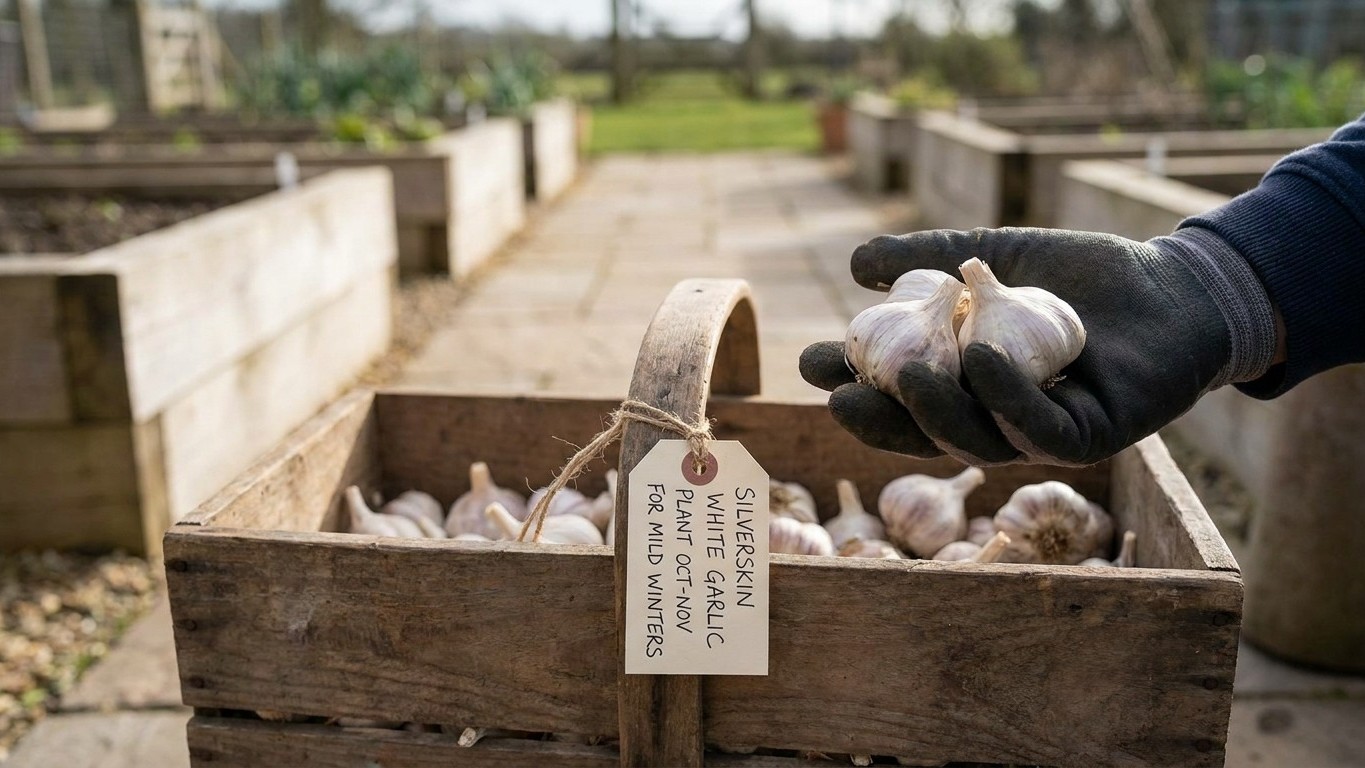

Six weeks. That’s how long the ground needs to sit below 40°F before a Silver White clove will split into a proper head instead of coming up as one solid round bulb, and if your winters don’t reach that mark, planting day is where you fix it, not harvest day. Walk your yard and think back on an average January — does the soil stay cold for a stretch, or does it swing warm? If the cold looks thin, the move is simple: chill the cloves yourself in the fridge for a few weeks before they go in the ground.
What Silver White actually is

Silver White belongs to the Silverskin family of garlic, the group breeders and seed catalogs rank as the mildest-climate type, the last to mature, and the one that stores longest in a pantry or braid. It is a softneck variety, so there is no woody stalk running through the center of the bulb and no scape to cut in early summer. That soft neck is also what makes it braidable, the reason so many Silverskin varieties end up hanging in a kitchen rather than boxed in a root cellar. For a broader look at how Silverskin compares to Porcelain, Rocambole, Purple Stripe and Artichoke types, the full rundown of garlic varieties is worth reading before you settle on one.
Seed catalogs that carry Silver White describe the flavor as sharp and hot when eaten raw, mellowing into something milder and sweeter once it’s roasted or sautéed, a pattern typical of Silverskins generally. What sets the type apart in the kitchen is less the taste than the keeping quality: catalogs commonly cite Silverskin garlic as the longest-storing type available, often outlasting a hardneck harvest by several months in a cool, dry space. That single trait is why growers in warm-winter states reach for it even when the cold-requirement arithmetic gets complicated, which is the subject of the next section.
What Silver White tastes like, and what to do with it
Silver White is described as mild by the standards of any garlic, not just mild for a Silverskin. That matters because the Silverskin family as a whole is already the group breeders call mildest of the major types, so a variety singled out as mild within that group is starting from a gentler baseline than almost anything else you could plant. What is not published is a breakdown of specific tasting notes, sweetness, or the sulfurous heat that hardneck growers chase — none of that detail exists in the record, so it is left out here rather than guessed at.
The one documented quirk is timing: the bite strengthens the longer the bulb sits in storage. Freshly cured Silver White eaten soon after harvest is milder than the same bulb pulled from the braid four or five months later. That is a useful thing to know given how long Silverskins keep in the first place — a bulb from the same batch can taste noticeably different in October than it does the following spring, simply from time in a cool, dry space rather than from any change in how it is cooked.
In the kitchen, that means raw uses — dressings, salsas, anything where a clove goes in uncooked — are where Silver White’s character is most visible, and where the storage-age of the bulb will actually change the result. Cooking flattens that difference the way it does with any garlic: heat breaks down the compounds responsible for raw bite, and a slow roast will turn even a late-storage, sharper bulb sweet and mellow. So reach for young Silver White when you want a gentle raw garlic, and don’t worry about which end of its storage life you’re using once it’s headed into a pan or the oven.
Will it get the cold it needs where you are
Garlic does not divide into cloves on its own. It needs a run of weeks in the ground with soil temperatures under 40°F, and without that stretch a Silver White clove planted in fall comes up the following summer as a single round bulb instead of a head split into cloves. Silverskins ask for less of this chill than a Rocambole or Porcelain hardneck, which is exactly why the type is marketed for mild winters in the first place. Even so, the margin runs out fast once a winter gets genuinely warm, and the clove risks staying whole rather than dividing.
Where the winter is too warm
| State (reference station) | Typical weeks under 40°F | Weeks Silver White needs | Verdict |
|---|---|---|---|
| California (Los Angeles) | 0 | 6 | Risky |
| Louisiana (New Orleans) | 0 | 6 | Risky |
| Texas (Houston) | 0 | 6 | Risky |
| Florida (Jacksonville) | 0 | 6 | Risky |
| Arizona (Phoenix) | 0 | 6 | Risky |
| Hawaii (Honolulu) | 0 | 6 | Risky |
In California, measured at the Los Angeles station, winters average zero weeks with soil under 40°F against the six weeks Silver White needs. The same shortfall shows up in Louisiana, where New Orleans figures put growers on a set-out window from late November to mid December with a first ripe date in late August, and in Texas, where Houston growers set out from early November to late November and harvest in early August. Florida growers working from Jacksonville figures face the identical gap, as do Hawaii growers near Honolulu and Arizona growers near Phoenix, neither of which sees a real cold snap at all.
Two real options exist where the numbers land like this. Refrigerate the cloves for several weeks before planting, in a mesh bag away from fruit, to fake the chill the winter won’t provide. Or plant a type that asks for even less cold, though Silver White already sits near the low end of the scale for garlic in general, so growers in these states usually find refrigeration the more workable of the two.
Where the winter is cold enough but the season is too short
At the other extreme, places cold enough to satisfy Silver White’s chill requirement several times over are not automatically easy gardening either. In Prince Edward Island, measured at Charlottetown, the growing season accumulates around 1,569 degree-days, a margin the calculation calls tight rather than generous. In Yukon, tracked at Whitehorse, the total falls to roughly 600 degree-days, too little cumulative heat to finish sizing the bulb no matter how long the ground stays frost-free. In both places the fix isn’t more chill. Growers there set out cloves in late September in Prince Edward Island and as early as the start of August in Yukon, and the missing piece is heat, supplied with plastic mulch, a low tunnel, or a greenhouse start.
When to put the cloves in
Garlic is planted in fall and harvested the following summer, and the goal is a clove that grows roots before the ground turns cold but does not send up much leaf before the days shorten. Push it in too early and the tops grow tall going into winter, using up stored energy the bulb needs later. Wait too long and the roots never establish, and the whole planting can heave out of loose soil once freeze-thaw cycles start.
The window shifts by climate, not by a fixed date
Extension services don’t agree on a single rule because the right window changes with how hard and how early the ground actually freezes. In a cold climate, growers plant while there is still time to root before a hard freeze locks the soil, but well after summer heat has passed. In a mild climate that hard freeze arrives much later or not at all, so the planting window slides later on the calendar instead of earlier.
The named stations in the cold-versus-heat comparison above show how wide that range gets in practice. Growers working from Louisiana‘s New Orleans figures set out cloves from late November to mid December, growers using Prince Edward Island‘s Charlottetown data are in the ground by late September, and in Yukon, tracked at Whitehorse, planting starts as early as the beginning of August. No single calendar date applies across that range, only the same underlying rule of rooting before a freeze without much top growth first.
Because Silver White carries a lower chill requirement than most hardnecks, growers in borderline climates sometimes plant later than a hardneck grower would in the same spot, on the logic that a shorter chill window is easier to still catch before winter ends. Check the garlic planting guidance your own state extension service publishes, since it accounts for local frost behavior that a national rule of thumb can’t.
Hardneck or softneck: what this one asks of you
Silver White is a softneck garlic, and that habit decides most of the labor difference between it and a hardneck like Music, a Porcelain type bred for climates with a real winter. A hardneck sends up a curling flower stalk called a scape that has to be cut in early summer so the plant puts its energy into the bulb instead of the stalk. Silver White skips that step entirely. There is no scape to watch for or harvest, one less task on the calendar in early summer.
What you gain in fewer tasks, you trade in clove size. Hardneck bulbs typically carry a single ring of large, easy-to-peel cloves, four to twelve of them, while a softneck bulb like Silver White packs in more cloves arranged in overlapping rings, often well into the double digits, running smaller and fussier to peel one at a time. The upside shows up months later in the pantry. Silverskin softnecks are the longest keepers of any garlic type, commonly cited as lasting through most of a year in a cool, dry, dark spot, well past when a hardneck harvest has started sprouting or drying out.
That trade only makes sense in the climate it’s built for. Hardnecks like Music need a hard winter to perform, which is why growers in the coldest states reach for them, while a softneck Silverskin like Silver White, or the Artichoke-type Susanville, ask for less cold and more heat, the profile suited to a mild-winter garden in the first place.
Growing and curing it without losing the crop
Set cloves about two inches deep, pointed end up, spaced roughly four to six inches apart in rows a foot or so wide, then cover the bed with a heavy mulch of straw or shredded leaves. That mulch matters more for an overwintered crop than for almost anything else in the vegetable garden. It buffers the soil against the freeze-thaw cycles that otherwise heave young roots right out of the ground before they’ve had a chance to establish.
Pull the mulch back partway once new growth appears in spring so the soil can warm, and water regularly through bulb formation. Stop watering a few weeks before you expect to harvest, since wet soil right up to lifting encourages the wrapper skins to split and shortens how long the bulb will keep.
Knowing when to lift
Silver White is ready when the lower third to half of the leaves have browned and died back while the upper leaves are still green, not when the whole plant has collapsed. Each green leaf corresponds to a wrapper layer around the bulb, so a plant left to die back completely loses its protective wrappers along with its leaves, and the bulb underneath ends up exposed and short-lived in storage.
- Lower leaves brown, upper leaves still green: ready to lift
- Whole plant collapsed and dry: lifted too late, wrappers likely lost
- All leaves still fully green: not yet, check again in a week
Cure the pulled bulbs whole, roots and tops still attached, in a shaded, well-ventilated spot out of direct sun for several weeks until the outer wrappers turn papery and the neck dries fully. Only then trim the roots and tops, and move the cured bulbs to a cool, dry, dark space for storage. Curing badly costs the whole crop just as surely as lifting late does, since a bulb put into storage with moisture left in the neck rots from the inside before anything looks wrong on the outside.
Common questions
Does Silver White send up a scape I need to cut?
No. Silver White is a softneck Silverskin, and softnecks don’t produce the curling flower stalk hardnecks send up in early summer. If a stalk shows up in a Silver White bed anyway, check whether the seed stock got mixed with a hardneck variety at some point, because a true Silverskin plant doesn’t do this.
I’m in a warm state. Should I even bother planting Silver White?
It’s worth trying if you take the chill shortfall seriously rather than ignoring it. Refrigerate the cloves in a mesh bag for several weeks before planting, kept away from fruit, and expect the split into cloves to be less reliable than it would be in a climate that delivers that cold on its own.
How long does Silver White garlic actually store?
Catalogs commonly describe Silverskin types, Silver White included, as the longest-storing garlic available, often citing storage life well past what a hardneck bulb manages. That figure assumes a full cure and a cool, dry, dark storage spot. A bulb cured too fast or stored somewhere warm and damp falls well short of that regardless of what type it is.
Can I plant grocery-store garlic instead of buying Silver White seed stock?
You can, but it’s a gamble worth naming. Grocery garlic is often treated to slow sprouting, rarely labeled by variety, and may carry disease that certified seed stock is tested against.